
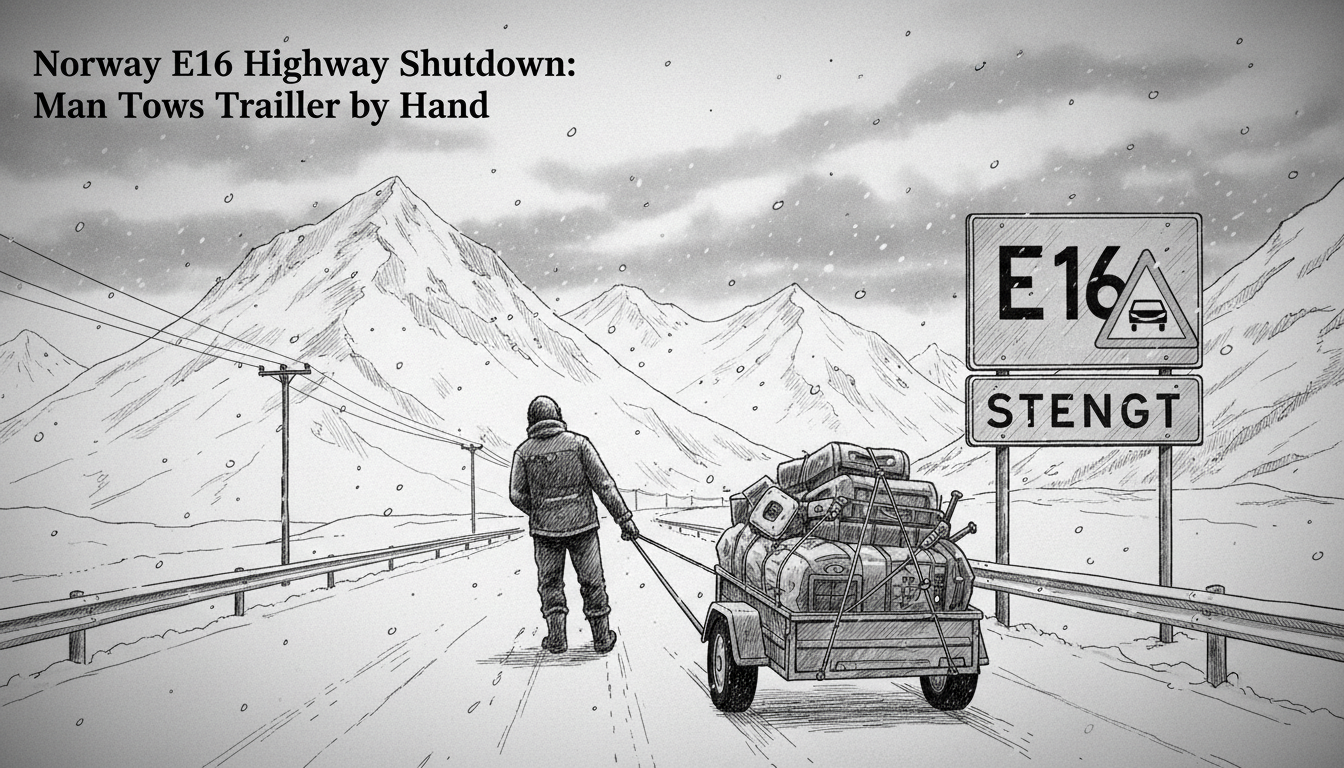
Norway's vital E16 highway faced an unexpected and bizarre shutdown Tuesday morning when a man was seen towing a trailer by hand along the road near Kongsvinger. Police in the Innlandet district received multiple reports of the incident, which occurred near the railway station on the major route. The disruption prompted an immediate police response and highlighted the fragility of key national infrastructure.
“This will create some traffic challenges. We are on our way to see what we can assist with,” the Innlandet Police District wrote in their official log at the time. The situation was resolved by 11:20 AM when police confirmed the man and his trailer had been moved off the roadway. Authorities later attributed the incident to a “technical fault” that forced the trailer’s owner to use “manual power” to remove it from the E16.
A Major Artery Grinds to a Halt
The E16 is not a minor road. It is a critical European highway approximately 630 kilometers long within Norway, forming a primary corridor between Oslo and Bergen and extending into Sweden. The stretch near Kongsvinger, a municipality in Innlandet county close to the Swedish border, is particularly important for cross-border freight and passenger traffic. Any obstruction here causes immediate ripple effects, delaying logistics and commuter travel across a wide region.
This incident, while resolved quickly, forced a temporary but complete stoppage of traffic on one of the country's busiest routes. It serves as a stark, almost surreal, reminder of how easily a single point of failure can disrupt complex systems. The visual of a lone individual manually pulling a trailer on a high-speed highway underscores a dramatic contrast between advanced national infrastructure and simple human mechanical failure.
The Safety and Economic Implications
Traffic safety experts point to the severe risks involved. “Having a pedestrian on a highway like the E16 is an extreme hazard, both for the individual and for motorists,” says Lars Tennfjord, a senior advisor at the Norwegian Institute of Transport Economics. “Drivers expect high speeds and predictable traffic flow. A sudden, slow-moving obstacle, especially a person on foot, can lead to catastrophic rear-end collisions or swerving accidents.”
Beyond immediate safety, the economic impact of halting such a route is significant. The E16 is a lifeline for the transport of goods between eastern Norway and Sweden. Every minute of closure translates to delayed deliveries, increased fuel consumption for idling trucks, and logistical headaches for shipping companies. While this particular stoppage was brief, it exemplifies how non-traditional disruptions can be as damaging as major accidents or weather events.
Police have not released the man's identity or specified the exact nature of the “technical fault” that left him stranded. It is also unclear whether he will face any fines or charges for creating a dangerous traffic situation. Norwegian traffic law strictly prohibits pedestrians on motorways, and violations can result in substantial penalties.
A Pattern of Unusual Disruptions
This event fits into a broader, albeit rare, pattern of unusual incidents causing major transport disruptions in Norway. Past events have included livestock on railways, protestors blocking roads, and even tourists stopping for photography in dangerous locations. Each event triggers a massive coordinated response from police, road authorities, and sometimes emergency services.
The response protocol is well-rehearsed. Upon receiving multiple confirmations of a hazard, police dispatch units to secure the scene. Traffic management centers activate electronic warning signs upstream to alert drivers. For a full highway stoppage, alternative routes are promoted, though options are often limited in areas like Kongsvinger, where the E16 is the dominant road.
“The system worked as intended today,” a police operations manager noted off the record. “The public reported it promptly, we responded to secure the area, and the situation was resolved without injury. But it consumes resources that could be needed for a real emergency.”
Infrastructure Resilience in Focus
The curious case of the hand-towed trailer invites a deeper discussion about infrastructure resilience. Norway prides itself on engineering marvels—tunnels, bridges, and avalanche protections—designed to withstand the harsh Nordic environment. Yet, this incident shows that vulnerability can come in the most mundane forms: a broken trailer hitch, a flat tire, or a simple engine failure.
Are recovery and contingency plans robust enough for these odd but impactful scenarios? Most emergency planning focuses on large-scale accidents, natural disasters, or severe weather. The “minor” incident that escalates into a major blockage receives less systematic attention. This gap could leave response agencies improvising, as they likely did today.
Furthermore, it raises questions about driver preparedness and vehicle maintenance standards. While the root cause is unknown, ensuring that vehicles and trailers are roadworthy before entering major highways is a shared responsibility between owners and regulatory authorities.
The Aftermath and Lingering Questions
By midday Tuesday, traffic on the E16 near Kongsvinger had returned to normal flow. The social media posts from the police log provided the only official glimpse into the disruption. For most travelers, it will be a minor anecdote, if they noticed the delay at all.
However, for transport planners and safety officials, it should be a case study. It demonstrates the effectiveness of public-police communication through channels like the police log. It also highlights the ever-present potential for human error and mechanical failure to intersect with high-speed, high-volume transport networks.
The incident leaves several unanswered questions. What specific mechanical failure occurred? Why did the driver not have access to or use a professional recovery service? Were there any near-miss accidents before police arrived? The answers could inform future public safety campaigns or even adjustments to roadside assistance protocols on key highways.
Norway's transportation network is the backbone of its economy and daily life. It is tested by snow, ice, and geography constantly. Today, it was tested by something far simpler: a man, a trailer, and a technical fault. The system held, but the event is a peculiar footnote that reminds us that even the most advanced systems depend on the reliability of their smallest components—and the people who use them. In an age of autonomous vehicle research and smart highway technology, the image of a man physically pulling his load down the E16 is a powerful, almost anachronistic, symbol of our ongoing vulnerability to the unexpected.