
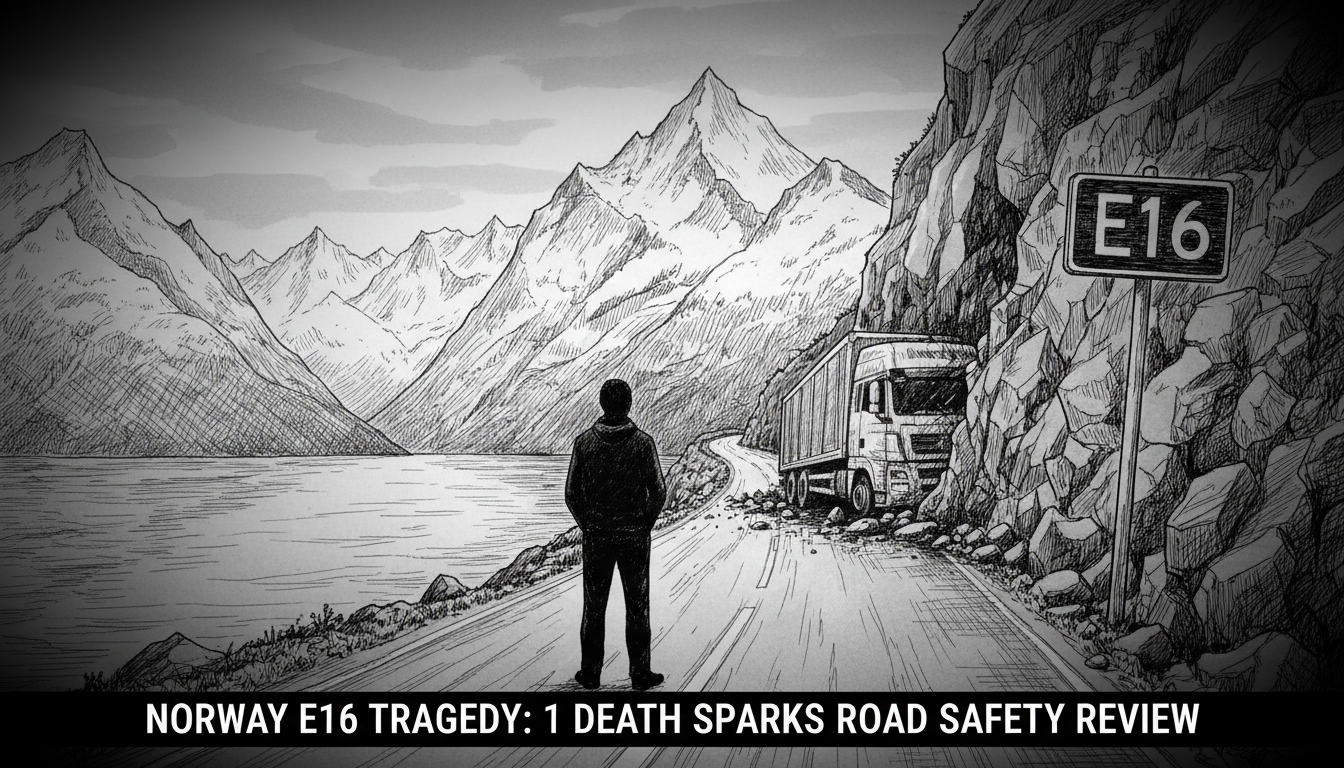
Norway's E16 highway was the scene of a tragic incident Saturday evening that has shifted focus from traffic accidents to driver health. A female driver died after possibly experiencing a sudden medical emergency while driving on the E16 in Ringerike, Buskerud county. Police have moved away from initial reports of a serious traffic accident, now indicating the driver may have pulled over due to feeling unwell before her death.
"Our current hypothesis is that the driver swerved to the side and stopped, possibly in connection with feeling unwell," said operations manager Lise Bjørnsund of the South-East Police District. The woman was confirmed dead at the scene. Next of kin have been notified. This single event on a major national artery raises complex questions about medical fitness to drive and roadside emergency response protocols across Norway's vast road network.
A Quiet Stretch of Major Highway
The E16 is a critical transport link spanning southern Norway, connecting the capital Oslo with the major west coast city of Bergen. The incident occurred on a stretch running through Ringerike municipality, an area of mixed forest and agricultural land northwest of Oslo. This is not typically considered Norway's most dangerous road, but it carries significant traffic including commercial vehicles and tourists. Saturday evening traffic would have been lighter than weekday commutes, but the road remains a vital corridor.
Norwegian police investigations into fatal incidents follow strict procedures. Forensic teams examine the vehicle for mechanical faults while medical authorities seek to determine the cause of death. The term "illebefinnende" covers a range of possible medical situations from cardiac events to sudden illness. Determining the precise sequence of events—whether a medical episode caused the stop or occurred after—is crucial for the official report.
The Silent Risk on Norwegian Roads
Road safety discourse in Norway overwhelmingly focuses on infrastructure, speed, and impairment. This incident highlights a less discussed factor: the driver's physical condition. "We have excellent data on accidents involving alcohol or excessive speed, but sudden medical events are a grey area in traffic safety," said Dr. Henrik Larsen, a researcher at the Institute of Transport Economics. "For individual drivers, the risk is low. For the system, it's a persistent, unpredictable variable."
Norwegian law requires medical certification for commercial and professional drivers. Ordinary license holders, however, are largely self-reporting. Drivers must notify the Public Roads Administration if they develop a condition that could impair their ability to drive safely. Enforcement relies on individual responsibility and occasional checks during license renewal. There is no routine medical screening for private drivers after the initial license issuance, unlike some other European nations.
"The challenge is balancing privacy, mobility, and public safety," Larsen explained. "Mandatory medical checks for all drivers would be costly and logistically difficult in a country with a dispersed population. But incidents like this remind us that the human body can fail without warning." The Norwegian Directorate of Health issues guidelines for doctors on assessing patient fitness to drive, but the system hinges on patient disclosure and physician judgment.
Emergency Response in Rural Corridors
The tragedy also spotlights the emergency response chain on highways outside major urban centers. The E16 in Ringerike is not remote, but response times can vary. A driver experiencing a medical crisis must recognize the danger, safely stop the vehicle, and then alert emergency services—a demanding sequence under duress.
Modern vehicles offer some assistance. Many new cars sold in Norway feature emergency stop assistants or systems that can detect an unconscious driver and slow the vehicle. Widespread adoption of such technology, however, is years away. The Norwegian Public Roads Administration has piloted emergency corridor systems for crashes, but no specific protocol exists for solo medical emergencies in vehicles.
"The first minutes are critical in a cardiac arrest," noted a spokesperson for the Norwegian First Aid Council. "If you feel unwell while driving, the priority is to get the vehicle safely off the roadway as quickly as possible. Then call for help immediately. Trying to 'drive through' the discomfort is extremely dangerous." They recommend all drivers carry a reflective vest and warning triangle, and know their exact location using road markers or GPS coordinates when calling emergency services.
A Family Notified, An Investigation Ongoing
Behind the official statements and safety analyses lies a personal loss. Police confirmed the deceased driver's next of kin have been notified. The standard procedure in such cases involves a family liaison officer providing support and information as the investigation proceeds. The police report will eventually be sent to the local prosecutor for review, a standard step in all unnatural deaths.
The woman's identity has not been made public, in line with Norwegian practice. The focus remains on determining the facts of the case rather than attributing blame. A sudden death on a roadside is a shocking event for any family, and it reverberates through a small community. Ringerike, with a population of around 30,000, is the kind of municipality where many residents know each other.
Policy Implications and Preventative Measures
This single incident is unlikely to trigger immediate legislative change. It does, however, contribute to an ongoing conversation among transport authorities. The Norwegian Public Roads Administration continuously reviews driver licensing regulations. Recent debates have centered on elderly drivers and those with specific diagnosed conditions, like sleep apnea or epilepsy.
A 2022 government white paper on road safety strategy emphasized technology and infrastructure over medical screening. The priority has been on achieving "Vision Zero"—no deaths or serious injuries on Norwegian roads—through safer road design, lower speeds in urban areas, and combating impaired driving. Driver health forms a smaller part of that puzzle, but a critical one.
Experts suggest practical measures could gain traction. These include broader public information campaigns about recognizing warning signs of medical issues, clearer guidelines for doctors on reporting requirements, and incentives for drivers to adopt vehicle safety technology that can mitigate such events. Norway's high trust in public institutions means drivers generally comply with regulations when they understand the rationale.
The Road Ahead
The E16 will continue to carry thousands of drivers daily between Oslo and Bergen. The tragic event near Ringerike serves as a somber reminder of the vulnerabilities inherent in driving. It underscores that safety depends not just on road engineering and traffic laws, but on the physical well-being of the person behind the wheel.
As police complete their investigation, the findings may inform quieter discussions in medical and transport policy circles. For now, the emphasis returns to a core principle of Norwegian road safety: personal responsibility. Drivers are entrusted with the safety of themselves and others, a duty that includes honest assessment of their own fitness for every journey. In a nation defined by long distances and car dependency, that responsibility carries profound weight. The ultimate question remains how society can better support drivers in fulfilling it, preventing future tragedies on lonely stretches of asphalt.