
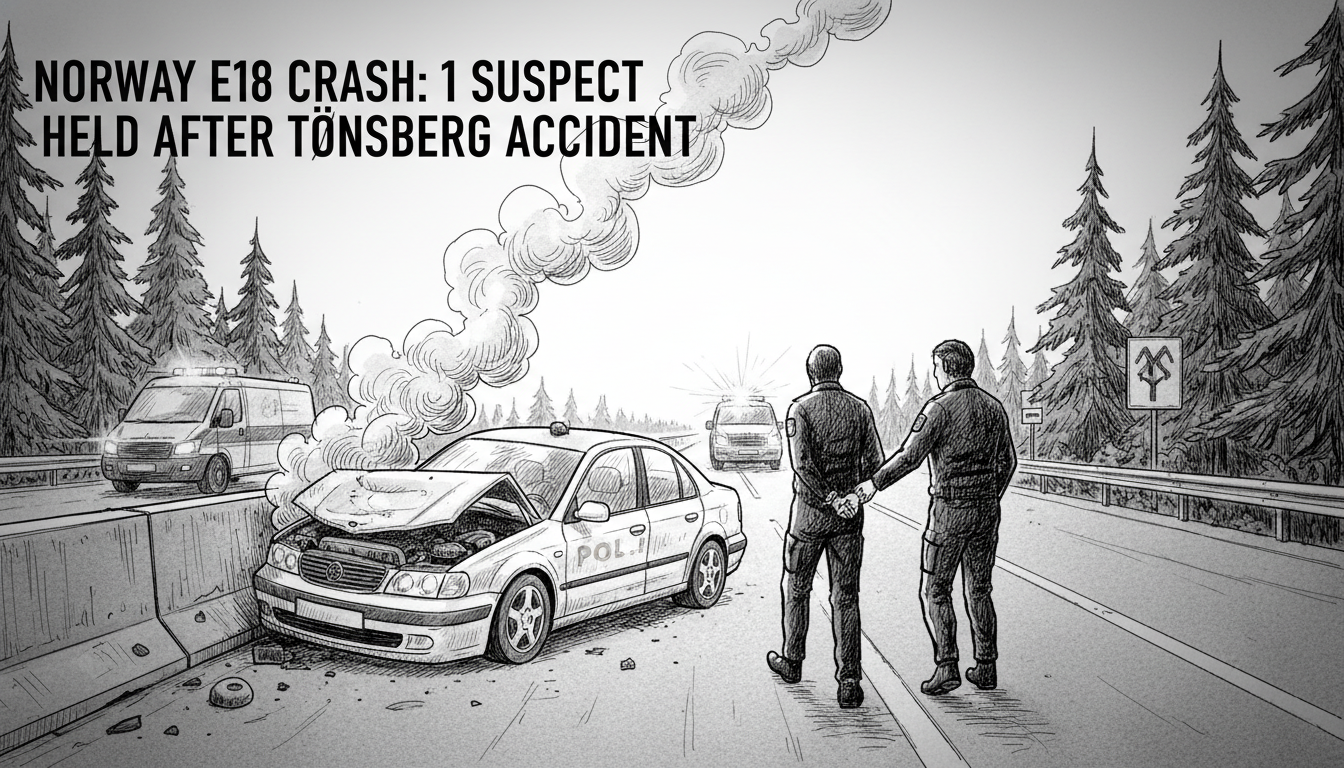
Norway's E18 highway was the scene of a serious accident Friday afternoon that left one man with life-threatening injuries. The crash occurred in the southbound lanes near Tønsberg, a key city in the busy Oslofjord corridor. Police have identified one person as a suspect for negligence, though no formal charges have been filed. The investigation into the collision is ongoing, raising immediate questions about safety on one of the nation's most critical and congested roadways.
Police prosecutor Andreas Baklie Haugen from the South-East Police District confirmed the suspect's status. "No one is currently charged in connection with the accident," Haugen said in a statement, "but one person has the status of being suspected of negligence." This legal distinction is significant in Norwegian law, indicating police have reasonable grounds to believe an individual's careless actions contributed to the event. The injured man was transported to a local hospital for emergency treatment.
A Vital Artery Paralyzed
The E18 is not just any road; it is a European route and a primary economic lifeline connecting Oslo to the southwestern coast. The stretch near Tønsberg, approximately 100 kilometers southwest of the capital, is notoriously busy with commuter and freight traffic. Accidents here cause disproportionate disruption, snarling logistics for the entire region. Friday's crash led to significant delays and a major police response, diverting resources to manage the scene and the ensuing traffic chaos.
This incident fits a troubling pattern on Norway's high-speed highways. In 2023, 127 people lost their lives in 117 fatal traffic accidents across the country. While Norway boasts one of the world's lowest road mortality rates per capita, each accident triggers a rigorous official response. Investigations consistently point to a familiar trio of causes: speeding, impaired driving, and distraction behind the wheel.
The Legal Path from Suspect to Charge
The police's focus on "negligence" or uaktsomhet is a central element of this case. Under Norwegian law, a person acts negligently when they fail to exercise the care a normally prudent person would in a given situation. On a highway like the E18, where speeds are high and margins for error are slim, the standard of care is particularly stringent. Police investigators will now piece together the moments before the collision.
"The investigation will look at all relevant factors," said a legal expert familiar with traffic cases, who spoke on background. "This includes vehicle speed, road conditions at the time, potential technical failures, and of course, the driver's actions and attention level. The designation of a suspect means they have specific reason to look closely at one individual's conduct." The evidence gathered will determine if the suspicion is strong enough to elevate the case to formal prosecution.
Safety Challenges on the Oslofjord Corridor
The Oslofjord region, where Tønsberg is situated, presents unique challenges. It combines dense urban zones, complex interchanges, and high-speed highway segments. The E18 here bears the weight of Norway's economic engine, carrying everything from daily commuters to heavy goods vehicles serving the nation's ports. This mix, especially during peak hours or in poor weather, increases risk.
Road safety advocates stress that infrastructure and behavior must align. "Roads like the E18 are designed for safety, but that design is only as good as the people using it," said an independent traffic safety analyst. "Adherence to speed limits, maintaining safe distances, and absolute focus are non-negotiable. When one driver lapses, the consequences on a road with this volume and speed can be catastrophic." Ongoing national campaigns continue to target distracted driving, which remains a persistent threat.
A Community's Anxious Wait
Beyond the traffic statistics and legal procedures, the human impact of Friday's crash is profound. A man fights for his life in hospital, his family and community awaiting news. The driver designated as a suspect also faces a life-altering situation, pending the investigation's outcome. For the emergency responders who dealt with the scene, it is another traumatic event in a demanding profession.
Local residents in Tønsberg and surrounding areas are all too familiar with the sound of sirens on the E18. Each accident renews debates about road design, traffic enforcement, and the societal cost of mobility. While Norway invests heavily in safer roads and vehicle technology, the human element remains the most unpredictable variable.
The Road Ahead for the Investigation
Police will now methodically compile their report. This process involves forensic analysis of the vehicles, gathering witness statements, and possibly reviewing dashcam or traffic camera footage. The final assessment will determine whether the suspected negligence rises to the level of a criminal offense, such as causing bodily harm through negligence, which can carry a prison sentence.
The case also highlights the broader, relentless work of traffic police across Norway. Their role is not merely to issue fines but to prevent tragedies through visibility and enforcement. Every serious accident triggers a review of whether preventive measures in that specific area are sufficient.
As the investigation continues quietly in police offices and workshops, the E18 near Tønsberg has returned to its normal flow of traffic. The skid marks may fade, but the questions linger. How do we balance efficient mobility with absolute safety? And in a nation celebrated for its orderly society and advanced infrastructure, what does it take to finally achieve zero serious accidents on its most important roads? The search for answers, much like the traffic on the E18, never stops.