
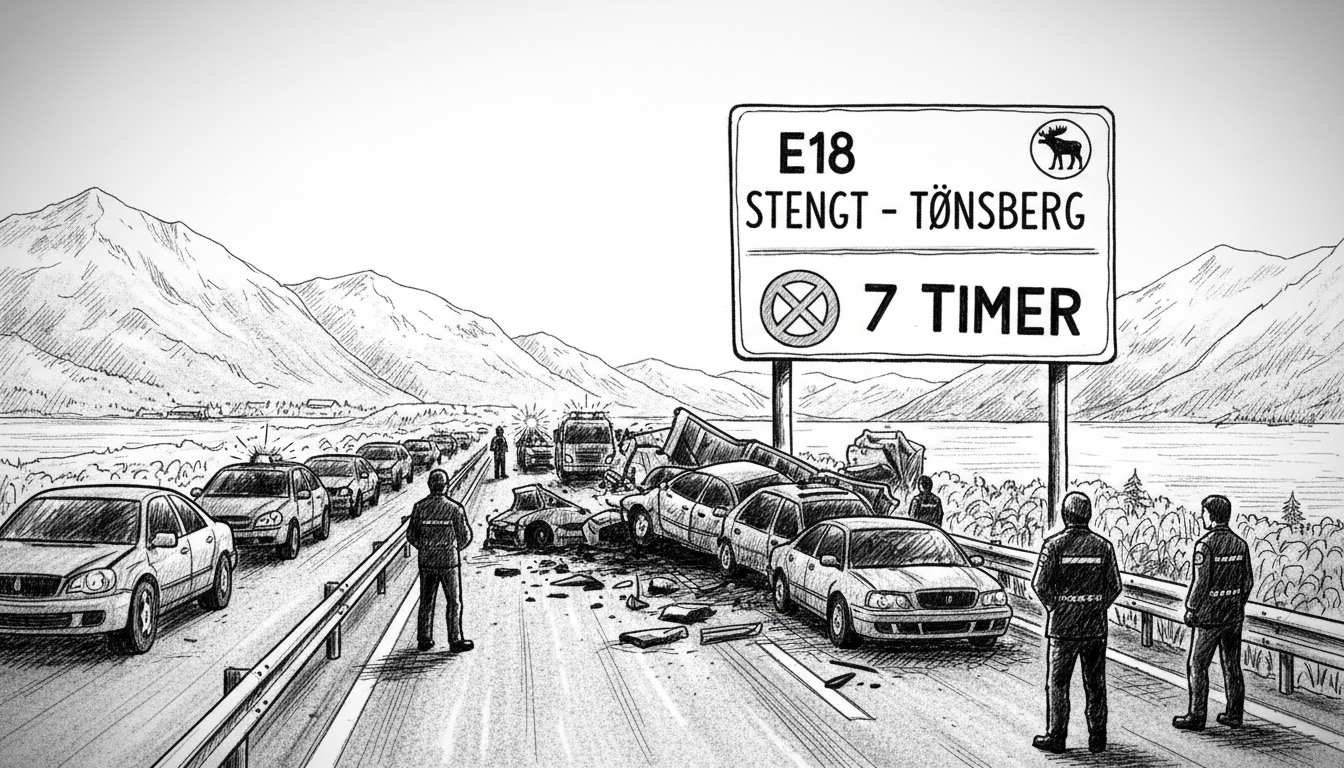
Norway's E18 highway has reopened after a serious multi-vehicle accident north of the Gullikrysset interchange in Tønsberg caused a seven-hour closure on Friday afternoon. The southbound lanes were shut for nearly seven hours as emergency crews and police forensic teams worked at the scene. One man sustained serious injuries after being struck by another vehicle upon exiting his car following an initial collision. Police reported several subsequent crashes involving cars that had stopped at the accident site and roadside barriers, with low light conditions at the time of the incident.
Traffic Chaos on Vital Artery
The closure of a primary section of the E18 south of Tønsberg created significant disruptions along Norway's southwestern coast. This highway is a critical transport link connecting Oslo to the major coastal cities of Kristiansand and Stavanger. Thousands of commuters and freight vehicles faced long detours through local roads in Vestfold county. The seven-hour stoppage underscored the network's vulnerability to single-point failures. Traffic authorities reported congestion stretching back several kilometers during the evening rush hour.
Police confirmed the complex nature of the collision sequence. An initial accident prompted a driver to exit his vehicle on the live highway. In the poor visibility, he was then hit by an oncoming car, sustaining what responders described as serious injuries. He was transported to a local hospital for treatment. This primary crash caused other motorists to stop abruptly, leading to a chain-reaction of collisions with stationary vehicles and auto-protection barriers.
Sequence of a Highway Tragedy
Investigators from the Norwegian Public Roads Administration's accident group and police forensic technicians spent hours documenting the scene. Their work is crucial for understanding the exact dynamics of the crash. A central focus is the decision to exit the vehicle on an active motorway. Police have not released the identities or nationalities of those involved. The southbound closure lasted from the afternoon into the night, finally lifting after investigators completed their on-site analysis.
Witnesses described a scene of confusion and sudden braking. The low light conditions at the time, typical for Norwegian autumn afternoons, likely reduced reaction times. The E18 in this region, while modern, features stretches with high speeds and significant traffic volumes, especially near interchanges like Gullikrysset. This junction is a known point of congestion and merging traffic, which can increase accident risk.
Why Exiting Your Car Can Be Deadly
Traffic safety experts consistently warn against leaving a vehicle on a live highway. The standard advice in Norway is to remain in the car with seatbelts fastened if it is safe to do so, and to only exit if there is an immediate threat like fire. If evacuation is necessary, occupants should move quickly to a safe area well away from the traffic lanes, preferably behind a barrier. The tragic event near Tønsberg is a stark reminder of this protocol's importance.
"Your car is your safest shelter in the initial moments after a collision on a high-speed road," explained a senior advisor from the Norwegian Council for Road Safety, which advocates for traffic safety. "The impulse to inspect damage or exchange details is understandable, but the risk from passing traffic is immense, particularly in low light or bad weather. The priority must always be to make yourself visible and get to a position of safety."
This accident also highlights the danger of secondary collisions. Experts emphasize maintaining a safe following distance, which provides crucial time to react to sudden stops ahead. On highways like the E18, where speeds often exceed 100 km/h, a several-second gap is recommended. Norwegian road authorities frequently run campaigns focusing on this message, especially before the winter driving season.
The Ripple Effect of a Road Closure
The economic and logistical impact of a major highway closure is substantial. The E18 corridor is a backbone for freight moving from the Oslo port region to the south and west. A seven-hour blockage disrupts delivery schedules and increases costs for haulage companies. For the region of Vestfold, it isolates key municipalities and affects local businesses reliant on passing trade.
Alternative routes, such as County Road 311, are not designed for heavy through-traffic. This diversion places strain on local infrastructure and increases travel times significantly. The incident demonstrates the limited redundancy in parts of Norway's road network, where mountainous terrain and fjords often leave only one viable route for long-distance travel.
Infrastructure and Safety in Focus
While Norway boasts one of the world's lowest traffic fatality rates, incidents like the Tønsberg crash prompt scrutiny of road design and driver behavior. The Storting has recently debated increased investment in road safety measures, including more frequent lighting and improved barrier systems on key highways. The government's National Transport Plan allocates billions of kroner for maintenance and safety upgrades on roads like the E18.
This accident may renew calls for enhanced emergency response protocols on major arteries. Some experts suggest exploring faster methods for clearing crash sites to reopen critical links. However, this must be balanced with the thorough investigation needed for justice and future prevention. The police's meticulous work, while causing delay, is essential for piecing together the causal chain.
The human cost of such accidents extends beyond physical injury. Those involved, including witnesses and first responders, can experience lasting psychological trauma. Road safety is not merely an engineering challenge but a continual public education effort. As vehicles become more advanced with automatic emergency braking and collision warnings, the fundamental rules of driver awareness and caution remain irreplaceable.
Norway's E18 will continue to bear heavy traffic, connecting communities and driving commerce. The lessons from Friday's serious crash near Tønsberg are etched in the delayed journeys of thousands and the serious injuries of one man. It serves as a sobering reminder that safety on the road is a shared responsibility, demanding vigilance from every person behind the wheel, especially as the dark Nordic winter approaches.