
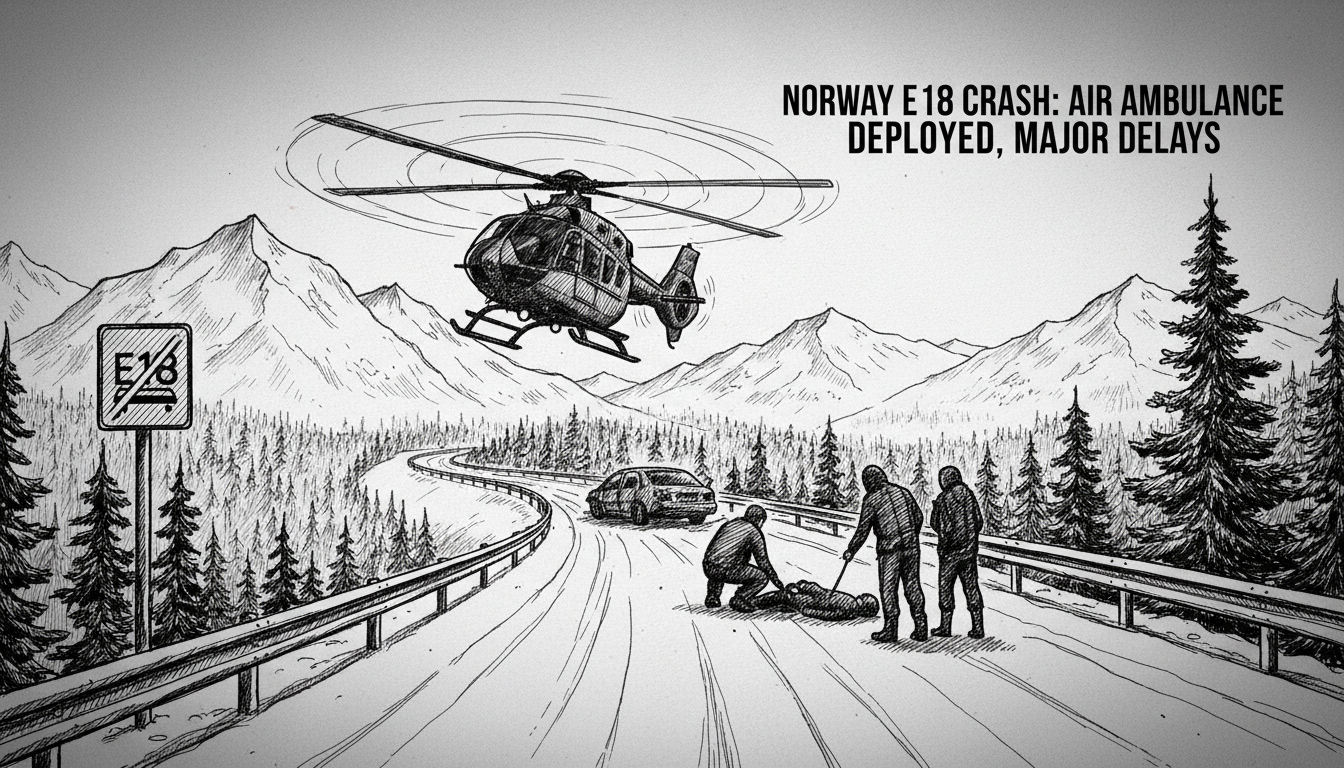
Norway's vital E18 highway was the scene of a serious multi-vehicle collision Friday afternoon, causing major traffic chaos and requiring an air ambulance response. The accident occurred just north of the Gullikrysset interchange in Tønsberg shortly before 2:30 PM, according to police. One person was airlifted to hospital with injuries, while southbound lanes were closed for hours, creating kilometers of tailbacks during the busy afternoon period.
"One person has been transported to hospital by air ambulance," said Roger Aaser, the operations leader for the South-East Police District, in an update. The police immediately closed the southbound lanes to facilitate the emergency response and initial investigation. Officers were on site directing stranded motorists, but traffic was at a standstill for miles in both directions as the crucial artery was severed.
Witnesses described severe congestion. Drivers reported queues stretching for several kilometers along the E18, a road that handles a significant portion of the region's commuter and freight traffic. The closure forced a major diversion, with local roads around Tønsberg absorbing the unexpected influx of vehicles. The ripple effect disrupted travel across Vestfold county for the remainder of the Friday rush hour.
A Critical Artery Severed
The E18 is not just another Norwegian road. It forms part of the transnational European route E18, running from Northern Ireland to Saint Petersburg. Within Norway, it is the backbone of the southeastern corridor, connecting the capital region of Oslo to key cities like Drammen, Tønsberg, Sandefjord, and Kristiansand. Its function as a primary route for both personal vehicles and heavy goods vehicles means any disruption has immediate and widespread economic and social consequences.
Friday's accident at Gullikrysset struck at a particularly sensitive point. This major interchange is where the E18 meets County Road 35, a key route into and around Tønsberg, one of Norway's oldest cities and an important regional hub. The closure effectively blocked the main southern approach to the city and cut the flow of traffic along the coast. For logistics companies, the delay translated directly into increased costs and missed deadlines.
"Incidents on the E18 create a domino effect," explains a traffic management consultant who has worked with the Norwegian Public Roads Administration. "The volume is so high that alternative routes saturate within minutes. The priority becomes preventing secondary accidents in the queues and ensuring emergency services have clear access. Every minute of closure adds significantly to the total economic impact, from wasted fuel to delayed goods."
Emergency Response and Investigation
The deployment of an air ambulance, or Luftambulanse, underscores the seriousness of the incident. Norway's air ambulance service is a critical component of its emergency medical response, particularly for accidents on remote stretches of highway or when road transport to a major trauma centre would take too long. The decision to call in the helicopter is made by emergency medical coordinators based on the initial reports from police and first responders at the scene.
While details of the injured person's condition have not been released, the use of the air ambulance typically indicates a need for rapid transport to a specialist hospital, such as Oslo University Hospital or a similar facility with advanced trauma care. The South-East Police District has launched an investigation to determine the cause of the multi-vehicle pile-up. This process will involve technical examinations of the vehicles, witness statements from other drivers, and analysis of any available traffic camera footage.
Common factors in such accidents on this stretch can include high speeds, sudden braking, driver distraction, or adverse weather conditions. The E18 south of Oslo has seen significant upgrades in recent years, but sections remain heavily congested during peak times, increasing the risk of chain-reaction collisions. The police investigation will seek to establish the sequence of events that led to this specific crash.
The Cost of Congestion
Beyond the immediate human cost, accidents like this have a measurable economic impact. Norway's Public Roads Administration regularly calculates the societal cost of traffic delays, which includes lost work hours, increased emissions from idling vehicles, and higher fuel consumption. A multi-hour closure of a primary route like the E18 during a Friday afternoon can easily run into millions of kroner in lost productivity and added logistics expenses.
The freight industry feels this acutely. The southeastern corridor is a gateway for goods moving from European ports to the Norwegian interior and for Norwegian exports heading south. Each truck stuck in a queue represents a broken link in a just-in-time supply chain. For commuters, the delay represents lost personal time and added stress at the start of the weekend.
This incident will likely reignite discussions about road safety and capacity on Norway's key highways. While the country invests heavily in public transport, the private vehicle remains dominant for personal travel outside major cities. The government's ongoing National Transport Plan always grapples with the balance between building new capacity, maintaining existing infrastructure, and implementing safety measures like improved signage, speed limits, and collision avoidance technology.
A Pattern of Vulnerability
Friday's crash is not an isolated event. The E18 has been the site of numerous serious accidents over the years, prompting calls for accelerated safety upgrades. Each incident exposes the vulnerability of a transport system that relies heavily on a few key routes. When the E18 stops, there are few viable alternatives for high-volume traffic, a fact starkly illustrated by the kilometers-long queues witnessed today.
Experts argue for a multi-pronged approach: stricter enforcement of traffic laws, continued investment in physical road improvements like wider shoulders and safer barriers, and public awareness campaigns. There is also an increasing focus on intelligent transport systems that can warn drivers of congestion or hazards ahead, potentially preventing the kind of rapid-onset, multi-vehicle collisions seen in Tønsberg.
The accident also highlights the importance of Norway's integrated emergency services. The coordination between local police, the air ambulance service, and road traffic controllers is essential for managing the aftermath effectively. Their swift action likely prevented further danger and ensured the injured party received rapid care.
Looking Ahead: Resilience and Response
As the tow trucks cleared the wreckage and the southbound lanes eventually reopened, the immediate crisis subsided. However, the questions it raises linger. How can Norway protect the functionality of its most critical transport infrastructure? Is the current balance between road expansion and public transport investment correct for a country aiming to reduce emissions while maintaining mobility?
The closure of the E18, even for a few hours, is a stark reminder of the system's fragility. For the residents and businesses of Vestfold, it was a frustrating disruption. For the injured individual and their family, it was a life-altering event. For policymakers, it should be a data point in an ongoing calculation about safety, efficiency, and the future of transport in a nation where long distances and challenging geography make every major highway indispensable.
The investigation will provide answers about this specific Friday afternoon near Gullikrysset. But the broader challenge of making vital arteries like the E18 both safe and reliable remains an ongoing journey for Norwegian authorities. The true test will be whether this incident translates into tangible actions that reduce the risk and impact of the next, inevitable, disruption on this busy road.