
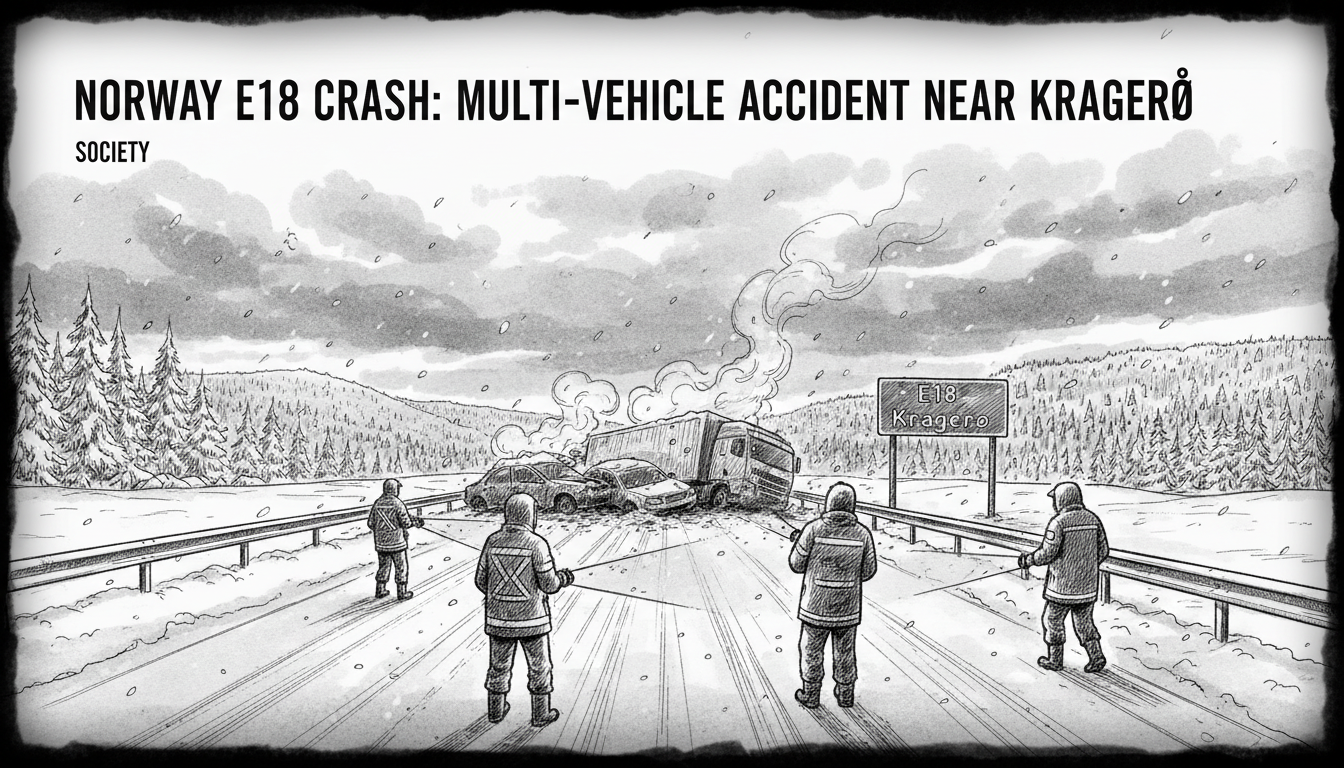
Norway's E18 highway was the scene of a serious multi-vehicle accident south of Kragerø on Tuesday, causing significant traffic disruption and prompting a major emergency response. The crash occurred between the Tangen and Gjerstad exits in the Agder region, blocking the southbound lanes of one of the country's most critical transport arteries. Police, fire services, and multiple ambulance units were dispatched to the scene, though the exact number of vehicles involved and the severity of injuries remain unconfirmed by authorities in initial reports.
Emergency Response and Traffic Chaos
First responders faced a complex scene with several vehicles damaged. The Norwegian Public Roads Administration (Statens vegvesen) immediately issued warnings for motorists to avoid the area, anticipating long delays. Southbound traffic was halted, with vehicles backed up for several kilometers. Drivers were advised to seek alternative routes, though options are limited in the coastal terrain of Telemark and Agder. The accident highlights the vulnerability of Norway's primary road network, where a single incident can sever a major national connection.
Local police established a perimeter to manage the crash site and begin preliminary investigations. Tow trucks were called to clear the wreckage, a process that officials warned could take several hours. The disruption rippled beyond immediate traffic, potentially affecting commercial freight and regional travel plans. This stretch of the E18 is a vital link between the Oslo region and the southern coast, making it a high-priority corridor for restoration.
The E18: A Critical and Congested Artery
The E18 is not just another road; it is part of the European route system and functions as Norway's economic spine. It connects the capital, Oslo, with key cities like Kristiansand and Stavanger, facilitating the movement of goods, commuters, and tourists. Its importance makes any closure a national event. Traffic volumes on this highway are consistently high, with congestion being a frequent complaint, especially during summer holidays and peak commuting times.
Experts point to this combination of high speed and high volume as a persistent risk factor. "Major highways like the E18 present unique safety challenges," said a traffic safety analyst with the Institute of Transport Economics. "The speeds are higher, driver concentration can lapse on long stretches, and the consequences of a mistake are magnified. When an accident occurs, it often involves multiple vehicles and creates a cascading effect of danger and delay." The geometry of the road near Kragerø, with its mix of curves and limited overtaking opportunities, can also contribute to risky driver behavior.
Norway's Road Safety Record in Focus
This incident brings Norway's generally strong road safety record into temporary focus. With 117 road fatalities in 2022, Norway has one of the lowest rates in Europe, a achievement credited to decades of investment in infrastructure, strict enforcement of traffic laws, and vehicle safety standards. However, each serious accident serves as a stark reminder that the goal of zero fatalities, part of Norway's "Vision Zero" policy, remains elusive.
Investigations into such crashes typically examine a standard set of factors: excessive speed, driver distraction or fatigue, vehicle technical faults, and prevailing road conditions. Weather, while not initially reported as a factor in this case, often plays a role in Norwegian accidents. The Public Roads Administration continuously works on safety upgrades, including improved signage, barrier systems, and road surface treatments, but human error remains the most unpredictable variable.
The Human and Economic Toll of Disruption
Beyond the immediate victims, whose condition we await updates on, an accident of this scale has a wider impact. Stranded motorists face hours of unexpected delay. Businesses relying on just-in-time logistics encounter supply chain snags. The collective loss of productivity and the strain on emergency services represent a significant, though often uncalculated, economic cost. For the local communities around Kragerø, Tangen, and Gjerstad, the sight of flashing blue lights and silent traffic is a grim disruption to daily life.
The response also tests the coordination of Norway's emergency services. Seamless cooperation between police, fire, and medical units is crucial for effective scene management and casualty care. The efficiency of this response can mean the difference between life and death in the critical "golden hour" after a traumatic incident. The use of air ambulances, though not confirmed in this case, is often a consideration for remote highway accidents to rapidly transport the severely injured to specialized trauma centers.
A Look at Infrastructure and Future Challenges
This crash will inevitably renew discussions about Norway's road infrastructure investments. While major projects like the E39 Coastal Highway Route garner headlines, maintaining and improving existing arteries like the E18 is a constant, less glamorous task. Debate often centers on widening congested sections, adding more overtaking lanes, and implementing intelligent transport systems that can warn drivers of hazards ahead.
Some safety advocates call for stricter measures, such as lower speed limits on high-risk stretches or more widespread use of automated speed cameras. Others emphasize the need for public awareness campaigns targeting driver fatigue, which is a known risk on long, monotonous drives common in Norway. The balance between building safer roads and fostering safer driver behavior is a continuous challenge for policymakers.
Awaiting Answers and Assessing the Aftermath
As the wreckage is cleared and traffic slowly resumes, the official investigation begins. Police will work to piece together the sequence of events that led to the collision. Their findings will inform any potential legal proceedings and, more importantly, contribute data to the broader effort to prevent similar tragedies. The true measure of this incident's impact will be seen in the wellbeing of those involved and the lessons that transport authorities take from it.
For now, the closed section of the E18 serves as a silent testament to the fragility of daily routine. It underscores how quickly a routine journey can turn into a crisis, and how dependent modern society is on the smooth flow of traffic. As Norway reflects on this accident, the core question remains: in a nation celebrated for its safety, what more can be done to protect lives on its most important roads?