
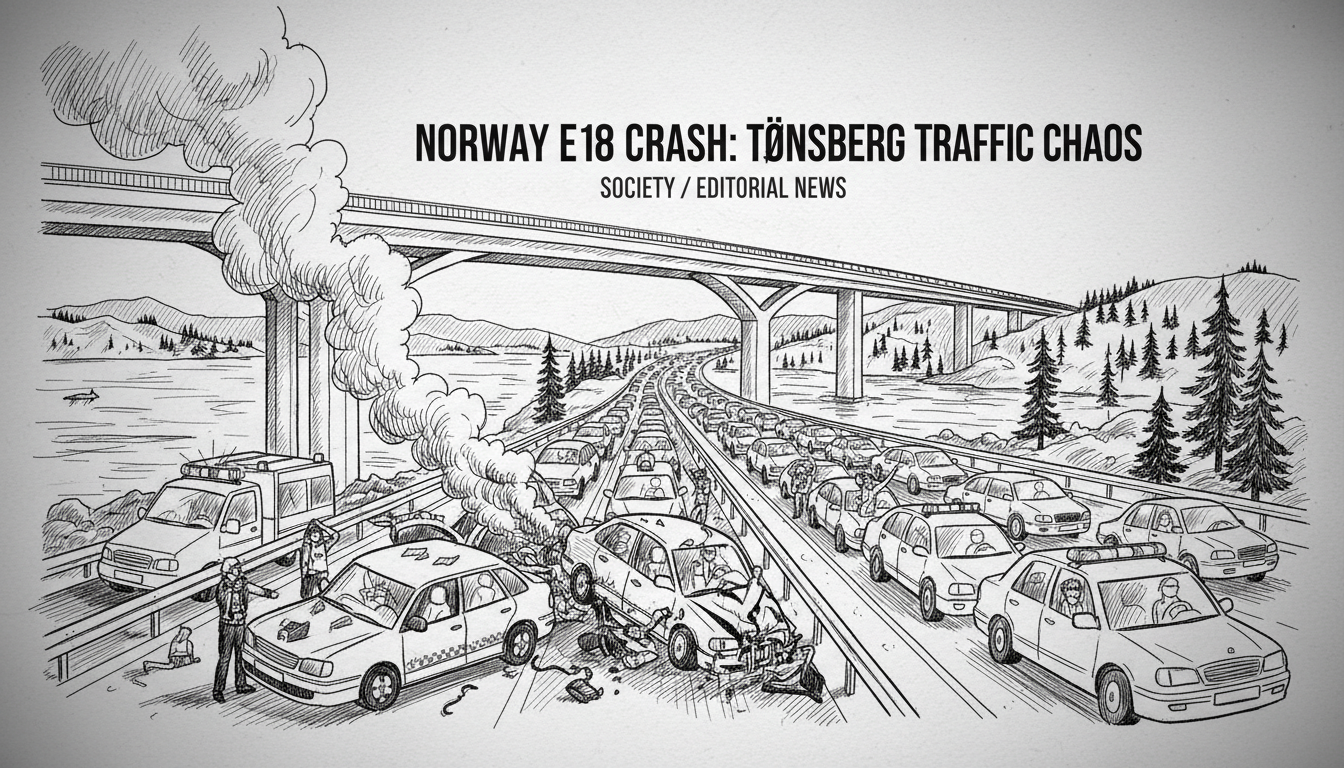
Norway's E18 highway was completely closed near Tønsberg on Thursday after a serious traffic accident during ongoing roadworks. The crash, which caused major damage to at least one vehicle, forced authorities to shut down all lanes in both directions, creating a major disruption on one of the country's most critical transport arteries.
“Due to roadwork, only one lane in each direction was in use. Traffic is therefore completely blocked in both directions while emergency services work on site,” said operations manager Roger Aaser in a police statement. Initial reports indicated significant vehicle damage but likely no serious personal injuries.
The closure immediately created a traffic crisis for the Vestfold region. The E18 serves as the primary corridor connecting Oslo to the southern coastal cities, including Tønsberg, Sandefjord, and eventually the Swedish border. Thousands of commuters, freight trucks, and regional travelers found themselves stranded or facing massive delays.
A Critical Artery Paralyzed
The E18 is not just another road. It is a vital piece of national infrastructure, handling a substantial portion of Norway's southbound passenger and commercial traffic. The stretch through Vestfold is particularly busy, linking the capital region to key ports, industry, and residential areas. A complete closure, even for a few hours, has a cascading effect.
Local police and the Norwegian Public Roads Administration (Statens vegvesen) moved quickly to establish diversions. Traffic was rerouted onto already congested local roads through Tønsberg and the surrounding municipalities. These roads, not designed for high-volume, high-speed interstate traffic, quickly became clogged.
“When the E18 stops, everything in the region slows down,” said a spokesperson for the Road Administration. “Our priority is safety at the accident scene, then restoring flow as soon as possible.” The presence of active roadworks complicated the response, as the usual shoulder and adjacent lanes were already out of service.
The Inherent Risks of Roadwork Zones
This incident highlights an ongoing challenge for Norwegian authorities: maintaining safety during essential infrastructure upgrades. Norway has an extensive and aging road network that requires constant maintenance, especially along the heavily used E18. These projects often necessitate lane reductions and altered traffic patterns.
Traffic safety experts point to construction zones as areas of increased risk. “Driver behavior must adapt to changed conditions,” explained Professor Arvid Aakre, a traffic safety researcher at the Institute of Transport Economics (TØI). “When lanes narrow and merge, especially on high-speed roads, it requires heightened attention. Speed differentials and last-minute lane changes are common factors in these incidents.”
While national statistics for 2024 are not yet finalized, data from previous years shows that a significant percentage of serious accidents occur in or near roadwork areas. The combination of high traffic volumes on the E18 and reduced capacity creates a volatile mix. The Road Administration implements temporary speed limits and signage, but compliance is variable.
Economic and Commuter Impact
The economic cost of such a closure is immediate and multifaceted. Freight transport is severely disrupted, with delays rippling through supply chains. For logistics companies, time is a direct cost. Per-Erik Holm, a manager for a major transport firm operating in the region, outlined the impact.
“A five-hour delay for a dozen trucks means missed ferry connections to Europe, missed delivery windows at warehouses, and drivers hitting their legal driving time limits,” Holm said. “The cost isn't just fuel for idling engines; it's contractual penalties and operational chaos that lasts for days.”
For daily commuters, the impact is measured in lost hours and personal frustration. The corridor between Tønsberg and Oslo is one of Norway's busiest commuter routes. An unplanned closure forces people to seek expensive last-minute train tickets, work remotely if possible, or simply wait in their cars.
Response and Infrastructure Pressures
The accident near Tønsberg will inevitably renew debates about Norway's road infrastructure resilience. The E18 is frequently cited as a bottleneck. While major projects like the E18 Rugtvedt-Dørdal are underway to add capacity, they also create more temporary work zones.
There is a constant tension between the need to upgrade infrastructure and the need to keep it running smoothly. The Public Roads Administration plans closures meticulously, but unexpected accidents within these constrained work areas are a persistent risk. Some politicians argue for accelerated investment to shorten project timelines.
“Every day of roadwork is a day of increased risk and congestion,” said Conservative Party (Høyre) transport spokesperson, Trond Helleland. “We must look at methods to complete vital upgrades faster and with less disruption, even if the upfront cost is higher. The total cost to society from these repeated closures is enormous.”
Opposition voices, particularly from the Green Party (MDG), argue that the solution lies in reducing dependence on the single-occupancy car and investing more heavily in parallel rail infrastructure for the Vestfold corridor. They see such disruptions as a symptom of an over-reliance on road transport.
Looking Ahead: Safety and Solutions
As the wreckage was cleared and traffic began to flow again on the E18, the broader questions remained. The investigation into the specific cause of the Tønsberg crash will take time. Was it driver inattention, excessive speed for the conditions, or a technical failure? The answers will inform future safety campaigns.
The Road Administration consistently runs awareness campaigns about “Yellow Zone” safety—their term for roadwork areas. The message is clear: slow down, pay attention, and merge early. Yet, as traffic volumes return to pre-pandemic levels and beyond, the pressure on the network grows.
For the residents and businesses of Vestfold, this incident is a stark reminder of their fragile connectivity to the capital. The E18 is their lifeline, and its vulnerability affects daily life. The promise of a future, wider, and safer E18 is little comfort during a long evening stuck in diversion traffic.
The final word from the scene came from the police, urging caution. “The road is reopening, but please drive carefully, especially through the remaining work zone,” said Operations Manager Aaser. “One accident is one too many.” As Norway continues its endless cycle of maintaining and expanding its vital roads, balancing progress with protection for drivers remains the paramount, and most difficult, challenge.