
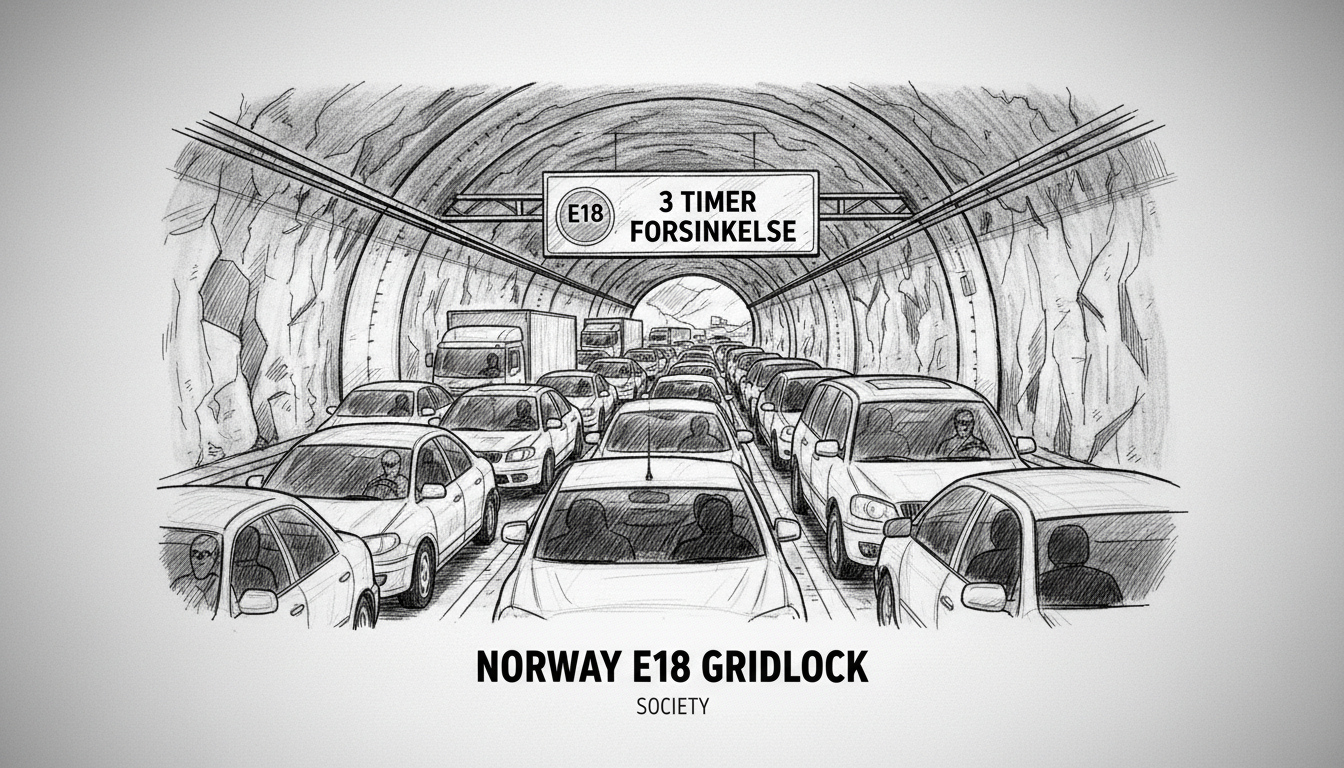
Norway's E18 highway experienced a major 3-hour traffic delay after a Friday evening accident in the Flårtunnelen. This critical European route, often hailed for its engineering, became the scene of a frustrating standstill that has drawn rare public criticism from the very authorities tasked with managing it. The incident exposes a paradox in Norwegian infrastructure management: despite advanced systems, response failures can paralyze key transport arteries.
A Stolen Car and a Systemic Breakdown
The collision occurred around 6 p.m. last Friday in the southbound tube of the Flårtunnelen. A stolen car crashed into the tunnel wall before striking a truck. Fortunately, no serious injuries were reported. The driver fled the scene but was later apprehended by police. The immediate aftermath, however, revealed a deeper problem. Emergency protocols stalled, leaving hundreds of motorists stranded in a queue that stretched for kilometers. Henning Johansen, the traffic response chief for the South-East Police District, did not mince words. "From the police side, this is completely unacceptable," he said in a statement.
Ingmar Ulvenes, section chief for the Norwegian Public Roads Administration's Operation South region, echoed the sentiment. "We must simply apologize to all motorists who were stuck," Ulvenes stated. Both agencies agree that the process of diverting traffic into the northbound tunnel tube took far too long. This admission of fault is unusual in a country known for efficient crisis management. The three-hour blockage on a primary route like the E18 represents a significant operational failure.
The High Cost of Highway Standstills
The E18 is not just any road. It forms a vital part of the Trans-European road network, connecting Oslo to the southern coast and onward to Sweden. Disruptions here have outsized consequences. For commuters, it meant missed appointments and family dinners. For freight carriers, delays translate into direct economic costs. Norway's geography, with its fjords and mountains, makes highways like the E18 irreplaceable corridors. There are few alternative routes when a key tunnel is blocked. This incident underscores the vulnerability of Norway's transport system to single points of failure, especially in tunnels.
Experts point to traffic incident response time as a key performance indicator. Per Eckhold, a transport logistics analyst based in Oslo, notes that such events test coordination. "The goal is always to clear incidents within 90 minutes to prevent cascading congestion," Eckhold explains. "A three-hour closure suggests a breakdown in communication or decision-making between police and road authorities. Tunnel safety procedures are complex, but the priority must be restoring flow." The Flårtunnelen delay likely caused ripple effects throughout the regional network, impacting local roads as drivers sought detours.
Investigating the Response Failure
Police and the Roads Administration have launched a joint review to identify what went wrong. The investigation will scrutinize several phases. First, the initial accident response and scene security. Second, the decision-making process for contraflow traffic management—diverting vehicles into the opposite tunnel lane. Third, the communication flow between emergency services, traffic control centers, and the public. Ulvenes confirmed the agencies are working to "find out what happened and try to avoid it happening again."
Specific points of inquiry may include the deployment of traffic management teams and the activation of digital message signs. Norway's tunnel safety systems are advanced, featuring ventilation, lighting, and emergency exits. However, this incident highlights that technology alone cannot prevent human or procedural errors. The fact that the involved vehicle was stolen adds a layer of criminal investigation, but the primary public concern remains the prolonged disruption for lawful road users.
Broader Implications for Norwegian Infrastructure
This event occurs amid ongoing national debates about infrastructure resilience and maintenance. The Norwegian Public Roads Administration manages thousands of kilometers of roads and hundreds of tunnels. Budget constraints and aging infrastructure pose challenges. While this was an accident, not a structural failure, it tests public confidence. For a nation heavily reliant on road transport for goods and mobility, reliable highways are non-negotiable. The Storting, Norway's parliament, regularly reviews transport budgets, and incidents like this provide concrete examples for policymakers.
Furthermore, with increasing traffic volumes and a focus on reducing emissions, efficient traffic flow is also an environmental issue. Idling vehicles in a three-hour jam produce unnecessary pollution. This aligns with Norway's ambitious climate goals, making efficient incident management a piece of the larger sustainability puzzle. The response to this single accident in Flårtunnelen could inform future protocols on other critical routes, such as the E6 or tunnels under the Hardangerfjord.
A Pledge for Improvement and a Call for Vigilance
Authorities have pledged transparency in their review. The findings are expected to lead to updated joint procedures between police and road operators. Potential improvements could include clearer chain-of-command protocols, faster deployment of mobile traffic barriers, and enhanced public communication via apps and radio. For Norwegian drivers, the incident is a reminder that even the best systems can falter. It also sets a benchmark for accountability, with officials publicly accepting blame and vowing to do better.
As Magnus Olsen, reporting from Oslo, the takeaway is clear. Norway's infrastructure is robust in design but dependent on flawless execution during crises. The E18 delay was more than an inconvenience; it was a stress test that revealed cracks in the response framework. Will this incident catalyze meaningful changes that prevent future gridlocks, or will it be forgotten until the next tunnel crisis? The answer lies in the forthcoming report and the commitment of those in charge to learn from a Friday night that left too many drivers stranded in the dark.