
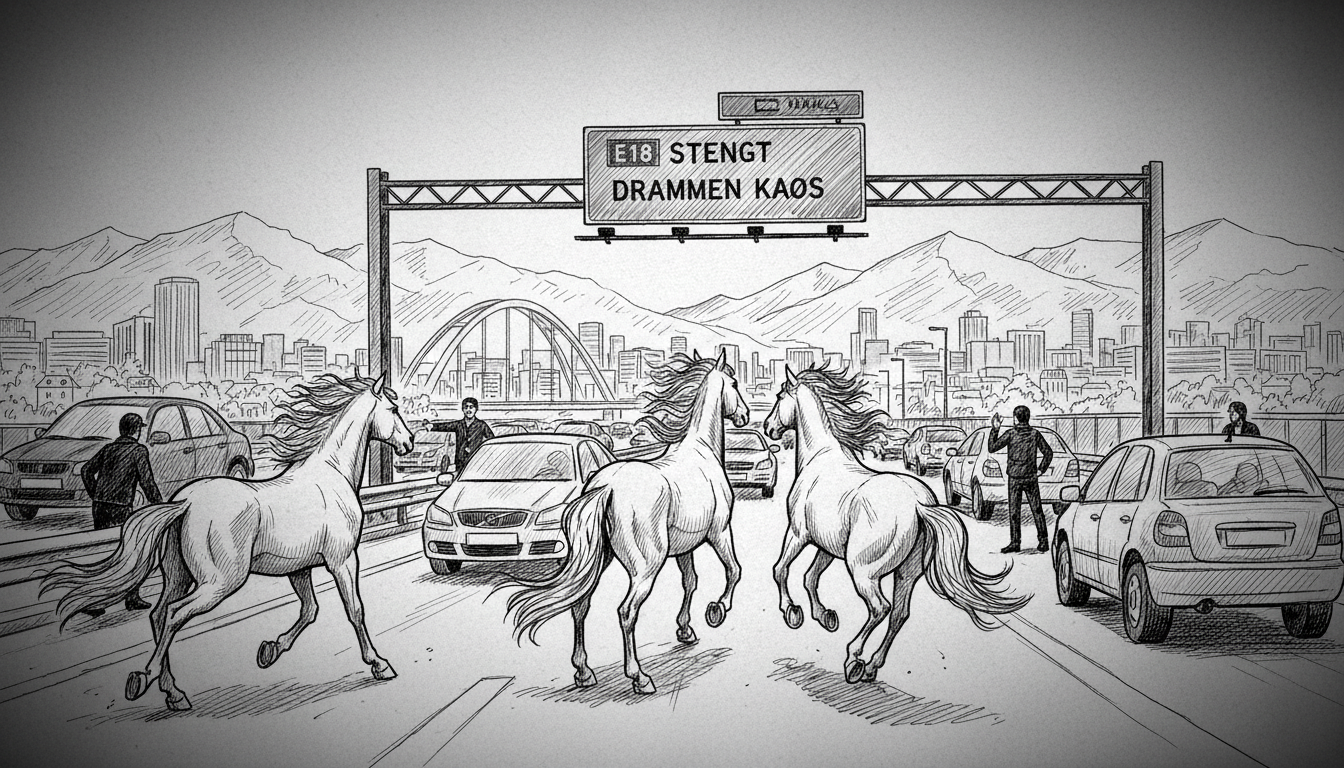
Norway's vital E18 highway was forced to a complete standstill near Drammen on Monday morning after three horses escaped onto the southbound lanes. Police halted all traffic in both directions near Skoger following reports received at 8:01 AM, creating significant disruption on a key national transport artery until the owner secured the animals and the road reopened.
A Major Artery Brought to a Halt
The E18 is not just any road. It forms part of the critical European route network, connecting Oslo to Kristiansand and onwards to the continent. This stretch near Drammen, a major industrial and commuter hub southwest of the capital, handles thousands of vehicles daily, including heavy freight traffic. A full closure, even for a short period, causes immediate ripple effects. Congestion builds rapidly on alternative routes like the E134 and local county roads, delaying commuters and disrupting logistics chains. The Buskerud Police District's decision to stop traffic in both directions was a standard safety protocol, but it underscores the vulnerability of concentrated transport networks to unexpected events.
The Persistent Challenge of Animal Incursions
While the image of horses galloping past highway barriers might seem surreal, such incidents represent a recurring, if infrequent, challenge for Norwegian authorities. The country's geography, where urban centers, farmland, and wilderness often exist in close proximity, creates unique traffic safety hazards. Moose collisions are a far more common and deadly occurrence, but loose livestock like horses or cattle pose a serious and unpredictable danger. A collision with a large animal at highway speeds can be catastrophic, leading to severe vehicle damage, human injury, and animal death. "Any time an animal of significant size enters a high-speed roadway, the risk of a tragic outcome is very high," explains a traffic safety analyst familiar with Norwegian road networks. "The immediate priority is always to remove the hazard and secure the scene, which necessitates a full closure."
From an animal control perspective, the incident near Skoger highlights the importance of rigorous maintenance for fences and enclosures bordering major infrastructure. Landowners have a clear responsibility under Norwegian law to ensure their livestock is properly contained. The fact that the owner in this case was able to regain control on-site suggests the animals had not strayed far from their point of origin, allowing for a relatively swift resolution. However, not all incidents end so cleanly. Searches for escaped animals in wooded areas adjacent to highways can prolong closures for hours, multiplying the economic and social costs.
Economic and Commuter Impact of Highway Closures
The cost of a major highway closure is measured in more than just inconvenience. For the logistics sector, delays translate directly into increased operational expenses. Perishable goods, just-in-time manufacturing supplies, and port-bound containers all face schedule disruptions. Each minute of idling for a heavy goods vehicle represents wasted fuel and driver hours. For commuters, the impact is felt in lost productivity and personal time. Drammen functions as a significant bedroom community for Oslo, meaning a morning closure on the E18 strands thousands trying to reach workplaces in the capital. The alternative routes through the Drammen region quickly become saturated, turning a localized incident into a regional traffic problem.
Norway's Public Roads Administration (Statens vegvesen) constantly balances safety with mobility. Their protocols for such incidents are well-established, but each event presents unique challenges. The terrain around Skoger, like much of the area, is a mix of residential zones, agricultural land, and forest, complicating efforts to corral loose animals. Effective coordination between police, road authorities, and the animal owner is crucial to minimize the closure window. Monday's incident appears to have been managed efficiently, but it serves as a stark reminder of the system's fragility.
A Broader Look at Norwegian Infrastructure Vulnerabilities
This event, while minor in the grand scheme, fits into a broader conversation about resilience in Norwegian infrastructure. The nation's transport network is consistently ranked among the world's best, but it faces distinct pressures. Harsh winter weather, challenging topography, and the very integration with nature that defines Norway also create vulnerabilities. From rockfalls and avalanches closing mountain passes to moose on motorways and now horses on the E18, the infrastructure must be managed in dynamic conditions. Investment focuses not only on building and maintaining roads but on monitoring, rapid response, and public communication systems to handle crises.
Furthermore, as urban areas expand, the interface between developed land and agricultural or natural zones becomes more pronounced. Planners increasingly consider these edge zones when approving new housing or farm developments near major roads. Regulations governing fencing standards and animal containment near highways may come under renewed scrutiny following a cluster of incidents. It is a classic Nordic challenge: preserving the rural character and agricultural traditions of the landscape while ensuring the safety and efficiency of modern, high-speed transport links.
Resolution and Lingering Questions
By mid-morning on Monday, the situation was resolved. The horses were secured, the E18 was reopened, and traffic began its slow process of returning to normal. The Buskerud police confirmed the owner had control of the animals and reported no accidents or injuries resulting from the escape. The clean outcome is a credit to the swift response of drivers who alerted authorities, the police who enacted the closure, and the owner who assisted in the recovery.
Yet, the incident leaves practical questions. What was the precise point of failure in the fencing or gate that allowed three horses to reach the highway? Are there specific sections of the E18 corridor near Drammen or elsewhere that require upgraded barriers where the road bisects farmland? While the owner's quick action prevented a disaster, the event triggers a review of preventative measures. Local municipalities and the Public Roads Administration often collaborate on identifying risk areas, but compliance and maintenance ultimately fall to individual property owners.
For the thousands of motorists caught in the delay, the episode was a frustrating start to the week. For analysts, it is a case study in non-standard transport disruption. In a nation that meticulously plans for snow, ice, and landslides, the unpredictable nature of animal behavior remains a wild card. The horses on the E18 underscore a simple truth: even the most advanced transportation systems are built upon a natural world that does not always follow the rules of the road. As Norway continues to develop its infrastructure, the balance between human engineering and the natural environment will remain a central, and occasionally galloping, concern.