
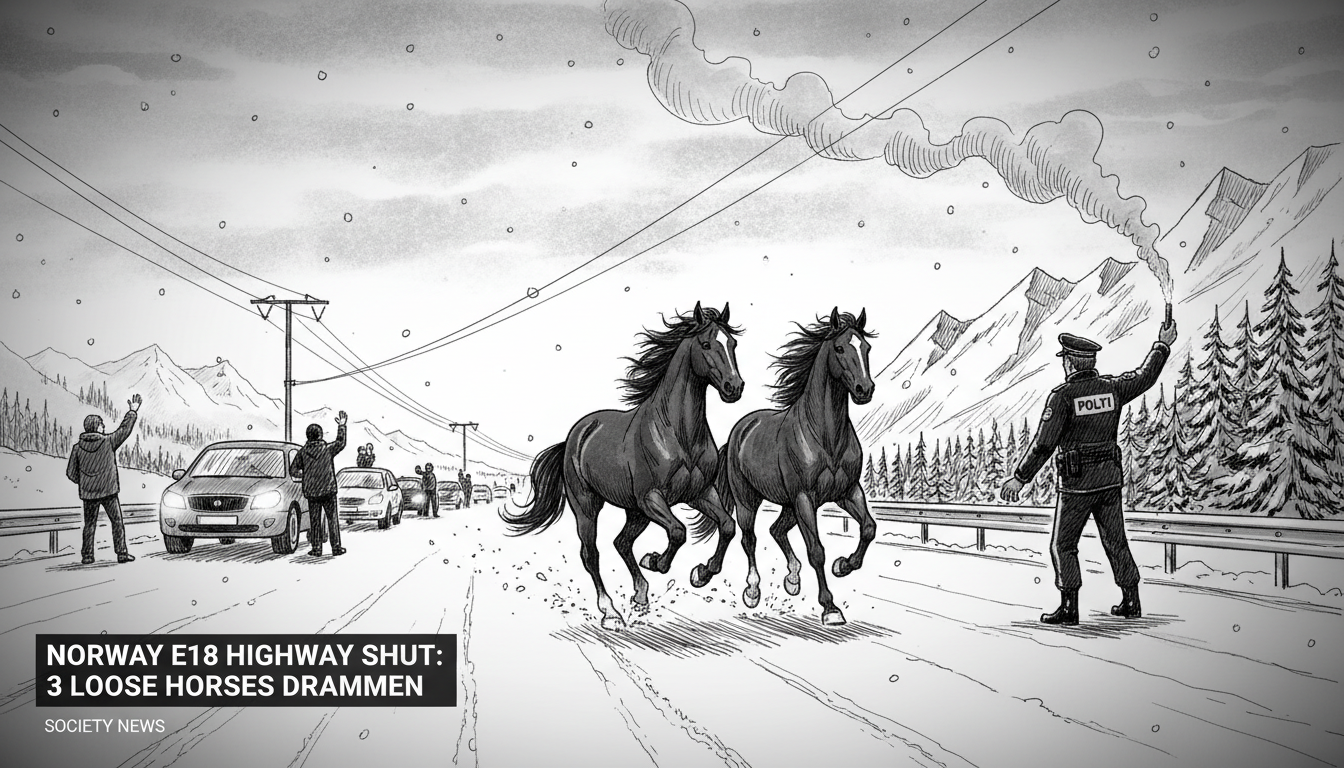
Norway's E18 highway faced a major shutdown near Drammen after three horses broke loose and ran onto the busy roadway. Police halted all traffic in both directions at Skoger, creating significant disruption on one of the country's most vital transport arteries while officers worked to secure the animals and locate their owner.
A Major Artery Brought to a Standstill
The incident occurred during a weekday, a time when the E18 typically carries heavy commuter and freight traffic between Oslo and the southwestern counties. The highway forms part of the European route network, connecting Norway to Sweden and beyond, making any closure a matter of regional economic significance. Police made the decision to stop all traffic as the uncontrolled horses presented an immediate and severe danger to motorists. "We have patrols on site and find ourselves forced to stop traffic in both directions," police said in a statement. The Vegtrafikksentralen, Norway's road traffic management center, was notified to coordinate warnings and diversions.
This is not a minor local road. The E18 handles thousands of vehicles daily, serving as a critical link for logistics, business, and daily life in Eastern Norway. A full closure, even for a short period, causes immediate ripple effects, backing up traffic onto alternative routes through Drammen and surrounding areas. Incidents like this test the response protocols of both police and road authorities, balancing public safety against mounting economic and social disruption.
The Persistent Challenge of Animals on Roads
While dramatic, incidents involving livestock on Norwegian roads are not unheard of. The Norwegian Public Roads Administration (Statens vegvesen) has long highlighted animal-related incidents as a traffic safety concern, particularly in rural and semi-rural areas that border expanding urban zones. Drammen municipality, where Skoger is located, features a mix of developed and agricultural land, creating potential zones of conflict between traffic and animals.
Traffic safety experts point to secure fencing and proper animal husbandry as the first line of defense. "The primary responsibility lies with the animal owner to ensure their livestock cannot access the road network," says a road safety advisor familiar with such cases. "When that fails, the risk escalates rapidly. A collision with a large animal like a horse at highway speeds is catastrophic." Norwegian law holds animal owners liable for damages and costs arising from loose animals on roads, a rule intended to enforce rigorous containment standards.
From an animal welfare perspective, the scenario is equally dangerous. Horses on a high-speed highway are terrified and disoriented, at risk of injury from vehicles, collisions with barriers, or simply from stress and exhaustion. Safe retrieval requires calm, specialized handling to avoid causing the animals to bolt further or into oncoming traffic on other lanes.
Economic and Logistical Ripple Effects
The cost of a major highway closure is substantial. It includes immediate costs like emergency service response and traffic management, but also broader economic impacts from delayed freight, lost work hours, and disrupted supply chains. The E18 is a key route for goods moving to and from the ports of Drammen and Oslo, meaning even a brief stoppage can delay shipments.
For commuters, an unplanned closure creates chaos. Alternative routes, such as county roads through the Drammen region, quickly become congested, multiplying travel times. The incident serves as a stark reminder of the vulnerability of modern transport systems to unpredictable events. While Norway invests heavily in tunnel safety and avalanche protection, a few loose animals can achieve what the harshest weather sometimes does: bringing traffic to a complete halt.
Response and Resolution Protocols
Police procedures in such events prioritize human safety first, then animal welfare, followed by traffic restoration. The initial response involves securing the scene to prevent accidents. Officers then work to contain the animals, often requiring patience and specific tactics to avoid causing a stampede. Contacting the owner is crucial, as they can often assist with handling and removal.
In this case, police confirmed they were working to locate the horses' owner while managing the scene. The involvement of the national road traffic center indicates the incident was escalated beyond a local police matter, ensuring coordinated messaging to drivers via traffic apps, variable message signs, and media alerts. This integrated response aims to minimize secondary incidents caused by sudden stops or frustrated drivers taking risky detours.
A Broader Look at Roadside Safety
This event connects to wider discussions about land use and infrastructure planning in Norway. As cities expand, the interface between urban infrastructure and agricultural land becomes more complex. Maintaining secure boundaries is an ongoing challenge. Some municipalities have implemented programs to subsidize secure fencing along major roads, recognizing the public safety benefit.
Furthermore, Norway's ambitious goals for zero traffic fatalities and serious injuries (the Vision Zero policy) encompass all road risks, including those posed by animals. This means prevention strategies must consider factors like roadside fencing, wildlife crossings, and public education for animal owners. While focused on wild animals like moose and deer, the principles of preventing animal-vehicle collisions apply equally to domesticated livestock.
The Aftermath and Lasting Questions
Once the horses were safely captured and traffic resumed, the investigation shifted to determining how the animals escaped. The owner could face fines and be billed for the cost of the police and traffic management response. The incident likely prompted local authorities to inspect fencing and enclosures in the area.
For the drivers caught in the disruption, it was an inconvenient reminder of shared vulnerability. For transport planners, it's a case study in network resilience. A single point of failure—three loose horses—can paralyze a system designed for efficiency and speed. It underscores that safety on Norway's modern highways depends not just on engineering and rules, but also on the security of a fence post in a field beside the road.
These incidents, though resolved without reported injury this time, leave a lasting impression. They reveal the fragile intersection between our controlled transport corridors and the unpredictable natural world. They ask a simple but persistent question: in our drive to connect and move faster, how do we ensure the basic security of the landscapes we pass through? The answer requires not just responsive police work, but proactive cooperation between landowners, municipalities, and transport authorities to prevent the next escape before it happens.