
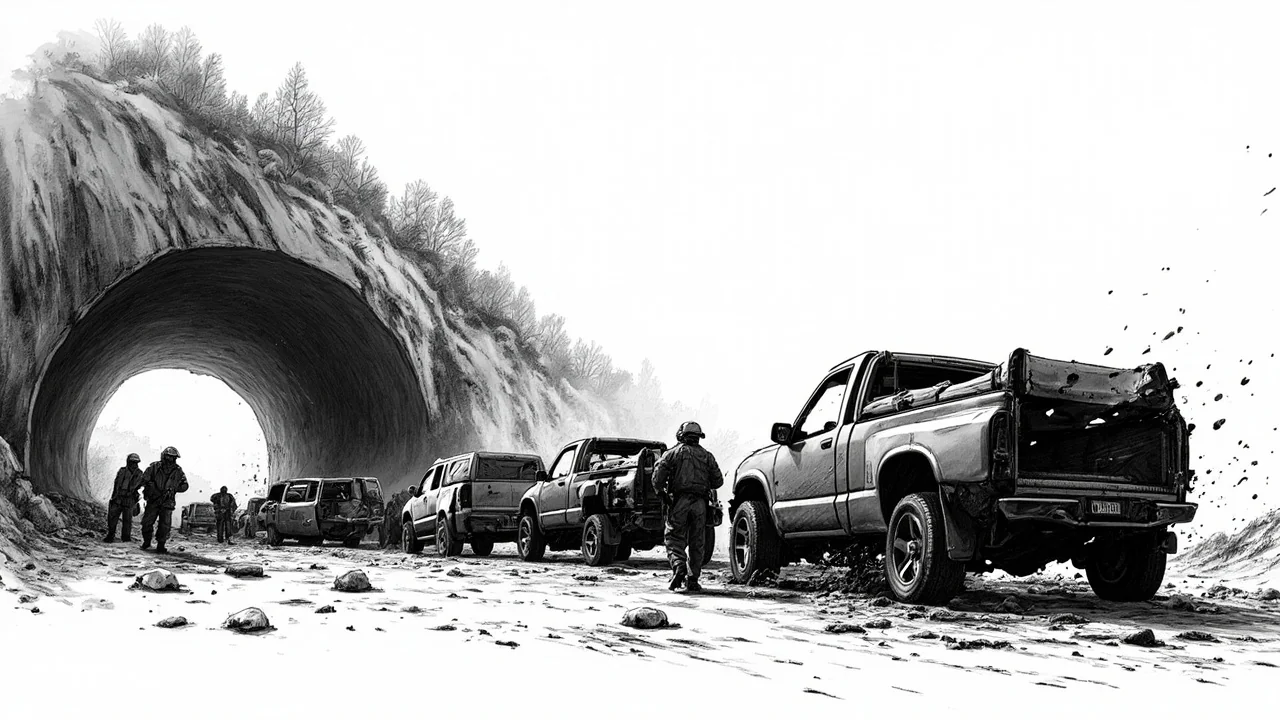
Norway's vital E18 motorway was completely shut down for hours on Tuesday after two separate accidents occurred within the same tunnel bore near Tønsberg. The Hem Tunnel, a critical artery for traffic between Oslo and the southern coast, became a bottleneck after a maintenance closure in one bore forced all traffic into a single tube, where a collision then brought everything to a standstill.
Emergency services rushed to the Hem Tunnel on the E18 at Tønsberg following reports of a traffic accident. The incident caused a total closure of the road in both directions, creating significant disruption along one of the country's busiest transport corridors. The closure highlighted the fragility of Norway's infrastructure when planned maintenance intersects with unforeseen incidents.
A Cascade of Disruptions
The situation was compounded by pre-existing conditions. One of the tunnel's two bores was already closed for scheduled maintenance, a common occurrence on Norway's aging road network. This forced all northbound and southbound traffic to be routed through the same, single tunnel bore—a procedure known as contraflow. It was within this congested, shared space that the initial accident occurred.
“In this tunnel bore, a traffic accident has happened in the same driving direction in the northbound lane,” Operations Manager Espen Reite of the Southeast Police District stated in the police log. “This means other traffic cannot pass now, and the E18 is completely closed.” The statement outlined a perfect storm of logistical failure. Health personnel were dispatched to attend to those involved in the collision, though the severity of injuries was not immediately disclosed.
The Fragility of Single-Point Infrastructure
This incident exposes a critical vulnerability in Norway's transport planning. The country's challenging geography, with its mountains and fjords, often makes roads like the E18 the only viable land route for vast regions. Tunnels like Hem become unavoidable chokepoints. When one bore is closed for essential maintenance—which is increasing in frequency as infrastructure ages—the entire system's resilience hinges on the remaining bore remaining incident-free.
“What we see here is a systemic risk,” says Lars Moe, a transport analyst based in Oslo. “Our dependency on these key tunnels is absolute. A single accident during a maintenance period doesn't just cause local delay; it severs a national corridor. The economic knock-on effects for freight, commerce, and daily commuters are immense.” The E18 is a primary route for goods moving from the Oslo port to the south and for tourists accessing the coastal areas of Vestfold.
The police worked to clear the scene. By 14:27, Operations Manager Reite informed the press that the vehicle had been recovered. “Traffic can now pass in north- and southbound directions, but some queuing must be expected as a consequence of the incident and the ongoing diversion in the one tunnel bore,” he wrote. The all-clear did not mean a return to normalcy; it signaled the beginning of a lengthy process of untangling the backlog of stranded vehicles.
A Recurring Challenge for Norwegian Mobility
This is not an isolated event. Similar incidents have occurred on other critical routes, such as the E16 through Lærdal and the E6 north of Oslo, where tunnel maintenance or accidents cause disproportionate national disruption. Each event renews debates about the need for parallel infrastructure, but the extraordinary costs of building duplicate tunnels or bridges in difficult terrain often stall such projects.
The Norwegian Public Roads Administration (Statens vegvesen) walks a tightrope. Postponing maintenance leads to long-term degradation and safety risks, but conducting it creates short-term vulnerability. The strategy often involves intensive work during lower-traffic periods, but on a road like the E18, there is truly no low-traffic time. The economic heartbeat of the region depends on its constant flow.
For drivers caught in Tuesday's gridlock, the experience was one of frustration and helplessness. Alternative routes around the Hem Tunnel are lengthy and involve navigating local roads ill-suited for heavy traffic or the diverted volume from a major motorway. The closure effectively cut off the most efficient link between key municipalities.
Policy Implications and Future Gridlock
The Tønsberg incident will likely prompt renewed scrutiny in the Storting. Questions for the Minister of Transport will focus on contingency planning and whether the current model of single-bore tunnel maintenance is sustainable. Are evacuation plans robust enough if an accident during contraflow leads to fire or serious injury? Is the economic cost of these recurring shutdowns being properly weighed against the benefits of different maintenance strategies?
Some experts advocate for a more aggressive investment in technology, such as AI-powered traffic management systems that can predict and mitigate congestion before it forms, or advanced monitoring to perform maintenance more surgically and rapidly. Others argue for a return to more fundamental solutions: investing in rail alternatives for freight or accelerating the development of ferry-free coastal highway routes to provide redundancy.
As Norway continues to develop its oil, gas, and renewable energy sectors, reliable transport for equipment and personnel is paramount. The E18 serves the important coastal industrial and maritime clusters. A shutdown doesn't just inconvenience commuters; it has a tangible impact on national economic output and project timelines.
The Human Cost of Congestion
Beyond the economics, there is a human toll. Ambulances and critical services can find themselves delayed. People miss flights from Torp Airport, important medical appointments, or family events. The stress of being trapped in indefinite gridlock, with no information or way out, is a significant public welfare issue often overlooked in infrastructure debates.
The Southeast Police District's handling of the incident, with regular updates via the police log and press statements, is part of a broader effort to improve crisis communication. In the digital age, providing accurate, timely information is a key tool in managing public frustration and ensuring safety.
Tuesday's double disruption on the E18 is a wake-up call. It underscores that Norway's celebrated engineering triumphs, its tunnels and bridges, are also its potential points of greatest failure. As the country looks ahead to a future of climate change and evolving transport needs, building resilience into these chokepoints may be as important as building the points themselves. The question for policymakers is whether the political will exists to fund that resilience, or if drivers will simply have to accept that, occasionally, the only road forward will be closed.