
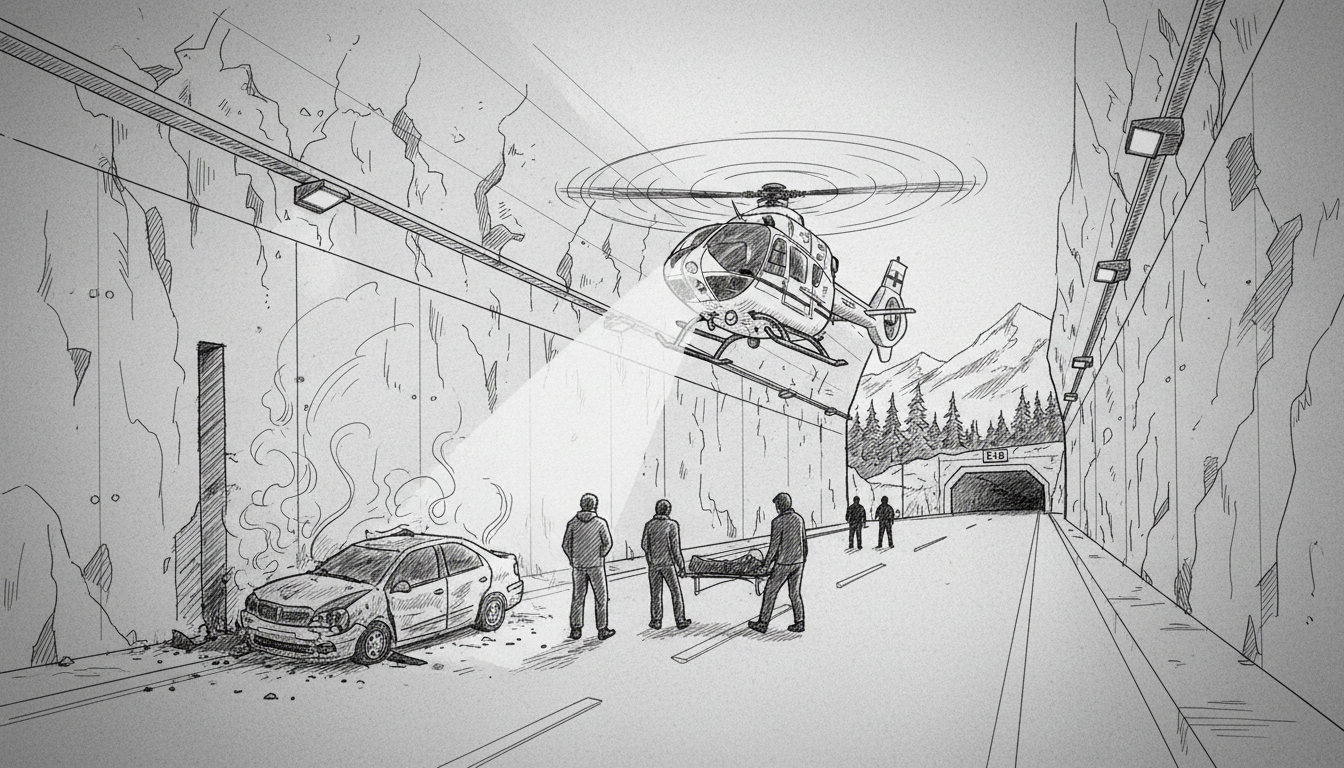
Norway's E18 highway was the scene of a serious traffic incident on Monday, requiring an air ambulance response. The single-vehicle accident occurred inside the Flårtunnelen near Tønsberg, halting all southbound traffic and prompting a major emergency mobilization. Police confirmed the crash involved only one car but the severity of the situation necessitated helicopter evacuation, highlighting the critical challenges of tunnel rescues on Norway's vital road network.
Emergency services, including police, ground ambulances, and the Luftambulanse air ambulance service, converged on the tunnel entrance. The immediate closure of the southbound lanes created a significant traffic bottleneck on a key artery connecting the populous Vestfold region to the capital, Oslo. While details on the condition of those involved remain limited, the deployment of an air ambulance typically indicates injuries requiring rapid transport to a specialized trauma center.
The Critical Minutes After a Tunnel Crash
Tunnel accidents trigger a distinct and urgent protocol for Norwegian emergency responders. "The confined environment of a tunnel changes everything," explains Lars Holm, a former chief of operations for the Norwegian Road Administration. "Visibility can be poor, there is a risk of secondary collisions, and access for large rescue vehicles is complicated. The priority is always rapid stabilization and extraction to open ground where proper medical care can be administered."
This incident in the Flårtunnelen, a 1.6-kilometer tunnel on the E18, exemplifies these challenges. The decision to call in the air ambulance, likely from its base at Rygge or another nearby location, suggests first responders on the scene assessed injuries as potentially time-critical. The helicopter allows for direct flight to a hospital like Oslo University Hospital, bypassing road traffic that would have been exacerbated by the accident-related closure.
A Recurring Strain on a Vital Artery
The E18 is not just any road; it is the main coastal highway linking Oslo to Kristiansand and the southern tip of Norway. The stretch through Vestfold, where Tønsberg is located, handles a dense mix of commuter, commercial, and tourist traffic. Any closure, especially one involving a tunnel where traffic cannot be diverted around the scene, causes immediate and widespread disruption.
Local commuters faced lengthy delays, with traffic backing up towards the towns of Holmestrand and Horten. Freight transport along the corridor was also interrupted, demonstrating the economic ripple effects of such incidents. Alternative routes through the region are limited, often consisting of smaller, two-lane roads ill-equipped to handle the volume of traffic displaced from a closed motorway.
The High Stakes of Norwegian Road Safety
Norway consistently ranks among the safest countries in the world for road travel, a fact attributed to strict enforcement, continuous infrastructure investment, and a strong cultural emphasis on safety. However, this incident underscores that serious accidents still occur, particularly on high-speed routes like the E18. Single-vehicle accidents, while less common than collisions, are often severe and can involve factors like speed, driver distraction, or mechanical failure.
Tunnel safety has been a particular focus since tragic fires in European tunnels decades ago. Norwegian tunnels are equipped with advanced safety systems including frequent emergency niches, fire suppression equipment, robust ventilation, and clear evacuation signage. The swift response in Tønsberg reflects the extensive training and coordination that exists between police, fire services, and medical responders for such scenarios.
Analyzing the Response and Infrastructure Demands
From a policy perspective, incidents like this feed into ongoing debates about Norway's transportation infrastructure. While the country invests heavily in public transit, the private vehicle remains dominant outside major cities, placing constant pressure on roads like the E18. Proposals for expanding highway capacity or building alternative routes often face environmental and budgetary hurdles.
The efficient emergency response also comes at a significant cost. Operating the Luftambulanse service, a non-profit foundation supported by government contracts and donations, requires millions of kroner annually. Each deployment represents a major expenditure, justified by the potential to save lives in situations where ground transport is too slow. This cost-benefit analysis is implicit in every decision to scramble a helicopter.
Looking Ahead: Investigation and Prevention
In the coming days, the South-Eastern Police District will conduct a technical investigation of the crash site. Officers will examine vehicle condition, skid marks, and tunnel infrastructure to determine the cause. This forensic work is crucial not only for any potential legal proceedings but for informing broader safety measures. Data from such investigations can lead to adjustments in speed limits, improved signage, or targeted road surface treatments in specific tunnels or on particular curves.
For the residents of Vestfold and the thousands who rely on the E18 daily, the incident is a stark reminder of the fragility of daily commutes. It reinforces the importance of basic safety practices: maintaining a safe speed, keeping a greater distance from other vehicles in tunnels, and remaining alert. As traffic eventually resumed and the helicopter became a distant sound, the questions remained about what happened in the Flårtunnelen and how a routine journey turned into an emergency. The true measure of Norway's transport system lies not just in preventing accidents, but in its capacity to respond when prevention fails.