
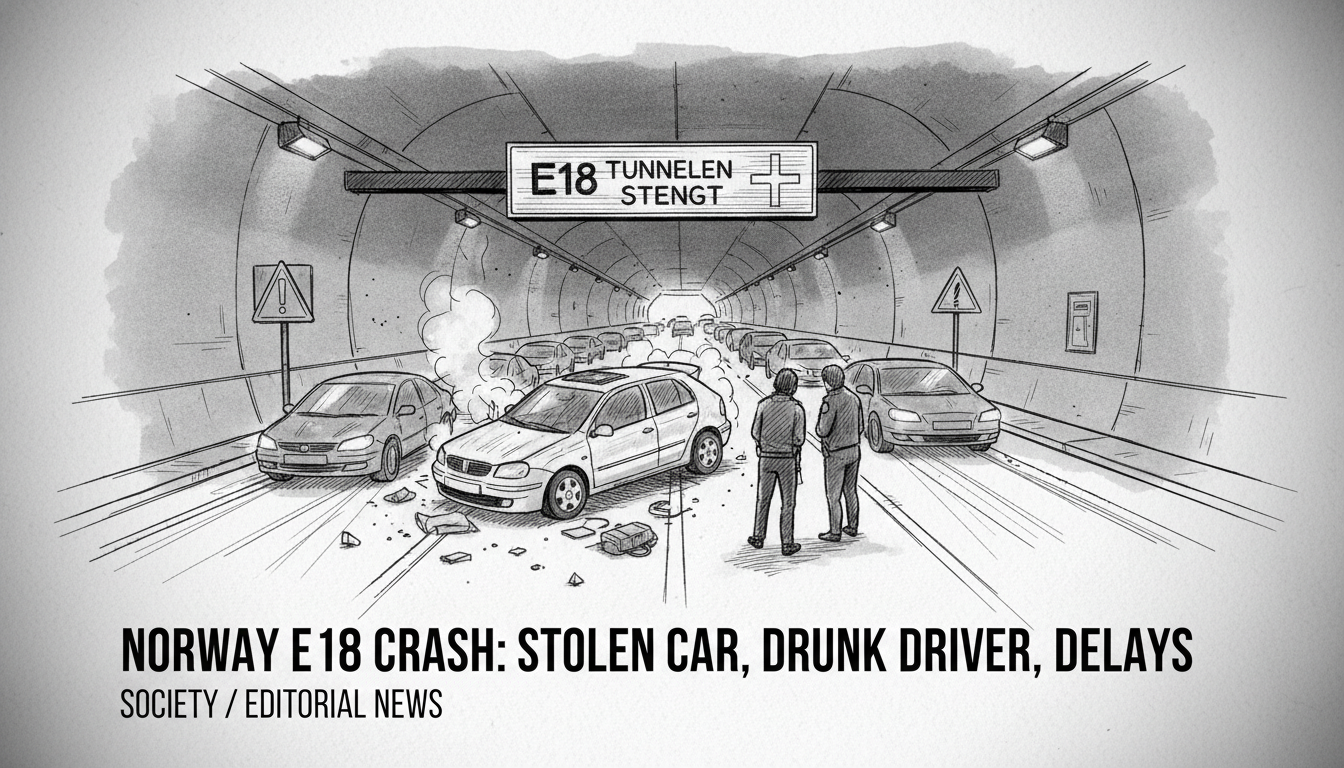
Norway's E18 highway faced severe disruption Friday evening after a high-speed crash involving a stolen car and a truck caused significant damage to a key tunnel. The incident, which police suspect involved a drunk driver in his twenties fleeing the scene on foot, forced the complete closure of the southbound lane for hours, creating long traffic queues during the evening rush.
A Chaotic Scene on a Critical Artery
The crash occurred inside a tunnel on the E18, a major European route that serves as a vital transport corridor connecting Oslo to southern coastal cities like Kristiansand. According to police, the driver of a stolen passenger car, after colliding with the tunnel wall, then struck a truck. The force of the impact caused damage to the tunnel's roof structure, raising immediate safety concerns. Jan Kristian Johnsrud, the operations leader for the Southeast Police District, confirmed the involvement of both vehicles.
Witnesses reported seeing a man flee the crash site on foot, but police quickly apprehended him nearby. The suspect, a man in his twenties, was transported to a hospital for examination but was not seriously injured. He now faces preliminary charges of drunk driving and auto theft, as investigators believe he stole the car shortly before the crash.
Safety First: The Complex Tunnel Closure
The decision to close the tunnel was not taken lightly. With debris and potential structural hazards, authorities prioritized public safety over traffic flow. Birger Andersen, the police incident commander on site, was direct about the implications. "This could take time," Andersen said. "The damage must be investigated before the tunnel can reopen. There is a danger of falling debris, so we are not taking any chances with traffic."
This closure created a logistical headache. The police worked to establish a contraflow system, diverting southbound traffic through the northbound tunnel tube. However, this reduced capacity to a single lane in each direction, guaranteeing delays. "Detours are being arranged via the northbound tube, but significant queues and waiting times must be expected. We can only apologize," Andersen stated, acknowledging the frustration of stranded motorists.
The Ripple Effect of a Single Reckless Act
This single incident underscores the vulnerability of Norway's transport infrastructure, particularly its reliance on tunnels. The E18 is not just a commuter route; it is a critical link for freight moving from ports to the capital region. Extended closures have a measurable economic impact, delaying goods and increasing costs for businesses.
Traffic safety experts point to this crash as a textbook example of compounded criminal negligence. "It's a cascade of illegal decisions," said a senior advisor from the Norwegian Public Roads Administration, who spoke on background. "First, the theft of the vehicle. Then, the choice to drive it while impaired. The result is not just a wrecked car, but a compromised piece of public infrastructure that costs society immensely in repairs and lost productivity."
Norway has strict laws and vigorous enforcement against drunk driving, with a low blood-alcohol limit of 0.02%. Penalties are severe, often involving immediate license suspension, heavy fines, and potential imprisonment. Adding auto theft to the charges significantly increases the potential sentence for the driver involved.
A National Challenge: Tunnel Safety and Security
The incident also brings tunnel safety back into focus. Norway, with its mountainous terrain, has over 1,000 road tunnels, including the world's longest. Regular maintenance and immediate response to structural damage are paramount. Engineers from the Norwegian Public Roads Administration (Statens vegvesen) were dispatched to assess the roof damage. Their inspection would determine whether temporary supports were needed or if concrete spalling had occurred, which would require cleaning and repair before reopening.
"Every tunnel incident is unique, but the protocol is consistent: ensure structural integrity before allowing the public back in," explained a structural engineer familiar with Norwegian tunnel standards. "The force from a vehicle striking the wall or ceiling can dislodge lining segments. Our job is to make absolutely certain there is no residual risk."
Furthermore, the theft aspect highlights a persistent issue. While Norway has relatively low car theft rates compared to some countries, incidents do occur, often linked to joyriding or other crimes. Police routinely advise drivers to never leave keys in unattended vehicles, especially during cold starts in winter, a common practice that thieves exploit.
Looking Ahead: Recovery and Accountability
As Friday night turned into Saturday, crews worked to clear the wreckage, conduct the structural assessment, and eventually reopen the tunnel. The financial cost will be tallied, including repair expenses, police and emergency service overtime, and the broader economic toll of the disruption.
For the accused driver, the legal process is just beginning. Beyond the initial charges, he will be liable for the substantial costs associated with the tunnel damage and cleanup—a sum that can reach into the millions of kroner. The case will likely be cited by road safety advocates and insurance companies alike as an extreme example of the consequences of impaired driving.
The E18 tunnel crash serves as a stark reminder. In an interconnected nation dependent on efficient, safe roadways, the reckless actions of one individual can paralyze a key transport artery, endanger others, and incur costs borne by the entire society. It reinforces the non-negotiable message from Norwegian authorities: driving under the influence is a serious crime with far-reaching consequences, never just a private risk.