
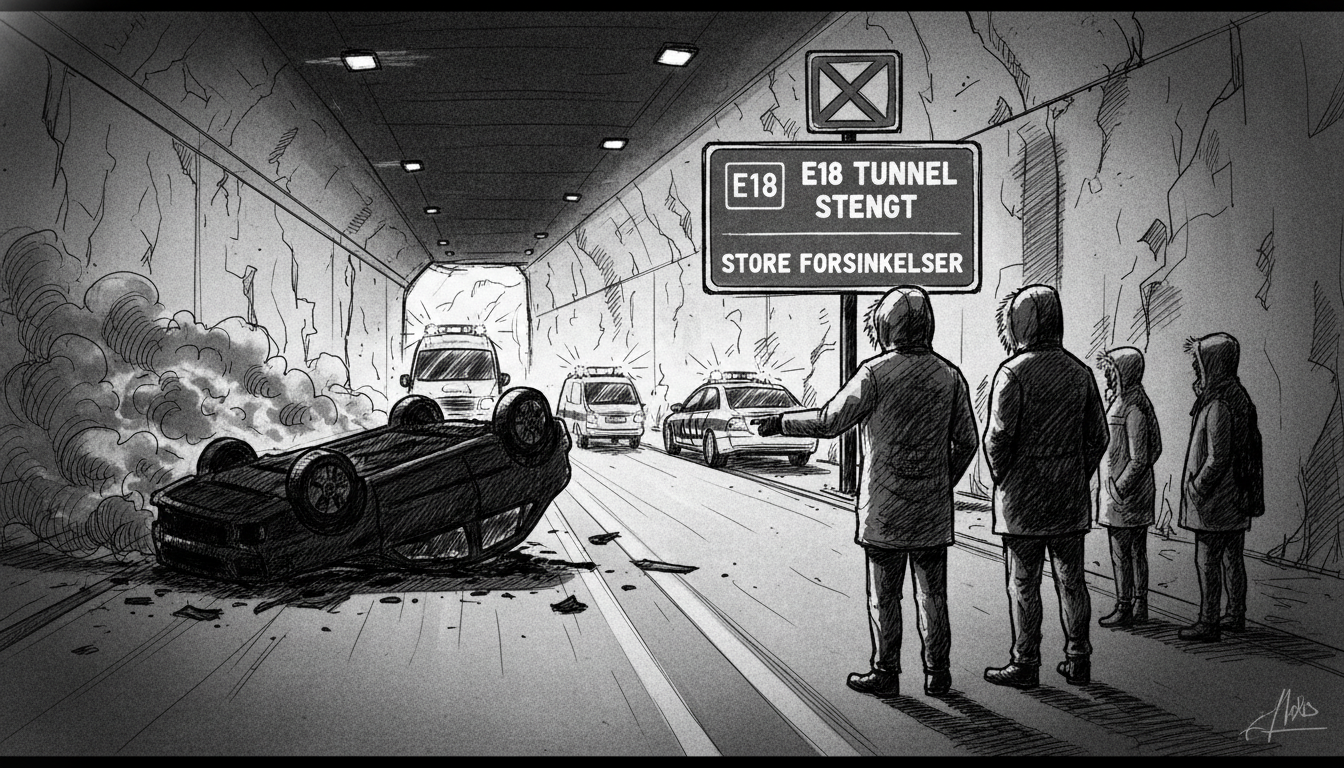
Norway's vital E18 highway faces a major disruption after a dramatic crash inside the Flårtunnelen near Horten. Police have confirmed the driver, who fled the scene on foot, was apprehended and the vehicle involved was stolen shortly before the collision. The incident has caused significant damage to the tunnel infrastructure, forcing a full closure and triggering major traffic delays across Vestfold county.
A stolen car, traveling southbound, first collided with the tunnel wall before striking a truck. The force of the impact caused damage to the tunnel's ceiling, raising immediate safety concerns for engineers. Authorities moved quickly to shut down the tunnel in both directions, a decision that will have a cascading effect on regional commerce and commuter traffic for an indefinite period. The driver was taken to hospital for assessment.
A Critical Artery Severed
The closure of the Flårtunnelen is not a minor local inconvenience. The E18 is a cornerstone of Norway's southern transportation network, part of the European route system that runs from Craigavon in Northern Ireland to Saint Petersburg in Russia. In Norway, it connects Oslo to the key coastal cities of the south, including Kristiansand. This stretch near Horten is a crucial link for freight moving to and from the port and for thousands of daily commuters.
"When a main tunnel on the E18 closes, the entire alternative road network in the region feels the strain immediately," explained a traffic management analyst familiar with the area. "The available detours, primarily county roads and smaller municipal routes, are not designed to handle the volume or the heavy goods vehicles that rely on the E18. We can expect significant delays, especially during peak hours." The economic impact, while difficult to quantify instantly, will accrue from delayed shipments, increased fuel consumption for idling vehicles, and lost productivity.
The Sequence of a Chaotic Incident
Police have begun piecing together a chaotic sequence of events. According to their initial investigation, the car was reported stolen in the local area not long before the crash occurred inside the tunnel. The driver lost control, hitting the wall of the Flårtunnelen before careening into the path of a truck. The nature of the collision with the heavy goods vehicle and the tunnel structure itself resulted in the ceiling damage.
This damage is the primary reason for the extended closure. Tunnel safety protocols in Norway are stringent. Engineers from the Norwegian Public Roads Administration (Statens vegvesen) must conduct a thorough structural assessment before any reopening can be considered. They will need to inspect lighting, ventilation systems, and the integrity of the rock and lining. Any loose material or compromised structures must be secured, a process that cannot be rushed.
"Safety is the absolute priority," a police spokesperson said in a statement. "We have one individual in custody in connection with the incident, and the investigation into the theft and the circumstances of the crash is ongoing. Our first tasks were securing the scene and ensuring public safety by closing the tunnel."
Ripple Effects on Land and Sea
The disruption extends beyond the asphalt. Horten is a municipality on the western shore of the Oslofjord, and the E18 closure severs the most efficient land route for ferry traffic connecting to Moss on the eastern side. Travelers and transport using the Bastø-Fosen ferry service, one of Norway's busiest, now face congested alternative land routes on either side of the fjord. This creates a compound delay, effectively bottlenecking a major cross-fjord transport corridor.
Local businesses that depend on just-in-time deliveries or customer access are bracing for a difficult period. The incident also highlights the vulnerability of concentrated infrastructure. A single point of failure—a tunnel—can paralyze a region's mobility. It reinforces ongoing debates about infrastructure resilience and the need for robust alternative routes, though such projects involve enormous cost and environmental considerations in Norway's challenging terrain.
A Broader Look at Road Safety and Crime
While the investigation is in its early stages, the incident sits at a troubling intersection of traffic safety and crime. The use of a stolen vehicle in such a serious crash introduces a different dimension of risk to public safety. It raises immediate questions about vehicle security and the potential for stolen cars to be used in reckless criminal activity that endangers the public.
Road safety experts often focus on driver behavior, vehicle standards, and road engineering. This event forces a consideration of how property crime can directly escalate into a major safety hazard. "Preventing vehicle theft isn't just about property loss; it's a critical component of public safety on our roads," noted a security consultant. "A stolen vehicle is often driven with extreme disregard for traffic laws, dramatically increasing the risk of a catastrophic outcome, as we may have seen here."
Norway generally has low rates of car theft compared to many countries, but this incident is a stark reminder of the severe consequences when it does occur. It will likely prompt local police to reiterate advice on vehicle security and may influence broader discussions on penalties for those who steal cars and cause public danger.
The Long Road to Reopening
For now, the focus is on the painstaking assessment and repair work. The Norwegian Public Roads Administration has not provided a timeline for reopening, stating only that the Flårtunnelen will be closed "for a period." In similar past incidents, tunnel closures have lasted from several days to weeks, depending on the extent of structural damage. Commuters and transport companies are advised to plan for a prolonged disruption, seek real-time traffic information, and allow for substantial extra travel time.
The economic and logistical toll will mount with each passing day. This single event in a tunnel under the Vestfold landscape demonstrates how fragile our interconnected mobility systems can be. It serves as an unplanned stress test for the region's infrastructure and a sobering lesson in how quickly routine travel can be upended by a single act of recklessness. The full cost, both in kroner and in public inconvenience, is yet to be tallied.