
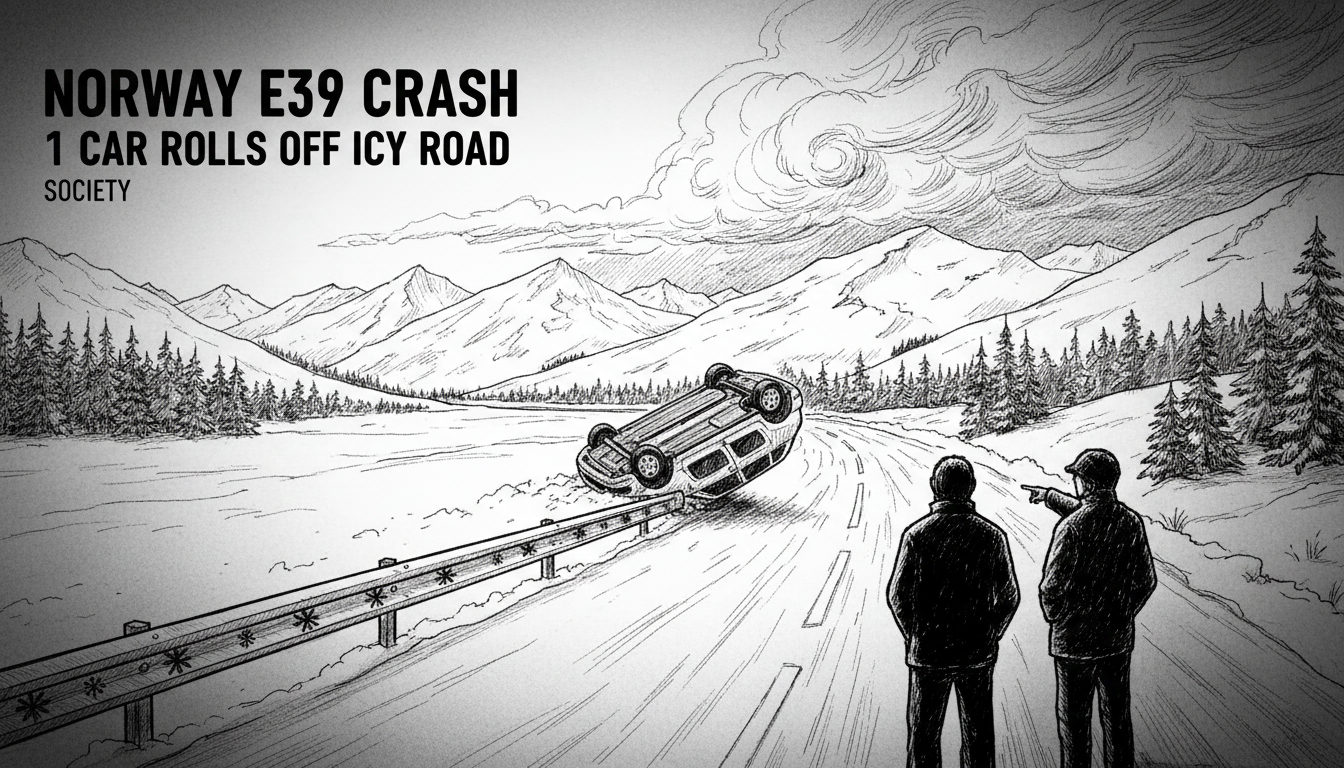
Norway's treacherous E39 highway claimed another vehicle Thursday afternoon when a single car slid off the road near Langelandsvatnet in Sunnfjord. The incident, reported to police at 3:45 PM, initially suggested multiple vehicles were involved, but authorities quickly clarified only one car had lost control on what responders described as "extremely slippery" conditions. The vehicle reportedly rolled over before coming to rest on its wheels off the roadway, with no immediate reports of personal injury. Emergency services, including fire crews and a contractor, were dispatched to the scene, where reduced mobility was reported.
A Recurring Hazard on a Vital Artery
The E39 is not just any road; it is the skeletal backbone of Western Norway's coastal transport network. Stretching from the southern city of Kristiansand to the northern town of Trondheim, this European route connects critical ports, ferry terminals, and population centers. The section near Langelandsvatnet in Sunnfjord municipality is emblematic of the route's challenges—winding, exposed to coastal weather systems, and prone to rapid ice formation. This single-vehicle incident, while minor in outcome, underscores a persistent, seasonal battle for Norway's road authorities. Every winter, the combination of freezing temperatures, precipitation, and high traffic volumes transforms stretches of the E39 into potential accident zones. Police operations leader Eirik Loftesnes confirmed the immediate cause, stating the location was "extremely slippery" and that all occupants were confirmed out of the car.
The Human Factor in Winter Driving
While the physical road conditions are a primary culprit, road safety experts consistently point to driver behavior as a critical variable. "The technology in modern cars and winter tires is excellent, but it cannot override the laws of physics," explains Lars Tennøy, a senior researcher at the Institute of Transport Economics (TØI) in Oslo. "On a road like the E39, where conditions can change from wet asphalt to sheer ice within a few hundred meters, adjusted speed and heightened awareness are the most effective safety features a driver has." The Norwegian Public Roads Administration (Statens vegvesen) runs annual winter driving campaigns, emphasizing the mandatory use of winter tires with adequate tread depth from November to Easter, depending on the region. Yet, as this Sunnfjord incident shows, compliance with equipment rules is only the first step. The fire department's on-scene commander, Børre Brekkvassmo, echoed the caution, advising simply, "Everyone should be out of the car," a standard safety protocol to prevent further risk if the vehicle were struck.
Statistical Ice: The Numbers Behind Slippery Roads
Accidents like this one feed into a sobering annual statistic. According to data from Statistics Norway (SSB), slippery road conditions are a contributing factor in approximately 20-30% of all personal injury traffic accidents during the winter months in Norway. While fatal accidents have decreased over the long term due to improved vehicle safety and infrastructure, non-fatal incidents involving skidding and loss of control remain frequent. The economic cost is substantial, encompassing emergency response, medical care, vehicle repair, and lost productivity. For major routes like the E39, even a minor, injury-free accident can cause significant disruption, triggering traffic delays and requiring the deployment of scarce emergency and maintenance resources in remote areas. This particular event, fortunately, did not escalate into a multi-vehicle pile-up—a common secondary risk on icy highways where one loss of control can create an obstacle for following traffic.
Infrastructure and Maintenance: A Constant Winter Battle
The response to Thursday's incident highlights the integrated system Norway has developed for winter road management. The police, fire department, and a private contractor were all notified simultaneously. This coordination is crucial. The contractor's role is to potentially sand or salt the road surface, assist with vehicle recovery, and ensure the roadway is safe for reopening. The Norwegian Public Roads Administration employs a fleet of plows and salting trucks, using detailed weather forecasts to pre-treat roads ahead of expected ice. However, the system is not infallible. Coastal areas like Sunnfjord present a specific challenge: temperatures hovering around zero degrees Celsius can cause rain or wet snow to freeze instantly upon contact with the cold road surface, creating "black ice" that is nearly invisible to drivers. This phenomenon often outpaces treatment schedules, creating sudden, localized hazards.
A Narrow Escape and a Universal Warning
The driver and passengers involved in the Sunnfjord incident experienced a frightening moment but emerged physically unscathed. Their vehicle, though likely damaged, came to rest upright. This outcome represents the best-case scenario for a winter skid. It serves as a potent, real-world reminder as the Nordic region transitions deeper into the spring threshold period, where freeze-thaw cycles are common. The incident required a multi-agency response, diverted resources, and temporarily affected travel on a key highway—all for a single car. It encapsulates the disproportionate impact of winter weather on mobility and safety in Norway. As the car was towed and the road treated, traffic on the E39 resumed its flow, but the underlying conditions remained. The lesson from Langelandsvatnet is not about a major disaster, but about the routine, ever-present risk that defines Norwegian winter travel. It asks every driver a simple question: is your speed appropriate for the conditions you cannot see?