
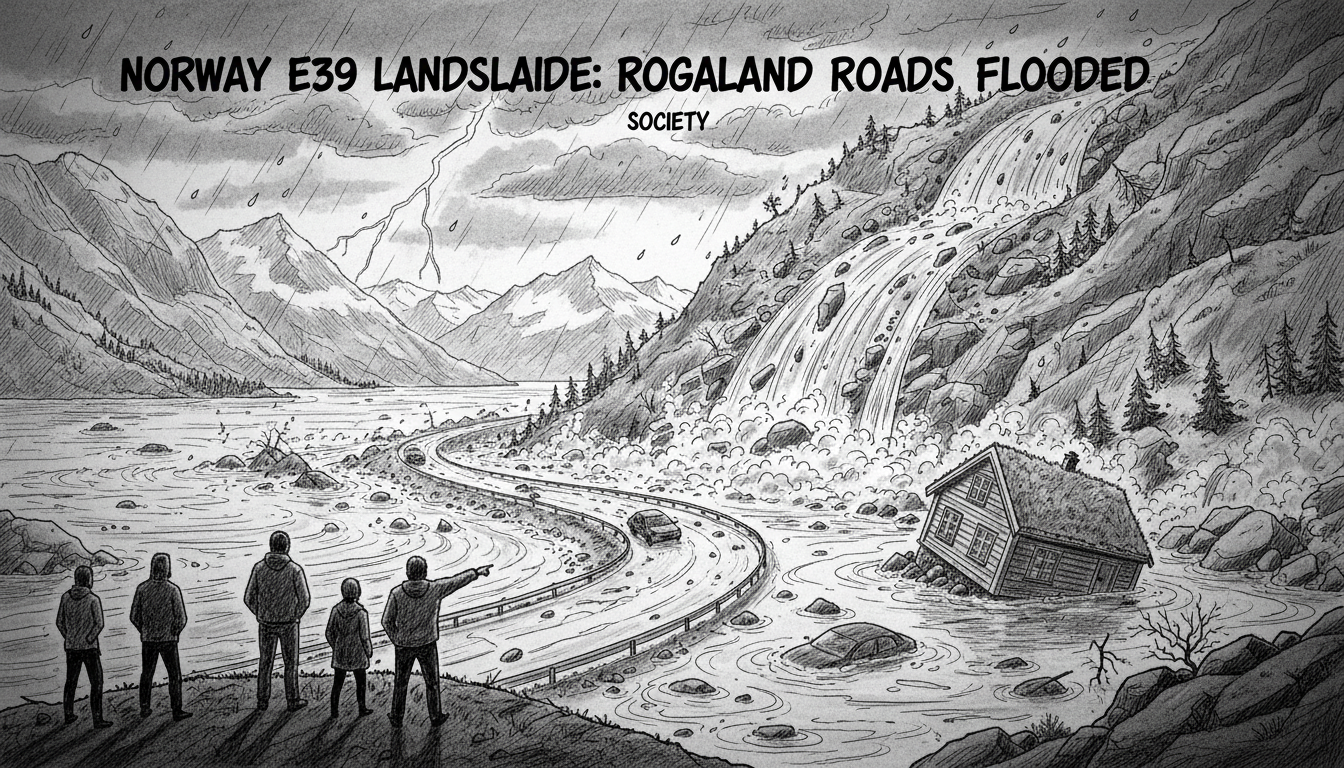
Norway's crucial E39 highway was partially blocked by a landslide near Uadalsvatnet in Bjerkreim municipality early Thursday. The Norwegian Public Roads Administration reported the small landslide, measuring approximately three to four meters, moved slightly into the roadway. Simultaneously, flooding forced road closures in the neighboring municipalities of Eigersund, Sokndal, Time, and Strand across Rogaland county. The incidents highlight the persistent vulnerability of Norway's coastal infrastructure to extreme weather, with yellow and orange flood warnings remaining in effect while the landslide warning was expected to subside later in the day.
Trafikkoperatør Jørgen Bødtker confirmed the event, stating the slide had encroached on the road. The E39, a vital artery running from Kristiansand in the south to Trondheim in the north, is no stranger to disruptions. Its route along Norway's rugged western coast makes it susceptible to landslides, avalanches, and flooding, particularly during periods of intense rain and rapid snowmelt. This latest event, though described as minor, caused immediate traffic complications and underscored the ongoing challenges of maintaining reliable transport links in the region.
A Highway Under Pressure
The E39 is more than just a road; it is a economic lifeline for western Norway. It connects major cities, industrial hubs, and ferry ports essential for both domestic travel and international freight. The highway's notorious reliance on ferry crossings—part of the government's ambitious Coastal Highway Route E39 project aims to replace them with bridges and tunnels—already creates bottlenecks. Adding geological and meteorological hazards like landslides and floods compounds these reliability issues. Each closure disrupts supply chains, commutes, and tourism, with ripple effects across the regional economy.
This specific landslide occurred in a region of Rogaland known for its dynamic terrain. The area around Uadalsvatnet, a lake in Bjerkreim, features slopes and soil compositions that can become unstable after heavy saturation. The concurrent flooding reports from nearby coastal municipalities point to a widespread weather system affecting the entire county. Such compound events—where multiple hazards occur simultaneously—are becoming a greater focus for Norway's emergency and infrastructure planners.
Climate Change and the Creeping Threat
While a single, small landslide cannot be directly attributed to climate change, experts consistently warn that a warming climate amplifies the risks. "We are observing an increase in the frequency and intensity of extreme precipitation events in Norway," explains Dr. Kari Sivertsen, a geohazards researcher at the Norwegian Geotechnical Institute (NGI). "This leads to more frequent saturation of slopes and a higher probability of both landslides and flash flooding. What we might have considered a 50-year event is becoming a 20-year event."
This scientific perspective frames the Bjerkreim incident not as an isolated anomaly but as part of a troubling trend. Warmer temperatures lead to more rain instead of snow at lower elevations, and they accelerate spring snowmelt. Both processes pump more water into the ground in shorter periods, overwhelming natural drainage and reducing soil stability. For highway engineers, this means historical data on landslide risks may no longer be sufficient for future-proofing infrastructure.
The Norwegian Public Roads Administration (Statens vegvesen) invests heavily in monitoring and mitigation. This includes slope stabilization projects, improved drainage systems, and advanced monitoring technologies like ground radar and inclinometers to detect early movement. However, the vast length of roads like the E39, traversing complex geography, makes comprehensive protection financially and technically daunting.
The Immediate Response and Regional Impact
The response to Thursday's events followed established protocols. Crews were dispatched to assess the landslide on the E39 and begin clearance work. In the flooded municipalities, roads were closed as a preventative safety measure to protect motorists from water damage and potential washouts. The priority is always human safety, followed by the restoration of transport links.
For local residents and businesses, these closures are a significant inconvenience. Alternative routes in Rogaland's fractured landscape are often long, winding, and less suitable for heavy goods vehicles. A closure on the E39 can force detours of dozens of kilometers, increasing travel time and fuel costs. Local ferry services, often used as part of the E39 route, can also experience cascading delays when connecting road links are severed.
The economic impact, while localized, is real. Delays in the delivery of goods affect shops and industry. Tourism, a key sector along the scenic coast, suffers when accessibility is compromised. Furthermore, repeated disruptions can influence long-term investment decisions, with companies favoring locations with more resilient transport networks.
Investing in Resilience: A National Imperative
The incidents in Rogaland feed directly into a larger national debate about infrastructure spending and climate adaptation. Norway's parliament, the Storting, has repeatedly allocated funds for road safety and landslide prevention, but experts argue the scale of investment must match the escalating threat. The multi-billion kroner Coastal Highway project, which aims to create a ferry-free E39, is itself a massive climate adaptation measure, designed to create a more reliable and weather-independent connection.
"Infrastructure is the backbone of our society," says Transport Committee representative Marit Arnstad. "The Storting recognizes that we must build not just for today's climate, but for tomorrow's. This means higher specifications for drainage, more robust slope engineering, and smarter monitoring systems. It is a continuous investment in safety and economic stability."
This philosophy extends beyond new construction to the maintenance of existing networks. Retrofitting thousands of kilometers of older roads against new climate norms is a colossal task. It requires prioritizing the most vulnerable segments, like the stretch near Uadalsvatnet, based on updated risk models that incorporate future precipitation projections.
Looking Ahead: A Future of Managed Risk
The landslide on the E39 and the flooding across Rogaland serve as a stark reminder. Norway's breathtaking geography, which defines its national identity and drives its economy, also presents constant natural hazards. As the climate changes, the management of these hazards becomes more complex and urgent.
The road ahead involves a combination of continued investment in physical infrastructure, refinement of early warning systems, and public awareness. Drivers in regions like Rogaland must become accustomed to checking weather and road status updates more frequently, especially during seasonal transitions and extreme weather warnings.
For the Norwegian Public Roads Administration, the work is never done. Clearing the debris from the Bjerkreim landslide is a short-term fix. The long-term challenge is systematically reinforcing the highway against the next storm, and the one after that. The question for Norway is not if another landslide will block the E39, but how the nation's world-class engineering and preparedness can minimize the frequency and impact of such events in an uncertain climatic future. The resilience of Norway's coastal communities quite literally depends on the road ahead.