
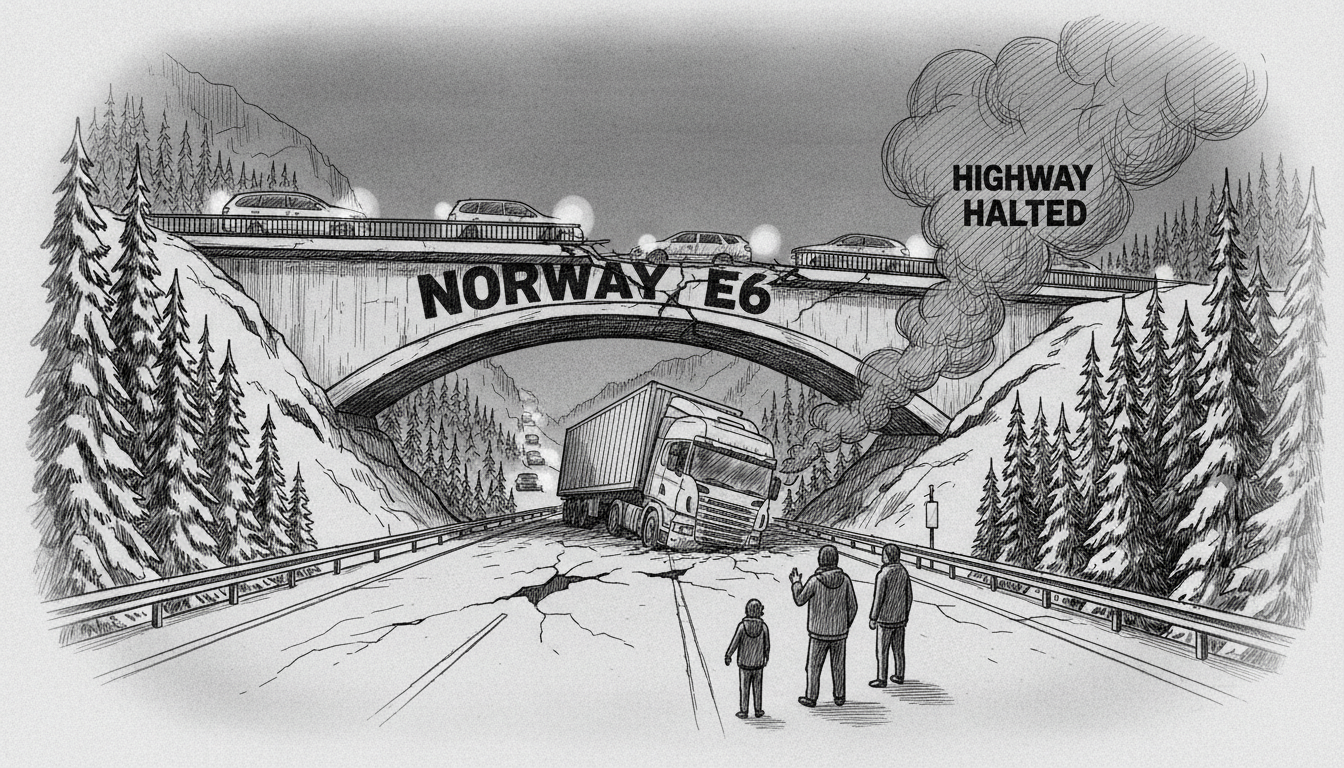
Norway's vital E6 highway faced major disruption Friday night after a container truck struck a pedestrian bridge near Trondheim. The incident at Sandmoen occurred at 8:17 PM, sending traffic into chaos on one of the country's most important north-south transport corridors. Police confirmed no injuries, but one container partially fell from the truck's trailer, leaning precariously against the bridge structure. Northbound traffic was completely halted as emergency crews and contractors rushed to the scene.
"It's fantastic that this is even possible. The traffic situation is complete chaos, but of course: accidents happen," said freelance photographer Bertil Lernæs, who witnessed the aftermath. "I haven't seen anything like this anywhere except on YouTube." Operations manager Wenche Johnsen said contractors were on site with detours established, but could not estimate how long the clearance operation would take. The visual of the massive container resting against the pedestrian overpass underscored the force of the impact and the vulnerability of infrastructure to such incidents.
A Critical Artery Paralyzed
The E6 highway functions as Norway's backbone, connecting the southern region around Oslo to the northern counties. The section through Trondheim, Norway's third-largest city and a central hub for education and technology, is particularly crucial for both commercial transport and daily commuters. Any closure creates immediate ripple effects across central Norway. Alternative routes for heavy goods vehicles are limited, meaning essential deliveries face significant delays.
This incident highlights a persistent challenge in Norwegian logistics: the transport of standardized international shipping containers on roads not always designed for their dimensions. While height restrictions are clearly marked, miscalculations or equipment failures can lead to catastrophic bridge strikes. The Sandmoen pedestrian bridge, like many similar structures, was built to specific clearance standards that modern freight transport constantly tests.
The Recurring Problem of Bridge Strikes
Friday's accident is not an isolated event in Norway or internationally. Bridge strikes by over-height vehicles occur with troubling regularity, causing millions in damage, severe traffic disruption, and occasional injuries. Each incident prompts investigations into whether the cause was driver error, inadequate route planning, faulty trailer equipment, or a combination of factors.
Transport safety experts consistently emphasize the non-negotiable importance of proper load securing and strict adherence to height restrictions. "For container transport, knowing the exact combined height of the truck and its load is fundamental," said a transportation analyst familiar with Nordic freight corridors. "These bridges are engineered to withstand weather and wear, but a direct impact from several tons of metal at speed is a different kind of stress altogether." The structural integrity of the Sandmoen bridge will now require a thorough assessment by engineers before it can be fully cleared for public use.
Economic and Commuter Impact
The economic cost of such closures is substantial. The E6 carries a large portion of goods moving between southern and northern Norway. Perishable goods, manufacturing components, and retail products all face delays. For the hundreds of daily commuters who rely on this stretch of highway, the closure meant lengthy detours through local roads ill-suited for the diverted volume, extending travel times by an hour or more during a Friday evening rush.
Local police and the Norwegian Public Roads Administration (Statens vegvesen) have well-rehearsed protocols for such events, focusing first on safety, then on establishing workable detours, and finally on clearing the obstruction and assessing damage. The complexity increases when a damaged container, potentially loaded with goods, is involved. Specialized equipment and careful procedures are needed to remove it without causing further damage to the bridge or creating a hazard on the road below.
Infrastructure Under Pressure
This event feeds into a broader national conversation about Norway's aging infrastructure and its capacity to handle increasing freight volumes. As international trade continues to rely on containerization, Norwegian roads and bridges face constant pressure. Major investment projects aim to upgrade key highways, but thousands of older structures remain. The Sandmoen bridge strike serves as a physical reminder of the margin for error in a system where centimeters can separate safe passage from a major incident.
Questions will inevitably be asked about whether additional preventative measures are needed. These could include more prominent advanced warning signs, improved driver education for freight companies, or even the installation of passive detection systems that alert drivers before they impact a low bridge. In other countries, so-called "crash beams" are installed in front of vulnerable bridges to absorb impact from over-height vehicles at a lower cost than bridge repair.
Looking Ahead: Safety and Scrutiny
The immediate priority for authorities in Trondheim is restoring normal traffic flow on the E6. Once the scene is cleared, the investigative phase begins. Police will likely examine the truck's documentation, the driver's route plan, and the condition of the vehicle's securing mechanisms. The trucking company involved will face scrutiny regarding its safety protocols and training procedures.
For Norwegian transport authorities, each such incident provides data to refine safety campaigns. The goal is always to prevent recurrence, but in a country with challenging geography and a deep dependence on road freight, the balance between efficient transport and absolute safety is complex. The image of a container leaning against a pedestrian bridge will likely be used in future safety briefings as a potent example of what can go wrong.
As Norway continues to develop its economy, the reliable movement of goods is paramount. Yet, this development must not come at the cost of public safety or the integrity of critical infrastructure. The Sandmoen incident, while thankfully not causing physical injury, is a wake-up call. It underscores that the nation's economic lifelines are physically fragile and that constant vigilance from drivers, companies, and regulators is the only true defense against chaos on the E6. Will this event lead to tangible changes in how container height is managed on Norwegian roads, or will it become just another statistic in an ongoing challenge?