
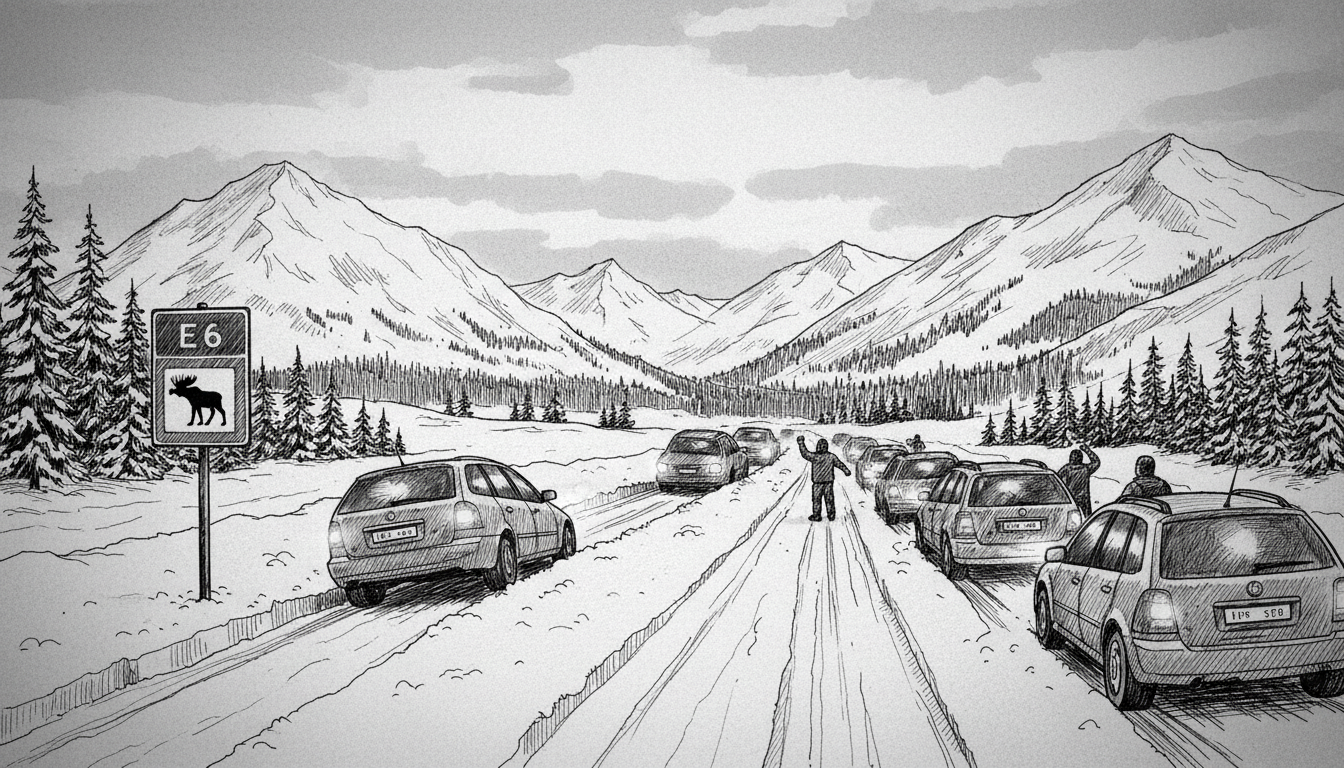
Norway's E6 highway saw multiple drivers reversing against traffic flow near Brumunddal on Tuesday afternoon. The dangerous incident followed a separate traffic accident that closed the southbound lanes near Hamar. Police in the Innlandet district confirmed they are identifying vehicles and will press charges, with license revocation a likely consequence for offenders. No injuries were reported in the initial crash, but the subsequent illegal maneuvers have sparked a major road safety debate.
A Critical Artery Blocked
The E6 is Norway's primary north-south corridor, stretching over 2,600 kilometers from the Swedish border near Oslo to Kirkenes in the far north. It is a lifeline for freight, tourism, and daily commutes. Any closure, especially in the populous south, causes immediate and severe disruption. The accident near Hamar, a key city in the Innlandet region, created a bottleneck that tested driver patience and judgment on Tuesday. While the closure was brief, the reaction from a segment of motorists was extreme and illegal.
Police logs from the Innlandet district were unequivocal in their condemnation. "We are noting registration numbers and will report drivers continuously," the statement read. "Driver's license confiscation is one of the consequences they risk." This strong language from authorities highlights the seriousness with which they view the offense. Reversing on a motorway is not a minor traffic infraction in Norway; it is an act that courts treat as reckless endangerment.
The Psychology of Gridlock and Poor Judgment
Traffic psychologists point to a phenomenon known as "time pressure aggression" in such situations. When a planned journey is abruptly halted, some drivers experience a disproportionate stress response. The rational understanding of safety is overridden by a desperate urge to regain progress. "On a high-speed road like the E6, the decision to reverse is catastrophically dangerous," said Dr. Anja Larsen, a transport safety researcher at the Institute of Transport Economics. "It introduces an unpredictable, slow-moving object into a stream of traffic moving at 80-100 km/h. The closing speed in a head-on collision would be devastating."
Larsen explained that drivers often underestimate this risk in the moment. They may look in their mirror and see an empty stretch of road behind them, failing to account for a vehicle cresting a hill or changing lanes at high speed. The field of vision from a rearview mirror is limited, and judging the speed of an approaching vehicle is difficult. Furthermore, such an action signals to other stranded drivers that this is an acceptable solution, potentially triggering copycat behavior.
Legal Repercussions and Enforcement Challenges
The legal framework in Norway is clear. The Road Traffic Act prohibits driving against the direction of traffic. Violations can lead to severe penalties, including heavy fines, license suspension, and even imprisonment for causing serious accidents. Police have the authority to confiscate a driver's license on the spot for gross violations. The Innlandet police's promise of "continuous" reporting suggests they are pursuing a zero-tolerance approach to this specific incident, likely using traffic camera footage and witness reports to identify every vehicle involved.
Enforcement in these scenarios, however, is challenging. Police resources are often directed to the original accident scene, managing traffic diversions and assisting any injured parties. This can create a perceived window of opportunity for impatient drivers. The incident underscores the importance of rapid, clear communication during highway closures. While Norwegian authorities are proficient at using variable message signs and radio alerts, the message does not always reach every driver, or is ignored by those who believe they can find a way around the stoppage.
A Broader Look at Norwegian Road Safety
This event presents a paradox. Norway is a global leader in road safety, with one of the lowest rates of traffic fatalities in the world. This is achieved through strict laws, extensive public education, and significant investment in safe road infrastructure. The E6 itself has seen continuous upgrades, with new stretches built to modern safety standards. Yet, this incident reveals that engineering and laws can only go so far. The final component is driver behavior, which can break down under pressure.
The contrast is stark. Norwegian drivers are generally law-abiding and cautious, particularly regarding seatbelt use, speeding, and drunk driving. The societal consensus on these issues is strong. However, the act of reversing on a motorway represents a different kind of violation—one born of impatience and a gross miscalculation of risk versus reward. It is an individualistic action that directly contradicts the collectivist safety culture Norway has successfully built.
Infrastructure and Crisis Response
Could better infrastructure prevent such behavior? Traffic experts suggest that more robust diversion plans at key junctions could help. When a main road closes, having pre-designated, signed alternative routes that are quickly activated can channel traffic away more effectively. The area near Brumunddal and Hamar is served by national and county roads, but these can quickly become congested themselves.
Another solution lies in technology. Real-time traffic apps like Vegvesen's official service provide updates, but not all drivers use them. Some experts have floated the idea of geofenced alerts that send push notifications to smartphones in a specific area, warning of a closure and explicitly stating the legal and dangerous consequences of illegal maneuvers. The goal is to create multiple layers of deterrence: physical barriers where possible, legal threats, and immediate informational feedback.
The Human Cost of a Few Minutes Saved
While no one was hurt in this particular event, the potential consequences of reversing on a highway are horrific. Head-on collisions at highway speeds are among the deadliest types of road accidents. They often involve multiple vehicles, as other drivers swerve to avoid the wrong-way vehicle, creating secondary crashes. The societal cost—in emergency response, medical care, long-term disability, and loss of life—is immense.
This is why the police response is so forceful. It is a preemptive strike against a behavior that has a high probability of causing tragedy. By making an example of the drivers from Tuesday's incident, authorities hope to reinforce the social norm and deter others in future traffic crises. The message is that saving ten minutes is never worth risking a lifetime of consequences, either for yourself or for innocent road users.
A Test of Patience on Norway's Main Street
The E6 is more than asphalt; it is a symbol of Norwegian connectivity and geography. Driving its length is a rite of passage for many. Its reliability is assumed. When it fails, even temporarily, it creates a ripple of frustration. This incident serves as a stark reminder that the system's safety relies on a shared social contract. Everyone must wait their turn, follow the rules, and trust that the authorities are working to reopen the road as fast as safely possible.
The drivers who reversed on Tuesday broke that contract. They prioritized personal convenience over collective security. As the Innlandet police process their registrations and the courts likely impose sanctions, the broader question remains: in an era of instant gratification, how do we reinforce the simple, critical virtue of patience behind the wheel? The answer will determine whether scenes like this remain a rare aberration or become a more frequent feature of Norway's traffic crises. For now, the authorities are sending a clear signal: on the E6, there is no reverse gear for the law.