
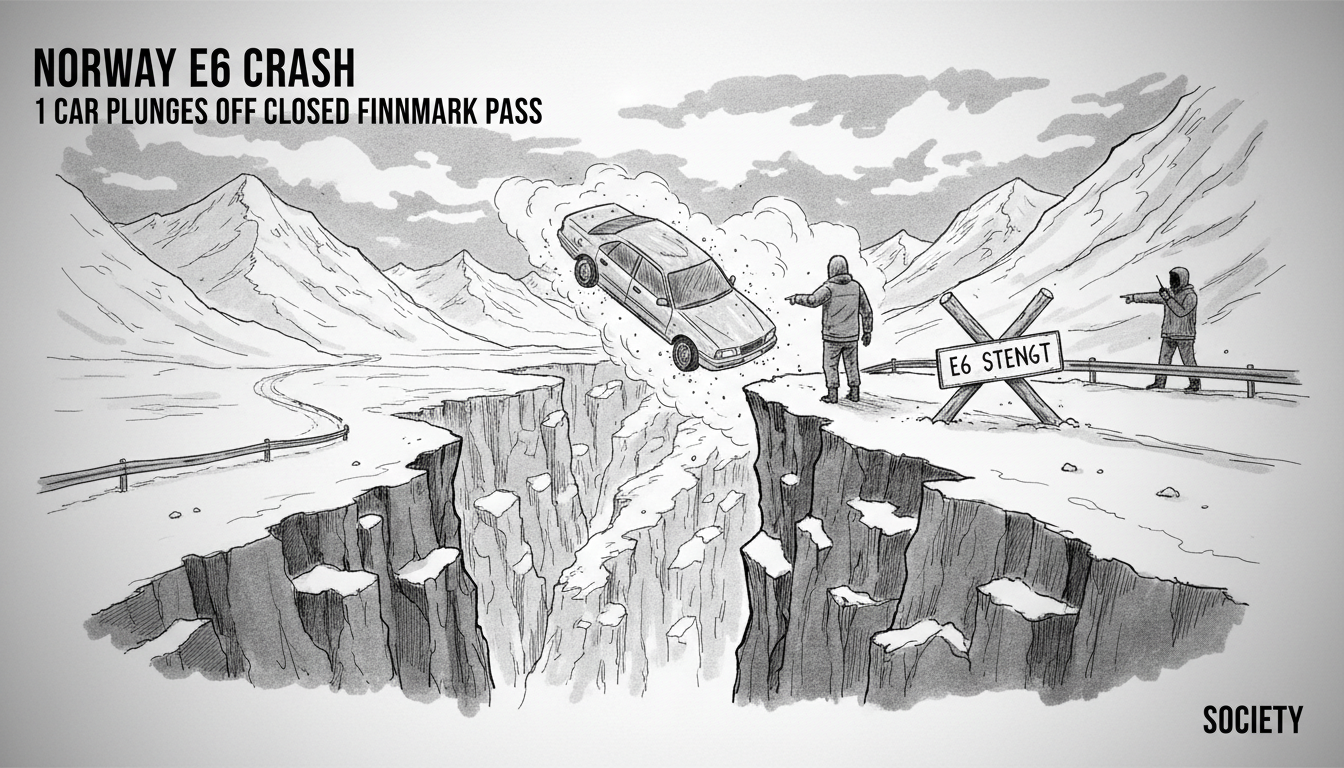
Norway's E6 highway, a vital 3,000-kilometer artery, became the scene of a dramatic rescue operation early Thursday after a car drove off the road and down a steep slope on the Sennalandet mountain plateau in Finnmark. The accident occurred on a section of the highway that was officially closed due to severe winter weather, raising immediate questions about driver decision-making and the effectiveness of closure enforcement. Emergency services, led by operations manager Lars Rune Hagen, were dispatched to the remote location, highlighting the perennial risks of Arctic travel during Norway's long winter.
A Treacherous and Closed Route
The Sennalandet plateau, a vast, exposed stretch of the E6 in Norway's northernmost county, is notorious for rapidly changing conditions. Authorities had shut the mountain pass prior to the incident, a standard procedure when high winds, heavy snowfall, or blizzards make travel unsafe. This particular closure was enacted due to a significant winter storm moving across the region. Despite clear warnings from the Norwegian Public Roads Administration (Statens vegvesen), accessible via road condition apps and websites, the driver proceeded onto the closed road. The vehicle left the roadway and tumbled down a slope, necessitating a complex emergency response in challenging weather.
The High-Stakes Reality of Arctic Logistics
This incident underscores a critical tension in Northern Norway. The E6 is not just a road; it is the primary supply line for communities, businesses, and industry in Finnmark. Prolonged closures disrupt freight transport, delay deliveries, and can impact local economies. This economic pressure sometimes conflicts with absolute safety mandates, potentially leading some drivers to underestimate risks or attempt closed routes. "The E6 through Finnmark is our lifeline," says a logistics manager for a Kirkenes-based firm, speaking on background. "Every day of closure has a real cost. But that calculation can never override the physical reality of a storm on Sennalandet."
Road safety experts point to a combination of factors that elevate winter risk. While Norway has strict laws requiring winter tires (often with studs) from November to Easter, technical equipment is only one layer of defense. "The most advanced tires cannot defy physics on sheer ice or in white-out conditions," explains traffic safety researcher Kari Nilsen. "The decision to drive, or not to drive, based on official warnings and personal judgment, is the most critical safety factor. Heeding closure signs is not a suggestion; it is an instruction based on real-time danger assessments."
Enforcement and Education in Remote Terrain
The crash on a closed pass inevitably prompts scrutiny of enforcement capabilities. Norway's vast geography, particularly in the north, makes it impossible to physically block every access point to a closed highway. Police and road authorities rely heavily on public compliance with digital and posted warnings. Penalties for ignoring road closure signs can be severe, including substantial fines, but the primary deterrent is meant to be the shared understanding of extreme hazard. This social contract between authorities and drivers is tested during every major winter storm.
Statistics from the Norwegian Public Roads Administration show a predictable increase in accidents during the winter months, attributed to icy surfaces, reduced daylight, and poor visibility. Mountain passes like Sennalandet are focal points for these incidents. The state agency invests heavily in forecasting, avalanche control, and public communication campaigns like "Åpne veger" (Open Roads), which provides continuous condition updates. Yet, as this crash demonstrates, communication alone cannot prevent all incidents if warnings are disregarded.
The Human and Economic Toll of Isolation
Beyond the immediate rescue, such accidents reveal the fragile connectivity of the High North. A serious crash on the E6 can block the road for hours, even after weather clears, stranding traffic in both directions. For remote towns that rely on just one or two daily grocery deliveries, the impact is immediate. For the tourism industry, which markets the dramatic Arctic landscape, images of cars overturned in snowdrifts present a stark contradiction to the curated adventure.
The response itself is a testament to Norway's emergency preparedness. Multi-agency operations involving police, ambulance, and sometimes helicopter services are coordinated to reach casualties in inhospitable terrain. These operations are costly and put emergency personnel at significant risk. Each incident triggers a review of procedures and communication strategies, seeking a balance between maintaining mobility and ensuring absolute safety—a balance that is inherently difficult to strike.
A Persistent Challenge for the Nordic North
This event on the E6 is not an isolated anomaly but a recurring feature of life in the Arctic. Similar stories play out on mountain roads across Norway, Sweden, and Finland each winter. The Nordic model relies on a high degree of individual responsibility paired with robust state support systems. In transportation, this means providing the best possible information and infrastructure while expecting citizens to make rational, safe choices based on that information.
The coming days will see investigation into the specific circumstances of the Finnmark crash. Authorities will examine why the driver was on the closed road and whether all warning systems functioned as intended. The vehicle's condition and the driver's experience with Arctic winter driving will also be relevant factors. Meanwhile, the incident serves as a sobering reminder to all who travel Norway's majestic but demanding landscapes: the weather is the ultimate authority, and its warnings are not to be tested. As the sun barely crests the horizon in the Finnmark winter, the message from this crash is clear—the beauty of the Arctic wilderness is matched only by its unforgiving power, and the line between a routine journey and a rescue operation is often drawn by a single decision to proceed.