
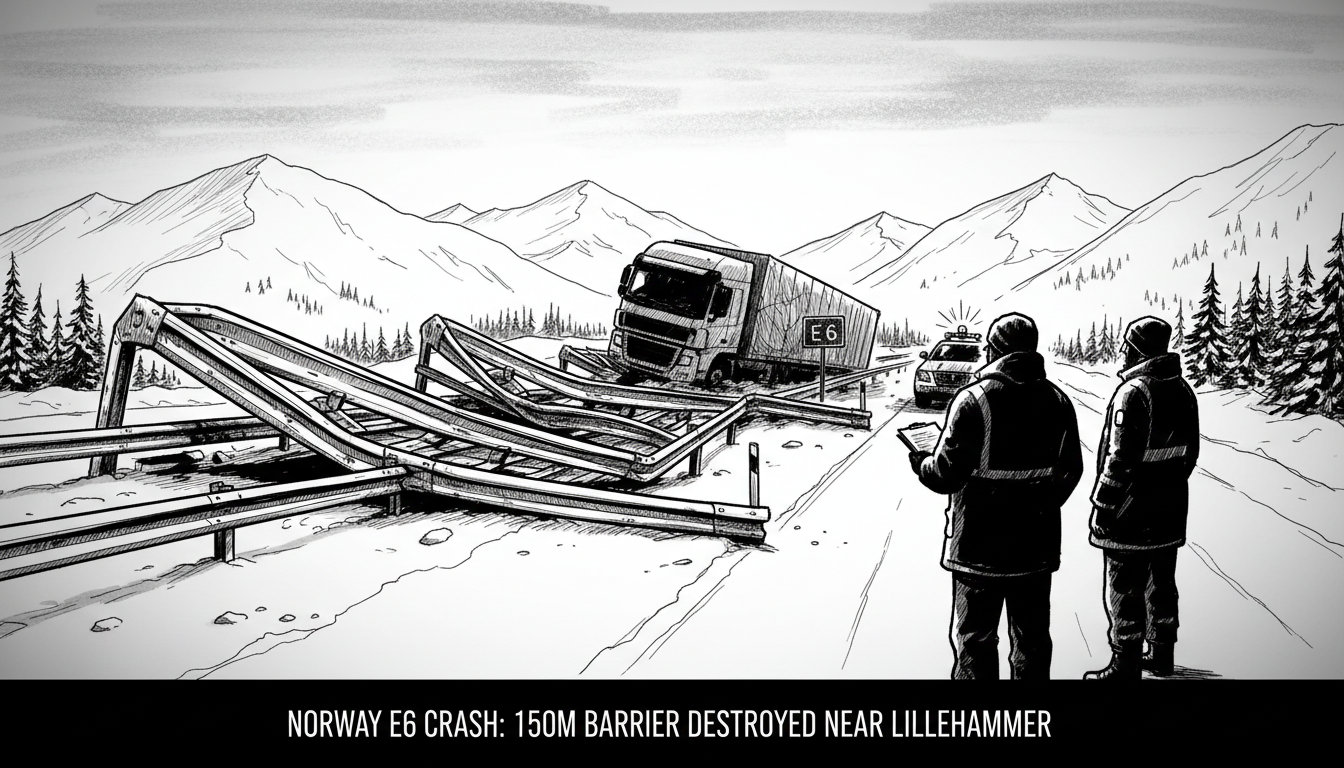
Norway's E6 highway south of Lillehammer was blocked Monday evening after a heavy goods vehicle destroyed 150 meters of safety barriers. The crash forced a full closure of the crucial north-south artery, with traffic authorities imposing a strict 50 km/h speed limit upon reopening. The incident highlights the fragility of Norway's main transport corridor and the severe consequences of a single accident.
"150 meters of median barrier and guardrail had to be repaired before the E6 could open again," said police operations leader Morten Danielsen at the scene. His statement underscores the scale of the impact, which required immediate and extensive repair work. While no serious injuries were reported, the material damage was significant enough to paralyze a key section of the national road network for hours.
A Critical Artery Severed
The E6 is Norway's primary highway, running from the southern tip of the country to the Russian border in the far north. The stretch near Lillehammer, a major tourist hub and former Olympic host city, is particularly vital. It connects the capital region of Oslo with central and northern Norway, facilitating the movement of goods, tourists, and daily commuters. A closure here creates a domino effect, causing delays on alternative routes and disrupting supply chains.
Traffic analysts estimate that an unplanned closure of the E6 for several hours can have an economic impact running into millions of kroner. This is due to delayed freight, increased fuel consumption from detours, and lost productivity. The 50 km/h restriction, necessary for safety until permanent repairs are finalized, continues to slow traffic flow, creating lingering inefficiencies long after the wreckage is cleared.
Infrastructure Under Pressure
This accident brings Norway's road maintenance and safety infrastructure into sharp focus. The autovern (guardrail) and midtdeler (median barrier) are designed to prevent cross-over collisions and keep errant vehicles from leaving the roadway. Their destruction indicates a high-energy impact, raising questions about vehicle speed, load security, or possible driver fatigue. The fact that 150 meters of barrier was compromised suggests the truck may have scraped along the structure for a considerable distance.
Road safety experts point to a combination of factors on routes like the E6. "Heavy traffic volumes, challenging weather conditions, and the mix of local and long-haul transport create a complex risk environment," explains a transport researcher from the Institute of Transport Economics, who requested anonymity as they were not directly involved in this incident. "While Norwegian roads are safe by international standards, the concentration of traffic on the E6 means any incident has outsized consequences. Continuous investment in barrier technology and road design is non-negotiable."
The Human Element in Transport Safety
Beyond the twisted metal and traffic reports lies the human element. For the truck driver, such an event is undoubtedly traumatic. For motorists caught in the ensuing gridlock, it meant missed appointments, anxious waits, and rearranged plans. Local residents near the accident site are reminded of the constant hum of traffic and its potential dangers just beyond their doorstep.
The police investigation will seek to determine the cause. Standard procedure will examine the vehicle's mechanical condition, the driver's logbook for hours-of-service compliance, and external factors like road surface conditions at the time. Norway has strict regulations governing commercial transport, but enforcement relies on a combination of checks and driver responsibility.
Economic and Logistical Ripple Effects
The temporary closure of the E6 near Lillehammer demonstrates how interconnected the Norwegian economy is with this single route. Transport companies face penalty clauses for delayed deliveries. Perishable goods in other trucks stuck in the queue risk spoilage. Tourists heading to mountain cabins or fjord destinations experience frustration that can color their entire holiday. The alternative routes, primarily county roads, are not designed for the volume or size of traffic diverted from a closed E6, leading to wear and tear on local infrastructure.
This event is not isolated. Similar incidents occur periodically along the E6, especially through mountainous regions and during winter. Each closure renews debates about building parallel routes, such as the long-discussed but controversial twin-track E6 project through Gudbrandsdalen. Proponents argue it is essential for redundancy and safety; opponents cite environmental impact and cost, which can exceed 30 billion NOK for major sections.
A Look at the Road Ahead
The immediate aftermath involves repair crews working to restore the barrier to its full safety specification. The temporary 50 km/h zone will remain until authorities are satisfied. Meanwhile, traffic planners will add this incident to their models, using it to refine emergency response protocols for future accidents.
The broader question for Norwegian authorities is one of resilience. How does a nation with such a long, narrow, and geographically constrained transport corridor build in redundancy? Investments in rail freight, improved avalanche and weather protection on existing roads, and advanced traffic monitoring systems are all part of the ongoing strategy. Yet, as Monday's crash shows, the system remains vulnerable to single points of failure.
For now, the traffic is moving again on the E6 past Lillehammer, albeit slowly. The scar on the median barrier will be repaired, a visible reminder of the event. The incident serves as a stark warning: Norway's economic lifeline is robust, but it is not indestructible. The balance between efficient transport and absolute safety is a constant, high-stakes calculation on the open road.
Will the lessons from this crash lead to tangible improvements in infrastructure or driver monitoring, or will it simply be recorded as another costly disruption on Norway's most important highway?