
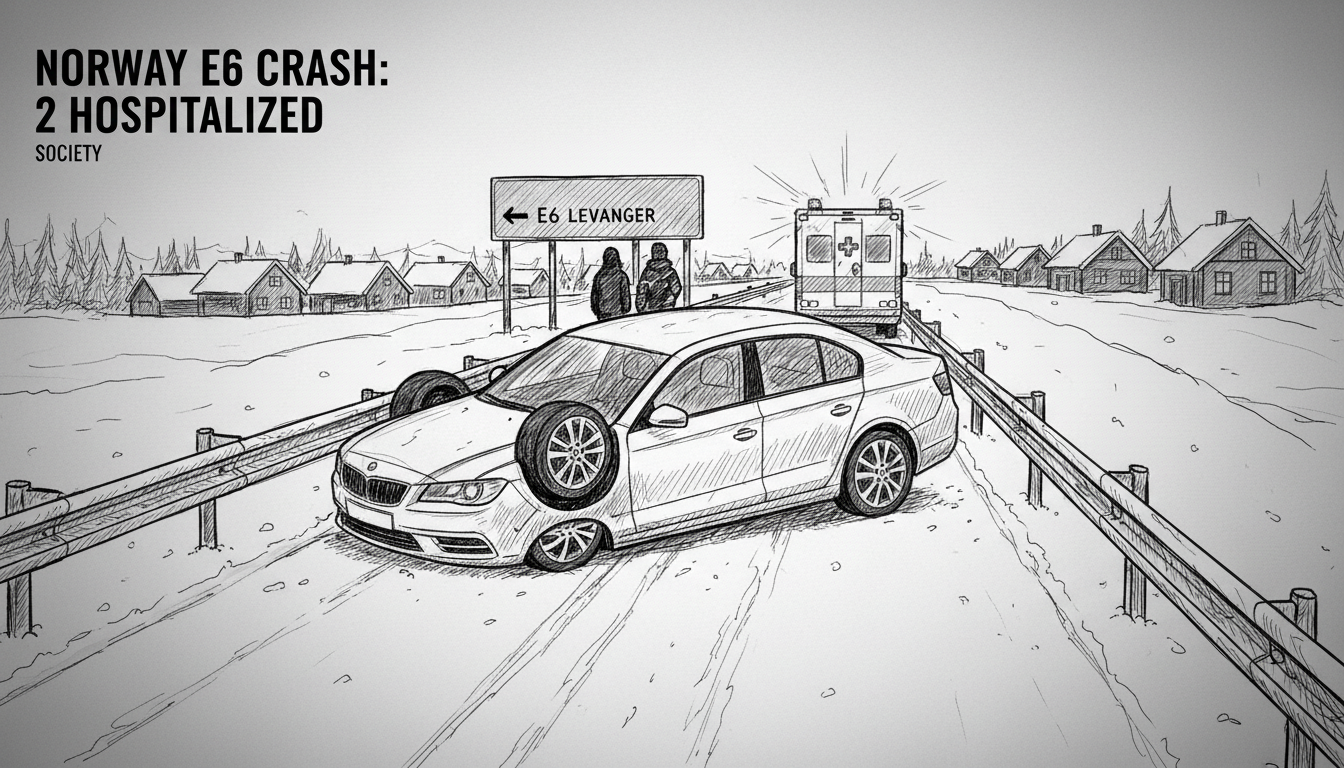
Norway's E6 highway was the scene of a serious collision near Levanger on Thursday, resulting in two people being rushed to the hospital. The accident involved two cars at Gråmyra, a location on this critical north-south artery in Trøndelag county. Operations manager Svein Helgetun from the Trøndelag police district confirmed the incident, noting that the extent of injuries remains unknown. Emergency services have blocked traffic on the E6, causing significant disruptions as crews work to establish detours.
The Incident and Immediate Aftermath
Police and ambulance teams responded swiftly to the crash on the E6 at Gråmyra. The collision led to the closure of the highway in both directions, stranding motorists and forcing commercial traffic to halt. Local authorities are coordinating with the National Road Administration to reroute vehicles through alternative roads, though this process is expected to cause delays for hours. The two hospitalized individuals were transported to Levanger Hospital for treatment. Their conditions have not been disclosed, reflecting the early stage of the investigation.
This accident underscores the vulnerability of Norway's transportation network. The E6 serves as the backbone for travel and freight between Oslo and the northern regions, making any blockage a major logistical challenge. In Levanger, a municipality of about 20,000 residents, local emergency protocols were activated immediately. The police have not released details on the cause of the collision, citing an ongoing investigation into factors like speed, weather, or vehicle failure.
Traffic Chaos and Economic Ripple Effects
With the E6 closed, traffic is being diverted onto smaller regional roads, which are ill-equipped for heavy volumes. This includes routes through villages like Skogn and Ytterøy, where congestion is building. The Norwegian Public Roads Administration estimates that over 15,000 vehicles use this section of the E6 daily, including trucks carrying goods to Arctic ports. Delays could impact supply chains for industries reliant on just-in-time delivery, from fish processing plants in Trøndelag to retail distribution centers.
Long-haul drivers face extended travel times, adding costs to logistics operations. "When the E6 shuts down, the entire region feels it," said a spokesperson from the Norwegian Trucking Association. "Alternative routes are longer and less safe, especially for heavy vehicles." The economic toll includes lost productivity and increased fuel consumption. For local businesses in Levanger, the disruption may affect deliveries and customer access, though the full impact will depend on how long the closure lasts.
The E6: Norway's Vital Artery
The E6 highway stretches over 3,000 kilometers from the Swedish border in the south to Kirkenes near the Russian border. In central Norway, it winds through Trøndelag's fjords and valleys, passing key cities like Trondheim. This section is notorious for accidents due to its mix of high-speed stretches and sudden weather changes. Levanger sits in a region where the road narrows, with historical data showing a higher incidence of collisions compared to southern segments.
Norway has invested heavily in E6 upgrades, including new tunnels and bypasses, but older sections like near Gråmyra remain challenging. The road is critical for tourism, with summer traffic peaking as travelers head to the Lofoten Islands. Accidents here often prompt calls for accelerated safety improvements. The government's National Transport Plan prioritizes E6 enhancements, but funding allocations face scrutiny from Parliament, the Storting, amid debates over climate goals versus infrastructure needs.
Expert Analysis: Road Safety Realities
Road safety experts point to several factors that contribute to accidents on highways like the E6. Professor Ingrid Haugerud, a transportation researcher at the Norwegian University of Science and Technology, emphasizes that human error remains the primary cause. "On long, monotonous stretches like the E6 in Trøndelag, driver fatigue and distraction are significant risks," she said in an interview. "Combined with variable weather—from fog to ice—even experienced drivers can be caught off guard."
Haugerud notes that Norway has some of Europe's strictest traffic laws, including low speed limits and rigorous vehicle inspections. However, enforcement on remote highways can be sporadic. She advocates for more automated systems, such as speed cameras and lane-departure warnings, which have reduced fatalities in other regions. "The quick response from emergency services in Levanger is commendable," she added. "But prevention through better road design and technology is where we must focus."
Comparative data from the Norwegian Road Federation indicates that E6 accident rates have plateaued in recent years, despite increased traffic volumes. In 2023, there were over 200 reported collisions on the Trøndelag section alone, resulting in numerous injuries. This incident in Levanger fits a pattern of seasonal spikes during holiday periods. Experts call for targeted campaigns on seatbelt use and distracted driving, especially among young motorists.
Infrastructure and Policy Implications
The Levanger collision will likely reignite debates in Oslo about transportation funding. The current government, led by Prime Minister Jonas Gahr Støre, has earmarked billions of kroner for road safety projects. Yet, competing priorities like renewable energy investments and healthcare often divert resources. Members of the Storting from northern constituencies frequently argue that the E6 deserves more attention due to its economic importance.
From a policy perspective, this accident highlights the need for integrated emergency response. Trøndelag's police and health services demonstrated effective coordination, but analysts suggest that real-time traffic management could be improved. Systems that alert drivers to hazards via mobile apps or dynamic road signs are under development. The Norwegian Road Administration is piloting such technologies on the E39 coastal highway, with potential for expansion to the E6.
Looking ahead, the investigation into the Levanger crash will inform safety recommendations. If mechanical failure is found, it may prompt recalls or stricter vehicle standards. For now, the community's focus is on the injured individuals and restoring normal traffic flow. As Norway balances its vision for a greener future with practical infrastructure demands, incidents like this serve as stark reminders of the human cost of transportation gaps. Will this lead to faster action on E6 upgrades, or will it be another statistic in a long list of highway accidents?