
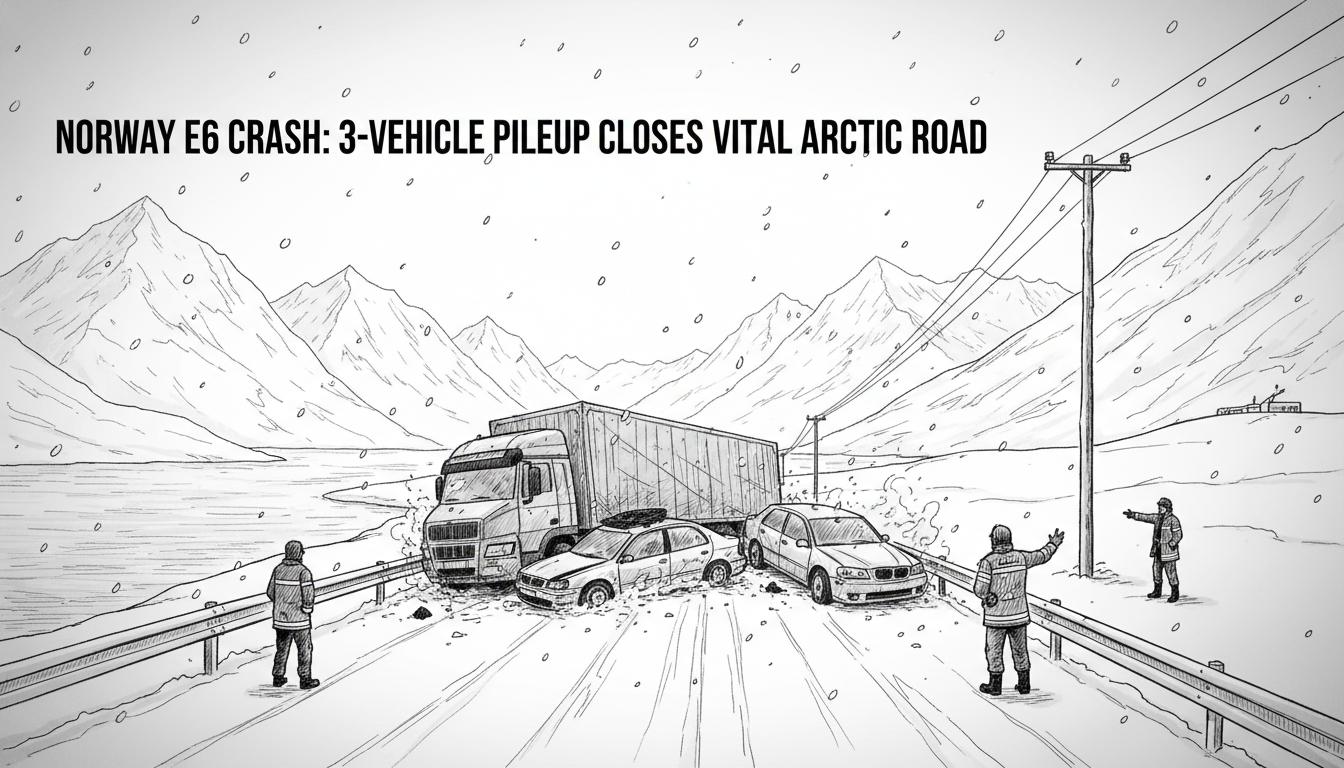
Norway's vital E6 highway was closed for hours on Thursday after a serious three-vehicle collision south of the Aspfjord Tunnel in Sørfold, Nordland. The crash involved two passenger cars and one heavy goods vehicle, trapping four people on the remote Arctic road. Police confirmed no serious injuries resulted from the wreck, which caused extensive material damage and severed the primary north-south transport corridor.
Emergency services from the Sørfold municipality responded to the scene near the Aspfjordtunnelen shortly after the afternoon collision. Operations leader May Wenche Hansen stated all four individuals were out of their vehicles and receiving assessment. The 80 km/h zone where the accident occurred is a critical section of the E6, a road often described as Norway's lifeline through its northern regions.
"The road was closed due to the accident investigation and cleanup operation," a traffic center spokesperson said. "It reopened to all traffic just after 6:10 PM." The several-hour closure caused significant disruptions for commercial and passenger traffic, highlighting the region's vulnerability when its main artery is blocked. Long queues formed as drivers were forced to wait in the sparse landscape of northern Nordland county.
The Fragile Artery of the North
The E6 highway runs over 3,000 kilometers from the Swedish border in the south to Kirkenes near the Russian border. In regions like Nordland, it is often the only viable road connecting communities, industries, and ports. A closure between Fauske and Narvik, where this crash occurred, can isolate towns and delay essential goods. The road winds through dramatic terrain of mountains and fjords, with tunnels like the Aspfjord providing crucial passage.
This stretch sees a high volume of heavy freight traffic heading to and from the Port of Narvik, a key hub for iron ore and other exports. Mixing tourist traffic, local commuters, and international trucking on a mostly two-lane road creates inherent risks. "The E6 in Nordland is a workhorse, not a motorway," said Lars Moe, a transport analyst with the Northern Institute for Transport Research. "Its economic function is immense, but its design often belongs to another era. Every closure has a ripple effect on logistics costs and community access."
Close Calls and Systemic Pressures
The fact that four people walked away from a crash involving a truck and two cars is being described by responders as fortunate. Initial reports indicate weather conditions were typical for the season, but investigations will examine factors like speed, driver attention, and vehicle spacing. Norway has some of Europe's strictest traffic laws, yet its main northern road remains a challenge.
"Accidents without serious injury are learning moments, not just lucky breaks," stated Anna Pedersen, a road safety advisor with the Norwegian Public Roads Administration. "We see these incidents on the E6 too often. They point to the pressure on this infrastructure. When you combine long-distance truckers on tight schedules with seasonal tourists unfamiliar with the roads, the margin for error shrinks." Pedersen emphasized that the 80 km/h limit in the crash zone is a maximum, not a target, especially for larger vehicles.
Economic Impact of a Closed Road
For the local economy in Sørfold and surrounding municipalities, the E6 is indispensable. The road closure halted all movement, affecting everything from fresh fish deliveries to hotel bookings. Per Hagen, manager of a transport firm in Bodø, explained the direct cost. "A four-hour closure for one of our trucks means missed ferry connections, delayed loading at ports, and contract penalties. The cost runs into tens of thousands of kroner per vehicle. And that's before you consider the perishable goods some are carrying."
The alternative routes in this part of Nordland are few and far between, often involving lengthy detours on lower-quality roads not suited for heavy trucks. This lack of redundancy is a persistent concern for regional planners and businesses investing in Northern Norway. Each incident reinforces calls for targeted upgrades, such as more passing lanes and improved tunnel safety systems on critical sections.
A Policy Challenge for Oslo
The recurring disruptions on the E6 place it firmly on the agenda in the Storting, Norway's parliament. The government's National Transport Plan allocates billions for road maintenance and upgrades, but the needs of the north often compete with more populous southern regions. The ruling coalition has pledged to strengthen transport infrastructure in Nord-Norge as part of its regional development strategy.
"This incident in Sørfold is a concrete example of what we discuss in abstract terms in finance committee meetings," said Marit Johansen, a member of parliament from the Nordland constituency. "Reliability is not a luxury; it's a necessity for economic survival and population retention north of the Arctic Circle. We need to see faster progress on E6 safety projects and better emergency response protocols for when closures do occur." Johansen noted that discussions include improved real-time traffic information systems and more strategically placed recovery vehicles.
Looking Beyond the Crash Barrier
While the Sørfold crash ended without tragedy, it serves as another stark warning. As Norway pushes for increased economic activity in the Arctic—from tourism to offshore wind and mineral extraction—the strain on its foundational road network grows. The government's Arctic policy emphasizes sustainable development, but sustainability requires resilient infrastructure.
Experts argue that investment must focus on both physical upgrades and smarter technology. "We can't straighten every curve or build duplicate roads everywhere," said analyst Lars Moe. "But we can use dynamic speed limits, better signage, and connected vehicle technology to make the existing E6 safer and more reliable. The goal should be zero closures, not just quicker cleanups."
For the residents of Sørfold and the thousands who depend on the E6 daily, Thursday's crash is a familiar story with a fortunate ending. The reopened road now carries traffic past the scarred asphalt, a temporary mark that will soon fade. Yet the underlying vulnerability remains, waiting for the next crisis—whether a crash, a landslide, or extreme weather—to expose it once more. The question for Norwegian authorities is whether future solutions will be proactive or merely reactive.