
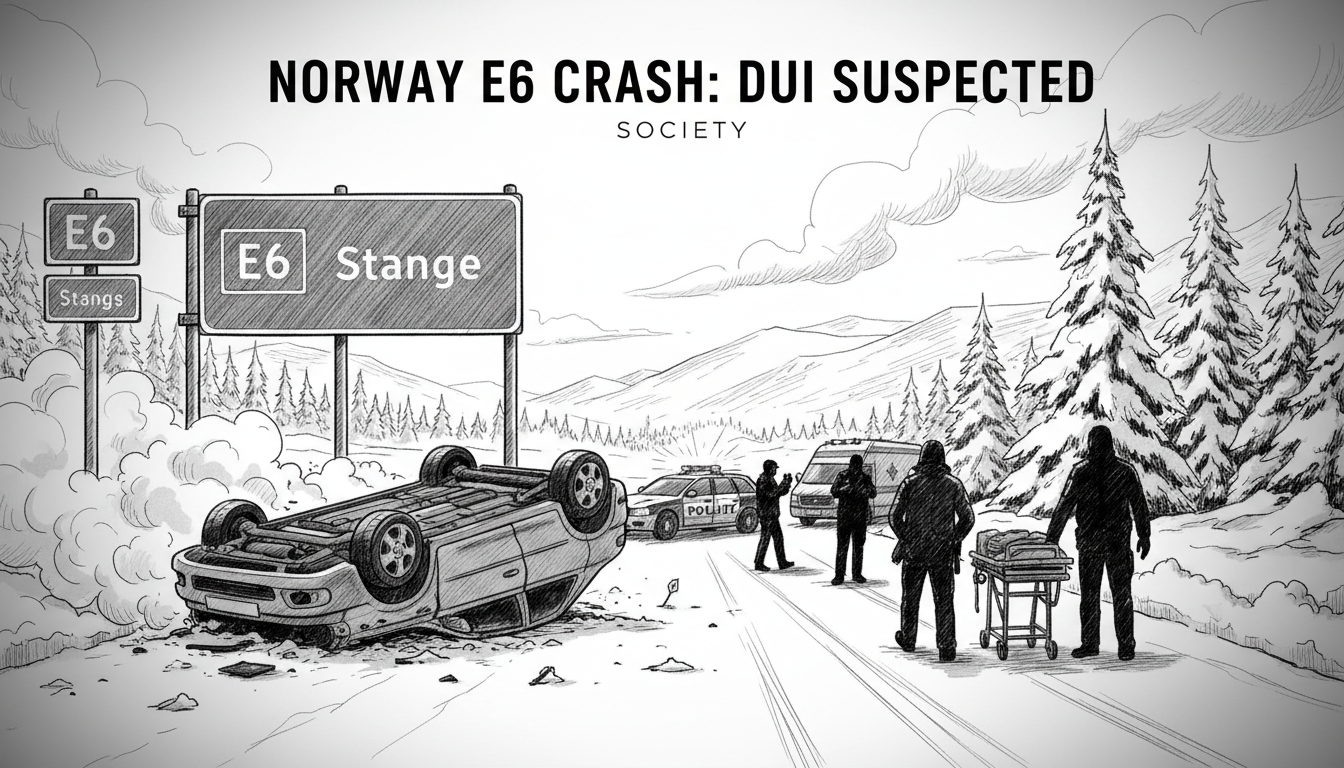
Norway's E6 highway saw reduced traffic flow and significant damage after a serious crash in Stange municipality. The accident, which occurred in the northbound lanes, involved a single vehicle colliding with the median barrier. Police suspect the driver was operating the vehicle under the influence of alcohol or drugs, a charge that carries severe penalties in Norway.
Emergency services responded to the scene on the vital transport artery in Innlandet county. They reported substantial material damage to both the car and the midtdeler, or median barrier. These concrete and steel dividers are a critical safety feature designed to prevent catastrophic cross-over collisions. Their deployment across Norway's highway network has been a cornerstone of the country's road safety strategy for decades.
A Critical Artery Disrupted
The E6 is Norway's primary north-south corridor, a sprawling 3,000-kilometer route from the Swedish border at Trelleborg to the northern reaches of Kirkenes. Any incident causing "redusert framkommelighet"—reduced passability—creates immediate ripple effects. For commercial hauliers, it means delays in freight moving between Oslo, Trondheim, and the Arctic region. For commuters and tourists, it translates to long detours and lost time.
The stretch through Stange, southeast of Hamar, is a key segment connecting the eastern region to the capital. Accidents here often force traffic onto smaller regional roads not designed for high volumes, creating secondary congestion and safety concerns. The Norwegian Public Roads Administration, Statens vegvesen, must quickly assess barrier damage. Repairing a compromised midtdeler is a high-priority operation to restore the highway's inherent safety level.
The Persistent Scourge of Impaired Driving
Police suspicion of driving under the influence (DUI) points to a stubborn and deadly problem. Norway has some of Europe's strictest drunk driving laws, with a general blood alcohol concentration (BAC) limit of 0.02%. Penalties are severe, including heavy fines, mandatory license suspension, and often imprisonment for higher levels or repeat offenses. Despite this robust legal framework, impaired driving remains a leading contributor to serious accidents.
"The laws are clear and the enforcement is rigorous, yet some individuals continue to make the catastrophic decision to drive after drinking or using drugs," said a senior traffic police officer, who spoke on condition of anonymity as the investigation is active. "Every such incident is a preventable tragedy that risks the lives of the driver, their passengers, and every other road user."
In 2022, 115 people died on Norwegian roads. While this figure represents a long-term downward trend thanks to improved vehicle safety, infrastructure, and legislation, experts note that human error—including impairment—remains the dominant risk factor. A significant percentage of fatal and serious injury collisions still involve alcohol or drugs.
Safety Engineering Put to the Test
The Stange crash highlights the life-saving role of highway engineering. The median barrier, or midtdeler, is a passive safety system intended to contain and redirect a vehicle, preventing it from vaulting into oncoming traffic. A head-on collision at highway speeds is often fatal; the barrier is designed to make that outcome far less likely.
"This is exactly what these barriers are for," explained traffic safety engineer Kari Nilsen. "They are a last line of defense when a driver loses control. The substantial damage reported indicates a high-energy impact. Without that barrier, the consequences could have been exponentially worse, potentially involving multiple vehicles."
The design of these barriers is the result of continuous research. They must be rigid enough to deflect a vehicle but also absorb and dissipate crash energy to reduce the forces on the occupants. The collision will be studied by safety engineers to evaluate the barrier's performance and inform future designs.
Legal Repercussions and Investigation
The driver now faces a meticulous legal process. If the suspicion of DUI is confirmed through blood tests, the case will move to prosecution. Norwegian courts do not treat such offenses lightly. Beyond legal penalties, the driver will be liable for the considerable cost of repairing the state-owned infrastructure. Damaging a median barrier often results in a claim from Statens vegvesen running into hundreds of thousands of kroner.
The police investigation will reconstruct the event. Officers will examine skid marks, vehicle damage patterns, and data from the car's onboard systems if available. They will seek to determine the exact speed and angle of impact. Witness statements will be collected, and toxicology reports will be awaited to confirm the nature and level of any impairment.
This process serves a dual purpose: securing evidence for prosecution and gathering data for preventative safety work. Each serious accident provides insights that can lead to targeted police enforcement, public awareness campaigns, or tweaks to road design.
A Broader View on Road Safety Culture
Norway consistently ranks among the world's safest countries for road travel. This is no accident. It is the product of Vision Zero—a policy philosophy that aims to eliminate all traffic fatalities and severe injuries—combined with sustained investment and public compliance. Strict drink-driving laws, extensive use of median barriers, and a culture that largely stigmatizes impaired driving have been key components.
However, the Stange incident is a stark reminder that the system is not foolproof. It relies on individual responsibility. Every driver who chooses to get behind the wheel after consuming alcohol or drugs directly undermines decades of collective safety work. They gamble not only with their own life but with the safety of others and the smooth functioning of a critical national infrastructure.
As traffic eventually returned to normal on the E6 near Stange, the scarred barrier stood as a temporary monument to a poor decision. The physical damage will be repaired within days. The broader question for Norwegian society is how to finally reach the few drivers who remain unconvinced by laws, enforcement, and social norms that clearly state: driving under the influence is an unacceptable risk.
Can Norway's already-strong road safety culture evolve to completely eradicate these preventable crashes, or is a certain level of impaired driving an intractable human failure? The answer may determine how close the nation gets to its ultimate goal of zero fatalities.