
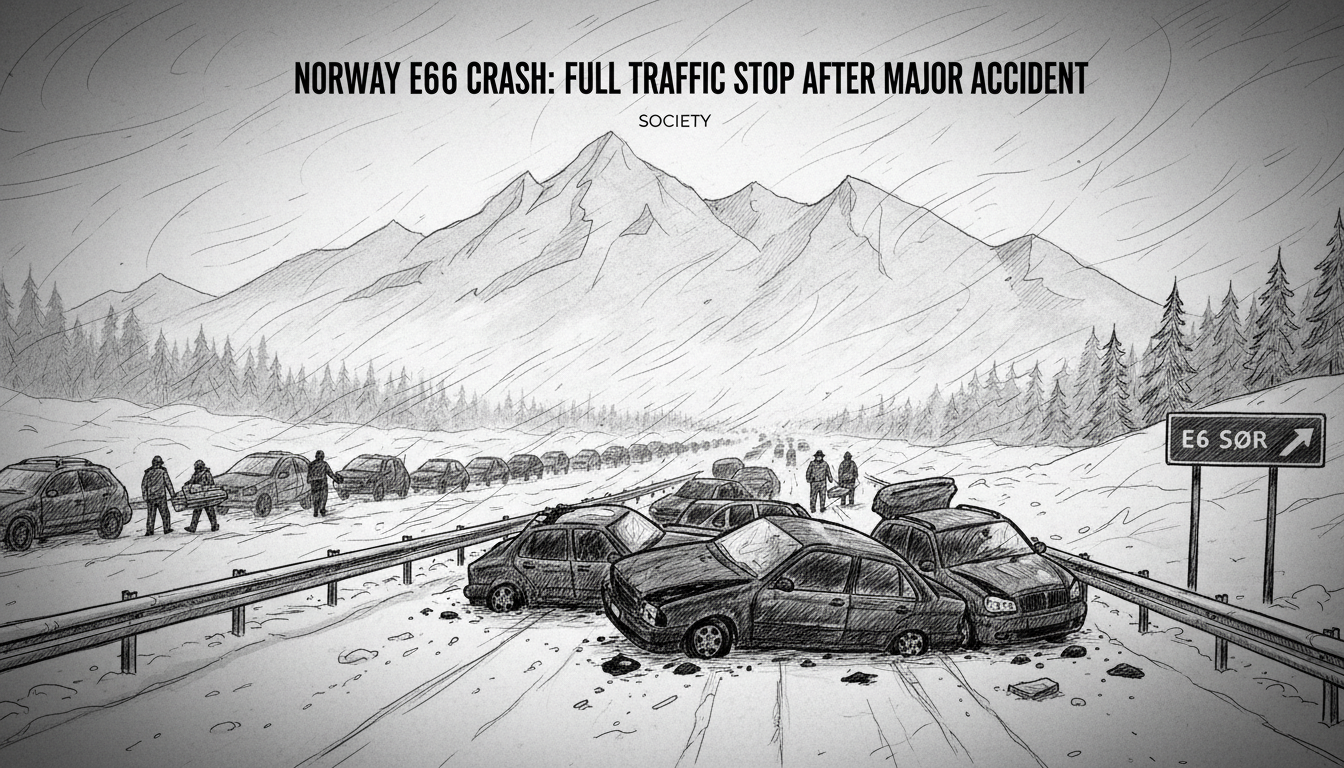
Norway's E6 highway has experienced a full traffic stop following a serious accident reported to police at 14:17. Emergency services are currently en route to the scene, according to operational manager Frode Øverås in the police operations center. The incident has brought all movement to a standstill on the nation's most critical north-south artery, with the Vegtrafikksentralen (Road Traffic Center) notified and mobilizing response units. The immediate priority is securing the scene and providing aid, but the ramifications of halting the E6 will ripple across the country's transport and logistics networks for hours to come.
A Nation's Main Artery Severed
The E6 is not just another road; it is the backbone of Norwegian land transport. Stretching over 3,100 kilometers from the southern city of Kristiansand to the Russian border at Kirkenes in the far north, it connects every major population center along Norway's long coastline. A complete stoppage, as reported today, creates an immediate and severe bottleneck. For context, the E6 handles a significant portion of all freight moving between southern Norway and regions like Trøndelag and Nordland. Alternative routes are often circuitous, involving mountain passes or ferry crossings that are less viable for heavy goods vehicles. "When the E6 stops, a large part of Norway's logistical chain stops with it," explains Lars Moe, a transport analyst at the Institute of Transport Economics. "The economic cost is measured in millions of kroner per hour, not just in delayed journeys, but in disrupted supply chains for everything from groceries to industrial components."
The specific location of today's accident will determine the scale of the disruption. Incidents south of Dovre or over the mountain passes can be particularly difficult to manage, as detours add hundreds of kilometers to journeys. Police and road authorities will now be engaged in a complex dual operation: managing the emergency response at the crash site and implementing a nationwide traffic management plan to mitigate gridlock.
Emergency Response in a Challenging Landscape
The response to a serious accident on the E6 tests Norway's emergency preparedness. The highway traverses some of the country's most demanding terrain, from deep fjords to high mountain plateaus. While major stretches are now modern multi-lane roads, other sections remain winding two-lane routes with limited access points. This geography can challenge response times for police, ambulance, and fire crews, especially in more remote areas. The notification to the Vegtrafikksentralen is a critical step, activating a coordinated response that can include air ambulance services (Luftambulanse) if required.
The severity of the accident, details of which are not yet released, will dictate the resources deployed. A multi-vehicle collision, particularly one involving heavy goods vehicles, often requires specialized extraction equipment and can lead to prolonged closure for forensic investigation. "Our first duty is to the injured," said a police spokesperson in a statement. "Securing the area for their rescue and for the investigators who must determine the cause is paramount. We understand the immense inconvenience a closed E6 causes, but safety cannot be compromised." Motorists are being advised via traffic alerts and navigation apps to avoid the area entirely and prepare for long delays on alternative routes.
The Ripple Effect on Commerce and Community
Beyond the immediate traffic headlines, a prolonged closure of the E6 has tangible effects on daily life and the economy. For northern communities, the highway is a lifeline. Perishable goods, including fresh food and seafood for export, move south on refrigerated trucks. Manufacturing parts for the maritime and energy industries flow north. A delay of several hours can mean missed ferry connections, missed delivery windows at ports, and spoilage of goods. Local businesses along the route, from gas stations to cafes, also feel the immediate impact as the steady stream of travelers vanishes.
The psychological impact is also significant for a nation so dependent on this single route. For many Norwegians, the E6 is the road home for holidays, the road to cabin country, and the main connection between regions. News of a serious accident and closure creates widespread anxiety, not just for those traveling but for families awaiting loved ones. Social media and local news outlets quickly fill with requests for information and offers of help from those near the blockage, highlighting the community response that often emerges during such crises.
Infrastructure Pressure and Future Challenges
Today's incident will inevitably renew debates about Norway's road infrastructure resilience. While massive investment has gone into projects like the E6 Bypass around Oslo and new tunnels through mountain ranges, the highway remains vulnerable to single points of failure. Proposals for parallel rail freight lines or more robust alternative highway routes are often discussed in policy circles but face high costs and environmental hurdles. "Each major accident on the E6 is a stark reminder of our infrastructure's fragility," notes political commentator Hanna Jensen. "In the Storting, questions will be asked about whether enough is being done to improve safety and redundancy on our most important road, especially as climate change brings more extreme weather that can also trigger closures."
The coming hours will be critical. Once the scene is cleared, the focus will shift to reopening the road. This process can be slow, involving cleanup, road surface repair, and ensuring the safety of the route. Traffic, once released, will then face a wave of congestion as the backlog clears. For now, the nation's attention is fixed on a stretch of asphalt somewhere along the long, winding path of the E6, where emergency lights pierce the afternoon light and the normal flow of Norwegian life has been abruptly, and seriously, interrupted. The full cost—in human, economic, and logistical terms—remains to be seen.