
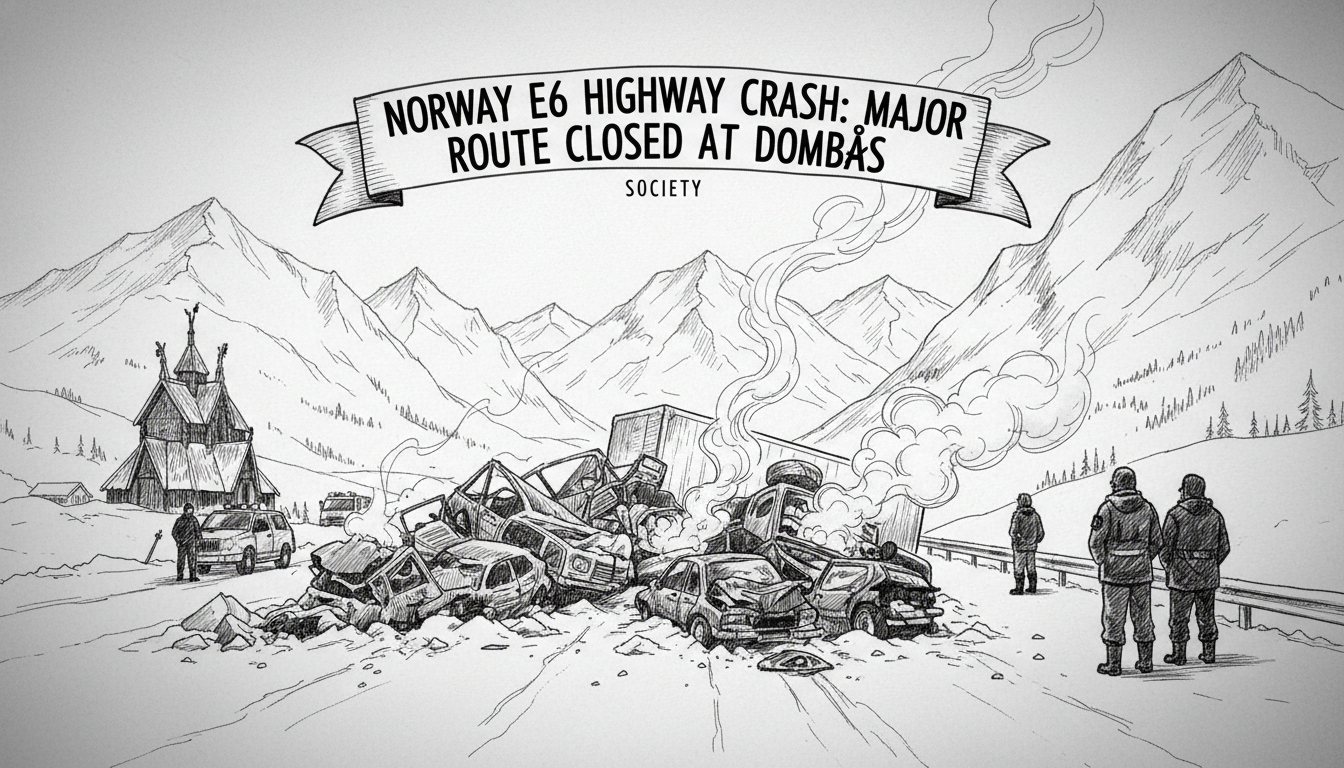
Norway's E6 highway is closed following a serious multi-vehicle crash near Dombås, causing major disruptions to national traffic and freight. The accident occurred at Skeivollen between Dombås and Dovre in Innlandet county on Monday afternoon, involving three cars. All occupants were reported conscious as emergency services arrived on the scene.
Innlandet Police District received the alert at 2:17 PM. Operations manager Frode Øverås confirmed traffic was at a standstill at the site. The East Traffic Center has officially closed the E6 in both directions. "The first reports are that three cars are involved, and that all involved are conscious. The emergency services have just arrived," said mission manager Ina Hjelsvold shortly after the incident.
A Critical Artery Severed
The closure of the E6 at this location creates an immediate and severe bottleneck for north-south travel in Norway. The E6 is the nation's primary highway, running over 3,100 kilometers from the southern Swedish border at Svinesund all the way to Kirkenes in the far north. The stretch near Dombås is particularly vital as it traverses the mountainous Dovre region, where alternative routes are few and often consist of smaller, winding mountain passes ill-suited for heavy goods vehicles.
Dombås itself is a key transport nexus. It is where the E6 meets the E136 highway running west to Åndalsnes on the coast, and it serves as a major station on the Dovrebanen railway line. A prolonged closure here disrupts not just passenger travel but the flow of essential goods, from groceries to industrial materials, between southern and northern Norway. The economic ripple effects begin accumulating with each hour the road remains shut.
Emergency Response and Travel Chaos
Police and road authorities have initiated standard diversion protocols, but the options are limited. Traffic is being redirected onto County Road 455, a significantly smaller road that cannot handle the volume or size of vehicles typically using the E6. Long delays are inevitable, with queues expected to build rapidly in both directions. The Norwegian Public Roads Administration (Statens vegvesen) has advised all non-essential travel to be postponed.
For freight companies, the closure presents a logistical and financial headache. "An unplanned stop like this costs thousands of kroner per truck in delayed deliveries, driver hours, and wasted fuel," said Lars Moe, a spokesperson for the Norwegian Transport and Logistics Association. "When the E6 closes, there is no true alternative for heavy transport. The entire supply chain for the region feels the impact."
Passenger vehicles face similar challenges. The closure cuts through the main tourist route from Oslo to destinations like Trondheim and the Atlantic Ocean Road. Travelers are urged to check the Road Administration's website for real-time updates before embarking on journeys through Innlandet.
The Persistent Challenge of E6 Safety
This incident brings renewed focus to road safety on Norway's most important highway. The E6 traverses diverse and often demanding terrain, from flat agricultural land to steep mountain passes. While modern stretches are built to high safety standards, older sections, particularly in mountain areas, can have narrow lanes, limited overtaking opportunities, and vulnerability to harsh weather.
"The E6 is our national lifeline, and its safety must be a perpetual priority," said Anna Larsen, a senior researcher at the Institute of Transport Economics (TØI). "Accidents in critical choke points like Dombås expose the system's vulnerability. They highlight the need for continuous investment in road upgrades, avalanche and rockfall protection, and driver awareness campaigns, especially for those unfamiliar with mountain driving."
Weather, while not cited as an immediate factor in this Monday afternoon crash, is often a contributing element on this stretch. The area around Dovre can experience rapid weather shifts, with fog, rain, snow, and ice posing hazards even outside the winter months. Police investigations will determine the exact cause of this collision, but such events frequently prompt broader discussions about speed limits, winter tire requirements, and infrastructure resilience.
Economic and Community Impact
The local community around Dombås is directly affected. While emergency services manage the incident, local businesses experience both disruption and an unexpected influx of stranded travelers. Cafés and petrol stations along the diversion route may see increased traffic, while hotels could fill with drivers unable to complete their journeys.
On a larger scale, the interruption of freight movement can affect store shelves and construction projects across central and northern Norway. Perishable goods are at particular risk. The closure demonstrates how a single traffic incident on a key transport corridor can have disproportionate national consequences, a reality for a long, mountainous country like Norway.
Looking Ahead: Investigation and Infrastructure
The immediate priority for authorities is clearing the crash site, assisting those involved, and reopening the E6 as soon as it is safe to do so. A thorough police investigation will follow to establish the sequence of events leading to the collision. That report will contribute to the ongoing statistical and analytical work on road safety in Norway.
Longer-term, this crash will likely be referenced in ongoing political debates about transportation budgets. The government has a National Transport Plan that allocates funds for road maintenance, upgrades, and new projects. Incidents that cause major national disruption strengthen the arguments for investing in more redundant systems, such as improving parallel routes or accelerating the construction of safer bypasses around critical villages and hazardous stretches.
For now, the focus remains on the individuals involved in the crash and the thousands of travelers whose plans have been upended. The silent line of halted trucks and cars stretching away from Skeivollen is a stark visual reminder of Norway's geographical dependence on this single paved ribbon through the mountains. Its closure, even for a few hours, underscores a fundamental national vulnerability. When will the journey north resume, and what lessons will be learned to make this essential artery safer for the next trip?