
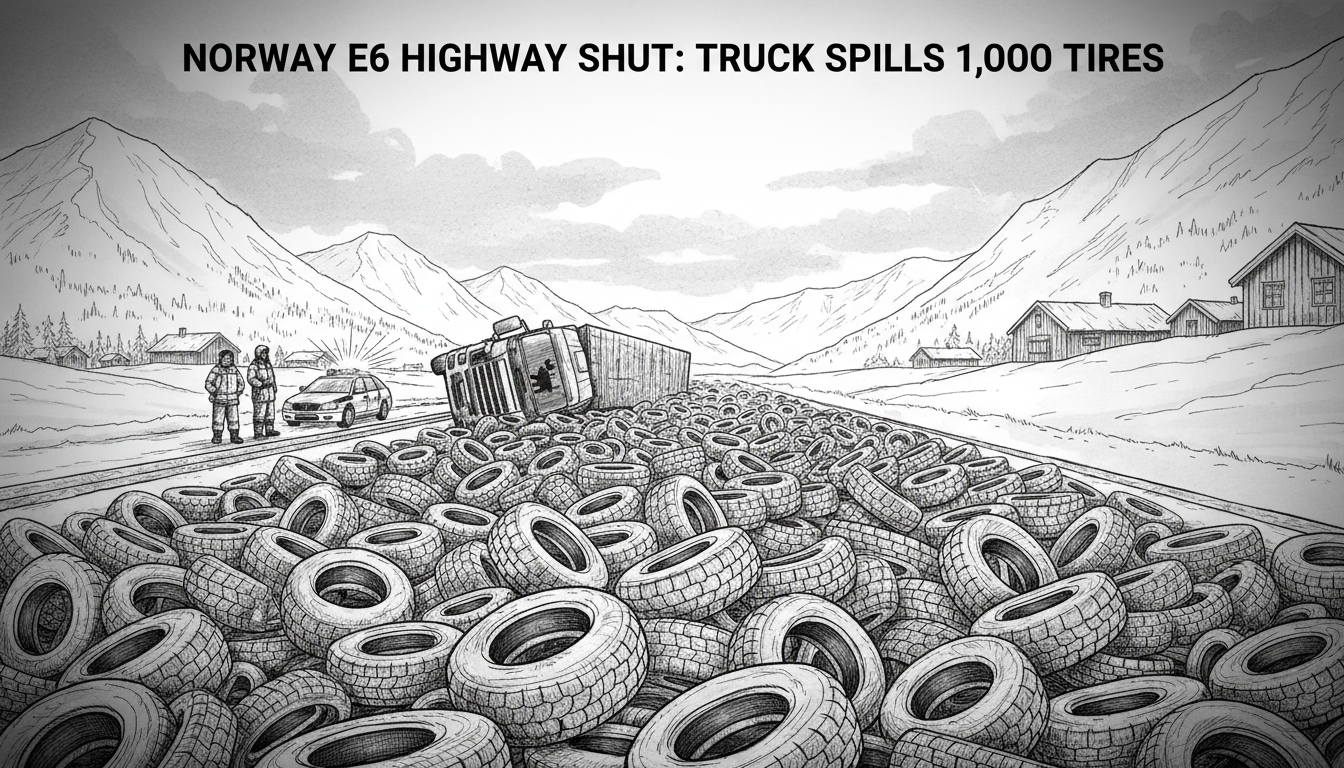
Norway's E6 highway faced a complete northbound shutdown after a truck carrying a container full of tires struck a bridge, scattering debris across the crucial transport artery. The incident occurred near Trondheim, causing significant damage to the bridge structure but resulting in no injuries. Emergency crews worked through the night to clear hundreds of tires and assess the structural integrity of the overpass, highlighting the vulnerability of Norway's primary north-south corridor.
Police operations leader Wenche Johnsen confirmed the severity of the situation in an initial statement. "There is damage to the bridge. There is a full stop of traffic on the E6 in the northbound direction," Johnsen reported. The accident happened at approximately 8:30 PM, when the truck's open container collided with the bridge. The force of the impact tore the container open, spilling its cargo of approximately one thousand tires across multiple lanes of the highway.
A Critical Artery Severed
The E6 is more than just a road; it is Norway's national spine. Running over 3,000 kilometers from the southern tip of the country to the Russian border in the north, it handles the majority of freight and passenger traffic between regions. A closure on this scale creates immediate logistical headaches. The Norwegian Public Roads Administration quickly established local detours, but for heavy goods vehicles, alternatives are often lengthy and impractical.
Torgeir Nilsen, a traffic operator with the road administration, described the response. "The contractor is assessing the situation there now and assisting with removing what is in the roadway," Nilsen said. Multiple heavy recovery vehicles were dispatched to the scene. By 9:40 PM, a complex recovery operation was underway, focusing first on removing the damaged container, which had become wedged against the bridge. The tractor unit of the truck was found several hundred meters further down the road, separated from its load.
The Cleanup and Safety Assessment
The immediate priority for authorities was twofold: clear the hazardous debris and determine if the bridge was safe. Scattered tires present a major danger to moving vehicles, especially at night. More critically, a bridge strike requires immediate engineering assessment. "The situation is quite clarified," said the on-duty manager at the Central Norway 110 emergency center. "Heavy haulers are on site and working to remove the container."
Bridge engineers were called to inspect the overpass for structural damage. Any impact can compromise reinforcement, crack support beams, or damage the road surface. Until a full inspection is completed and any necessary repairs are made, traffic cannot resume. This process can take hours or even days, depending on the severity of the damage. The economic cost mounts with each passing hour, as delayed freight, fuel for idling vehicles, and emergency services all tally up.
The Human and Economic Impact
While no physical injuries were reported, the accident inflicted a wound on regional commerce. The E6 north of Trondheim is a vital link for industries in Nordland and Troms counties, including fisheries, aquaculture, and tourism. Fresh seafood transport, time-sensitive deliveries, and supply chains for remote communities all rely on this route. Each closure forces trucks onto smaller, slower roads not designed for high-volume heavy traffic, increasing travel time by hours and raising risks on narrower mountain passes.
Logistics analysts point to this incident as a case study in national infrastructure vulnerability. "A single accident can paralyze a significant portion of Norway's goods movement," says Lars Holm, a transport economist based in Oslo. "It exposes the lack of redundancy in our long-distance road network. When the E6 stops, there are very few equivalent alternatives, especially for heavy goods vehicles." The incident will likely renew debates about investment in parallel rail freight capacity and road upgrades to improve resilience.
Recurring Challenges on the E6
This is not an isolated event. The E6 sees frequent accidents involving heavy goods vehicles, particularly in sections with challenging weather, sharp curves, or older infrastructure. The highway traverses diverse and difficult terrain, from coastal cliffs to mountain plateaus. Cargo security is a perennial concern. Norwegian regulations on load securing are strict, but accidents caused by shifting or unsecured loads still occur, with potentially catastrophic consequences.
Traffic safety experts emphasize that proper load securing is not just a regulatory box to tick; it is a critical component of road safety. A container coming loose or striking an overpass can easily cause fatal collisions. The fact that this incident resulted only in property damage is, authorities note, a matter of luck. The driver of the truck involved will face investigation to determine if load securing protocols were correctly followed prior to departure.
Looking Forward: Infrastructure and Enforcement
The cleanup operation continued into the early morning hours. The focus shifted from immediate debris removal to a detailed inspection of the bridge and full reopening of the lane. The road administration's stated goal was always clear: "We are interested in getting the road opened again as soon as possible," the emergency center manager stated. However, "as soon as possible" is dictated by safety, not convenience.
This accident serves as a stark reminder of the balancing act Norway faces. The country depends on road transport to connect its long, sparsely populated geography, yet the main artery is fragile. It raises questions about ongoing maintenance of aging bridges, the enforcement of transport regulations, and long-term planning for a more robust network. Will this event lead to increased spot checks on cargo trucks, or accelerated infrastructure upgrades? For the trucking companies and businesses waiting for the all-clear, the immediate concern is more concrete: when will the tires be cleared, the bridge pronounced safe, and the flow of goods restored?
As dawn broke over the site, the scale of the mess became fully visible. Hundreds of black tires littered the asphalt like a chaotic rubber carpet, a tangible symbol of a transport system momentarily broken. The silent bridge above stood as a testament to the force of the impact. The incident on the E6 is a temporary disruption, but it underscores a permanent truth: in a nation defined by its distances, the road is a lifeline, and its fragility affects everyone.