
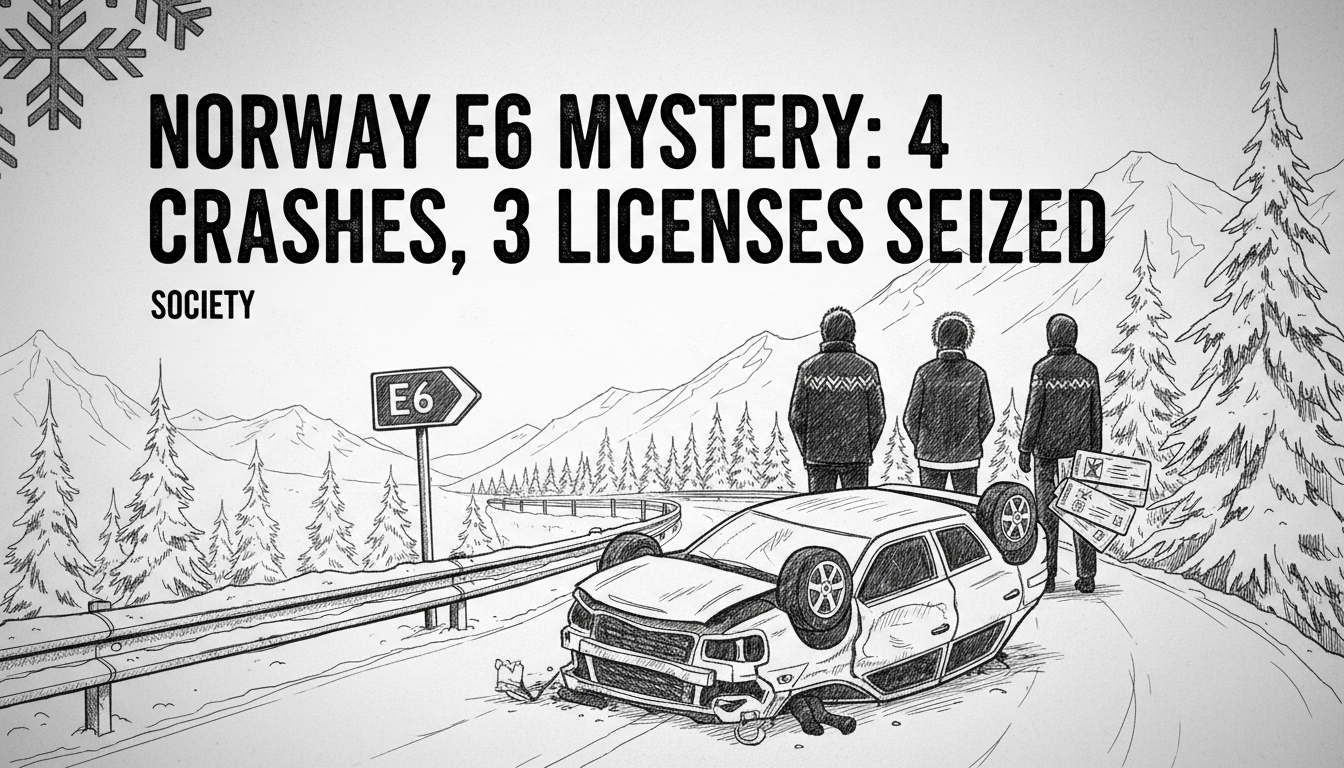
Norway's E6 highway witnessed a baffling series of four separate accidents at the same location in Nordland county early Sunday morning. Police confiscated the driving licenses of three motorists involved in the crashes near Sagpollen in Hamarøy municipality, raising immediate questions about the cause of the repeated incidents.
The first collision was reported to Nordland Police District at 00:45. According to operations leader Kai Henrik Eriksen, a single vehicle struck a rock wall. "The car hit a mountain wall, spun around on its roof, and ended up on its wheels again," Eriksen said in a statement. Other motorists stopped to assist the driver, who was conscious and able to stand.
Despite this initial crash, three more vehicles were subsequently involved in accidents at the same spot. The police have not released details on the nature of the follow-on collisions or possible injuries. The decision to seize three licenses indicates officers suspect serious traffic violations, such as impairment or reckless driving, were factors.
A Notorious Stretch of Road
The E6 is Norway's vital arterial road, running over 3,100 kilometers from the southern coast to the Russian border. The stretch through Nordland, above the Arctic Circle, is known for its dramatic and challenging terrain. Long, dark winters combined with rapidly changing weather create notoriously difficult driving conditions. While the road is a modern highway in many sections, other parts, particularly in the north, are narrower and wind through rugged landscapes.
Local officials have long highlighted safety concerns on northern segments of the E6. The area near Sagpollen is not marked as a statistically high-accident zone on national road authority maps, which makes this cluster of incidents more unusual. It suggests a specific, temporary hazard or a coincidental concentration of driver error.
"When we see multiple incidents in the same location over a short period, it demands a thorough investigation," said a senior traffic engineer with the Norwegian Public Roads Administration, who spoke on background. "The immediate suspicion falls on a sudden change in road conditions—like black ice, heavy snowfall, or oil spillage—or on driver-related factors that became apparent at that specific time."
The Immediate Police Response
The police response involved securing the scene, assisting drivers, and initiating an immediate traffic investigation. Confiscating a driver's license on the spot is a significant measure under Norwegian law. Police can seize a license immediately if they have reasonable grounds to believe a driver is under the influence of alcohol or drugs, is driving dangerously, or is medically unfit.
The seizure is typically followed by a formal review, which can lead to a temporary suspension or permanent revocation. The fact that three licenses were taken suggests police found compelling evidence against those drivers shortly after the accidents occurred.
"Our priority was securing the area and ensuring no further collisions occurred," said Eriksen. The police have launched a standard investigation to determine the exact sequence of events and assign responsibility. This will involve examining vehicle data, possible witness statements, and a detailed analysis of the road surface and weather at the time.
Unpacking the Potential Causes
Road safety experts point to a limited set of plausible explanations for such a cluster of accidents. The most common factor in single-vehicle accidents in Norway, especially at night, is driver fatigue. The long, monotonous stretches of the E6, particularly in the north, can lull drivers into inattention.
Impaired driving due to alcohol or drugs is another primary concern, though random checks are frequent in Norway. Speed inappropriate for the conditions is a perennial issue. Norway has strict speed limits, but adherence can wane on long, open roads.
Environmental factors are a major suspect. Early Sunday morning in Nordland in late winter or early spring presents a high risk for black ice—a thin, transparent layer of ice that forms on the road surface and is virtually invisible to drivers. A sudden snow squall or patch of freezing fog could also drastically reduce visibility and traction on a specific curve or incline.
"It's rare but not unheard of for a specific micro-section of road to become a trap," explained the traffic engineer. "A small water seepage across the road can freeze instantly. A truck might leak hydraulic fluid. The investigation will look for any such transient hazard that was then cleared by traffic or weather by the time daylight came."
The Broader Context of Norwegian Road Safety
Norway consistently ranks as one of the safest countries in the world for road travel, a achievement credited to rigorous laws, extensive public education, and continuous investment in infrastructure. The country's Vision Zero policy, which aims to eliminate all traffic fatalities and serious injuries, is a cornerstone of its transport policy.
Despite this, remote highways like the E6 in Nordland present unique challenges. Maintenance crews cannot be everywhere at once, and distances between service stations are vast. The population is sparse, meaning emergency response times are longer than in urban areas.
The Norwegian Public Roads Administration (Statens vegvesen) has an ongoing program to upgrade the E6, including straightening dangerous curves, adding barriers, and improving lighting. However, the scale of the project means some high-risk sections remain for years.
This incident will likely prompt a fresh local review of the Sagpollen area. If the investigation reveals a correctable road condition—like poor drainage or inadequate signage—the roads administration will be under pressure to act quickly.
What Happens Next for the Drivers
The three drivers who lost their licenses face an anxious wait. The police will submit their reports to the relevant administrative authority, which will decide on the duration of the suspension. For serious offenses like high-level drunk driving, licenses can be revoked for years, requiring drivers to retake their tests.
They may also face criminal charges if evidence of gross negligence or impairment is found. In cases involving injury, penalties can be severe. Norwegian law takes a harsh view on dangerous driving, reflecting the society's commitment to road safety.
Insurance claims from all four vehicles will be complex, with investigators needing to untangle the sequence of events to determine liability. If a road hazard is proven to be the primary cause, the state could potentially face claims.
A Warning to All Motorists
This strange cluster of accidents on the E6 serves as a stark reminder of the inherent risks of long-distance driving, especially in Norway's northern regions. It underscores the non-negotiable rules of Arctic driving: extreme vigilance, speeds adjusted far below the limit for conditions, and absolute sobriety.
For now, the stretch of road near Sagpollen has returned to normal traffic flow. But the questions linger in the dark. Was it a ghostly patch of ice, a moment of collective human error, or a tragic coincidence? The police investigation holds the answers, and its findings will determine whether this location is simply unlucky or fundamentally unsafe. Until then, it stands as a cryptic black mark on Norway's safest highway.