
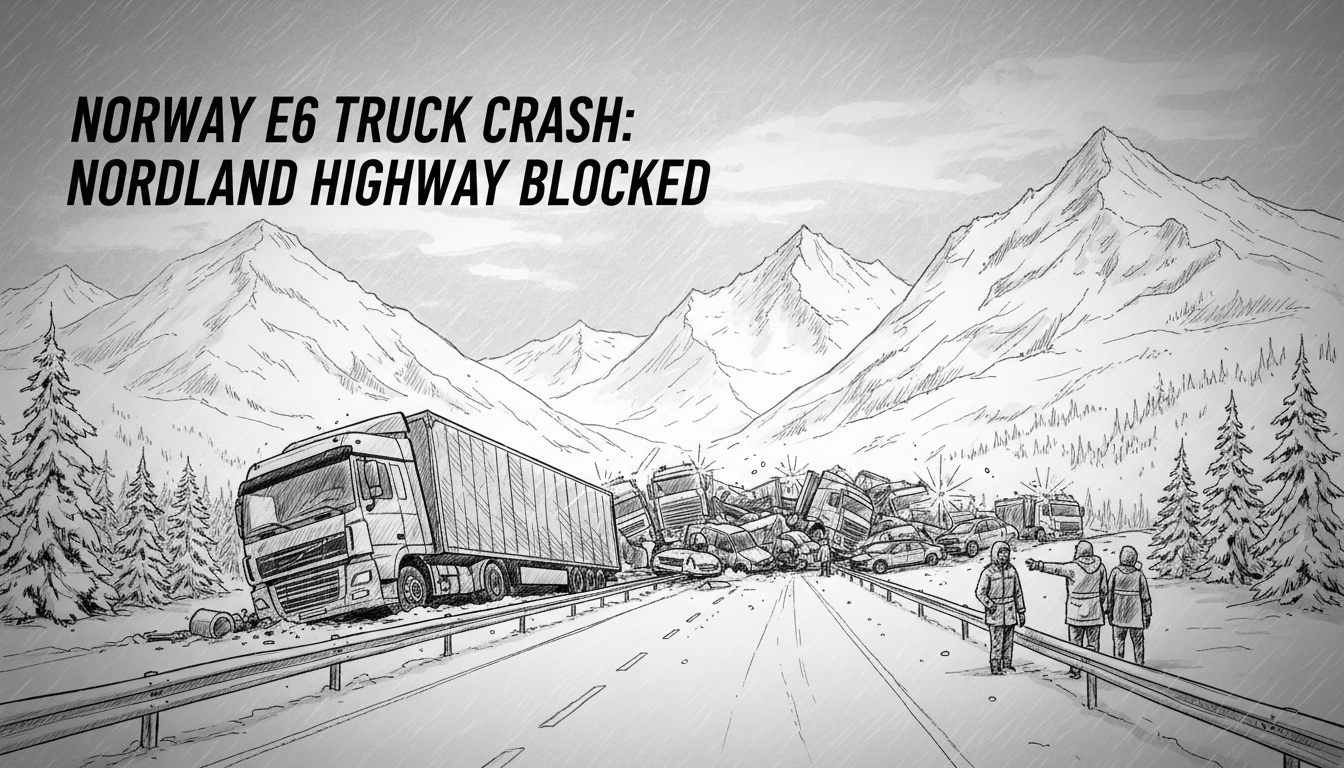
Norway's E6 highway is blocked near Sagpollen in Hamarøy municipality after a semi-trailer truck overturned across the roadway. Police confirmed the closure just after 1:00 PM local time. The driver escaped without injury. Emergency services had responded to a separate single-vehicle accident in the same area shortly before the truck crash. That driver was conscious and standing after other motorists provided assistance, according to police operations leader Kai Henrik Eriksen. The dual incidents have severed the primary north-south transport artery in Northern Norway, highlighting the region's vulnerability to road closures.
A Critical Artery Severed
The E6 is Norway's national spine, a 3,000-kilometer ribbon of asphalt running from the Swedish border to the Russian frontier at Kirkenes. In the rugged terrain of Nordland county, alternatives are scarce. The closure at Sagpollen creates an immediate logistical choke point. Local traffic is forced onto smaller, winding county roads ill-suited for heavy goods vehicles. For long-haul freight, the detours add hundreds of kilometers and hours of delay. "When the E6 closes in this area, everything stops," said Lars Moe, a transport analyst based in Bodø. "There is no parallel rail line capable of handling significant freight volume here. The road is it."
The accident site sits in a region defined by fjords and mountains. Hamarøy municipality, with a population scattered across islands and mainland, relies completely on the E6 for connection to major centers like Narvik and Bodø. Local businesses, from fisheries to tourism operators, now face disrupted supply chains and cancelled visits. The economic ripple effect begins the moment the road closes.
The Human Element in Harsh Conditions
While the truck driver was unharmed, the earlier single-vehicle accident serves as a stark reminder of the risks inherent on this highway. Police described a car striking a rock face, rolling onto its roof, and landing back on its wheels. Passersby helped the driver before emergency crews arrived. This sequence is familiar to Northern Norwegian rescue services. Winter conditions—ice, snow, and polar darkness—are often cited as primary factors, but summer brings its own challenges with tourist traffic and narrow, unfamiliar roads.
Heavy goods vehicles, or 'vogntog', are involved in 10 to 15 percent of all injury accidents on Norwegian roads. Experts point to a combination of factors: driver fatigue on long Arctic hauls, challenging weather, and the physics of managing a 50-ton vehicle on steep grades and sharp curves. "The margin for error is minimal," explained Dr. Anette Berge, a road safety researcher at the Institute of Transport Economics. "A slight misjudgment in speed or positioning on a curve can have catastrophic consequences, especially with a fully loaded trailer. Continuous training and strict adherence to rest periods are non-negotiable."
The Economic and Strategic Fallout
Beyond the immediate traffic disruption, such accidents expose deeper strategic vulnerabilities. Northern Norway's economy is tied to the seamless operation of the E6. Fresh fish from Lofoten needs to reach European markets. Supplies for the region's towns and villages arrive by truck. Major industrial projects, including those related to energy and minerals, depend on reliable heavy transport. A prolonged closure can force production halts and incur contractual penalties.
The Norwegian Public Roads Administration maintains a contingency plan for major E6 disruptions, but options are limited. In some sections, ferry connections can provide a bypass, but they have limited capacity and are subject to weather. The incident will likely reignite political debate about infrastructure investment in the north. Proposals for road-widening projects, more passing lanes, and improved safety barriers often compete for funding with other national priorities. Each major accident adds weight to the argument for accelerated upgrades.
A Pattern of Vulnerability
This is not an isolated event. The E6 in Nordland has seen several serious truck accidents in recent years, leading to multi-day closures. Each incident follows a similar pattern: a critical blockage, a scramble for alternatives, and significant economic disruption. The frequency raises questions about whether current safety measures are sufficient. Road design standards from the 1960s and 70s, when much of this highway was built, do not meet modern traffic volume and vehicle size requirements.
Local politicians have long advocated for targeted safety campaigns and infrastructure hardening in known high-risk sections. "We know the curves that are problematic. We know the stretches where crosswinds are dangerous," said Hanna Johansen, a county councilor for Nordland. "Investment in proactive safety—better signage, improved road surfaces, more barrier systems—is an investment in regional economic security. We cannot accept these closures as an inevitable cost of living in the north."
Looking Ahead: Resilience and Response
As recovery crews work to clear the overturned truck and investigate the cause, the focus turns to resilience. How can Northern Norway build a transport system that can withstand these shocks? Experts suggest a multi-pronged approach. First, accelerating the E6 upgrade program is essential. Second, exploring modal shift, even incrementally, for certain types of freight could reduce risk. Third, enhancing real-time communication and dynamic routing for truck drivers regarding weather and road conditions could prevent accidents.
The Sagpollen closure is a dramatic, visible failure. But it underscores a chronic condition. Norway's prosperity is built on efficient transport, and its most geographically vulnerable region is served by a single, fragile thread. The truck will be righted, the debris cleared, and the E6 will reopen. The question for policymakers in Oslo is whether they will simply restore the status quo or take decisive action to strengthen the artery that keeps the north alive. The next winter is only a few months away.