
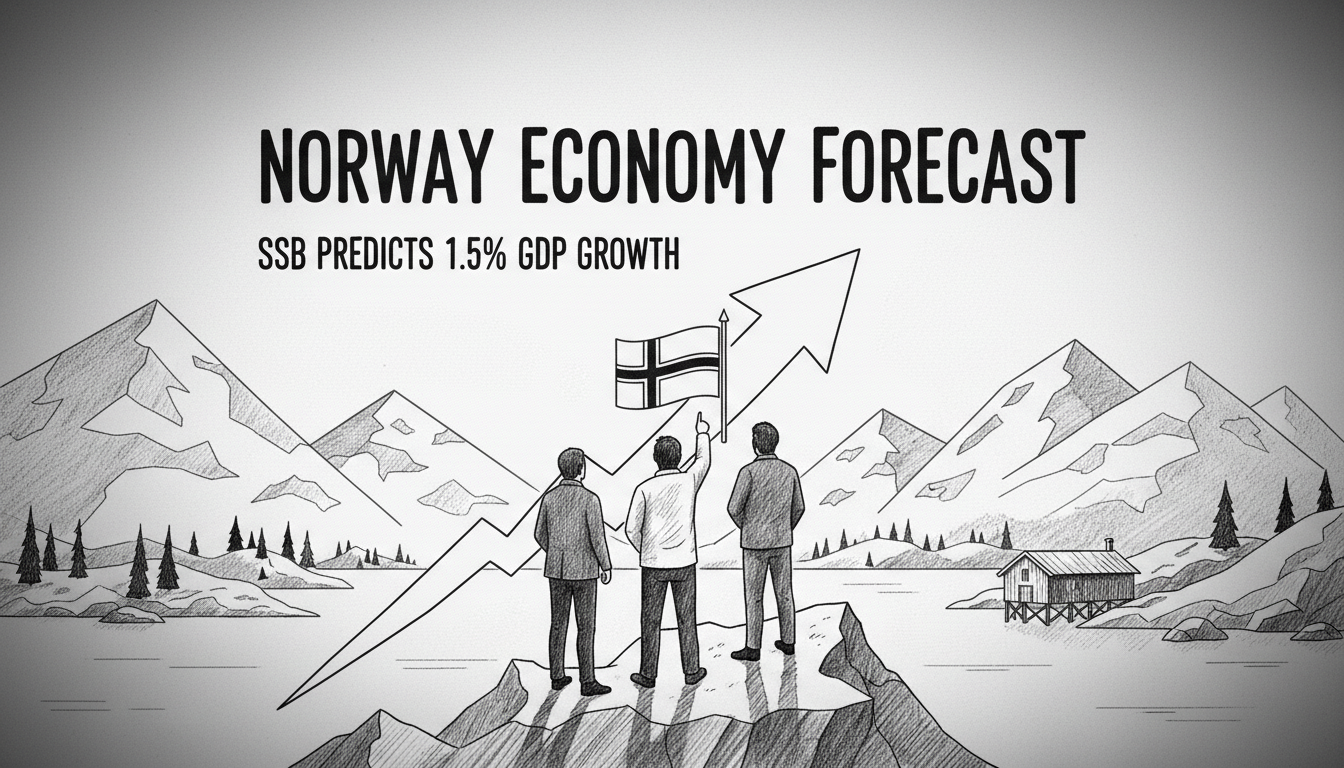
Norway's economy is set for a period of stable, moderate expansion according to the latest official forecast. Statistics Norway (SSB) projects mainland GDP growth will settle at a 'normal' pace of approximately 1.5 percent annually through 2028. This steady trajectory emerges despite significant headwinds from a cooling housing market and reduced petroleum sector investment.
'Despite ongoing trade conflicts and uncertainty surrounding EU cooperation, growth in the Norwegian economy is expected to remain positive in the years ahead,' said SSB research director Thomas von Brasch in a statement accompanying the report. The forecast highlights a shifting economic engine, where weaker construction and oil investments will be counterbalanced by stronger household spending and increased public demand.
A Shift in Economic Drivers
The projected 1.5 percent growth rate represents a return to a long-term average for Norway, distinct from the volatile swings driven by oil price cycles. This normalization comes with a notable change in its composition. For years, massive investments in offshore projects like Johan Sverdrup and Johan Castberg fueled economic activity. That phase is now moderating.
Simultaneously, the red-hot housing market, particularly in cities like Oslo, Bergen, and Trondheim, has cooled. Construction starts have declined, removing another traditional growth pillar. In their place, Norwegian consumers are opening their wallets. Rising real wages, supported by negotiated pay increases and moderating inflation, are boosting disposable income. This is translating directly into stronger retail sales and service sector activity.
Public spending is also providing a lift. Municipal and state budgets are expanding, funding everything from healthcare and education to infrastructure projects outside the oil sector. This fiscal support acts as a stabilizer, ensuring domestic demand remains resilient even when export-oriented industries face global uncertainty.
The Persistent Shadow of Oil and Global Politics
While the economy diversifies, the petroleum sector remains the elephant in the room. Norway is the largest oil and gas producer in Western Europe, and revenues from the continental shelf still fill the world's largest sovereign wealth fund, the Government Pension Fund Global. Any significant shift in oil prices or investment plans sends ripples through the entire economy.
The SSB's 'normal' forecast is predicated on a stable, if not spectacular, outlook for the sector. Investments are declining from historic peaks but remain substantial as the industry focuses on extending the life of existing fields and exploring new areas, including in the Barents Sea. The export revenue from oil and gas continues to provide a formidable financial buffer, allowing for the steady public demand cited in the forecast.
However, von Brasch explicitly notes external threats. 'Ongoing trade conflicts and uncertainty surrounding EU cooperation' are key risks. Norway is not an EU member but is deeply integrated through the European Economic Area (EEA) agreement. Any disruption to this framework or to global trade flows would immediately impact Norway's export-dependent businesses, from seafood producers in Tromsø to maritime equipment manufacturers in Stavanger.
Expert Analysis: Stability Versus Ambition
Economic analysts received the SSB report as a portrait of remarkable stability, but some question if 'normal' is sufficient for the long term. 'A 1.5 percent growth rate is manageable for a wealthy, mature economy like Norway's, especially with our vast sovereign wealth fund,' says Kari Due-Andresen, a senior economist at the independent research institute NUPI. 'But it does raise questions about productivity and our competitive edge beyond hydrocarbons.'
This sentiment echoes a long-running debate in Norwegian policy circles. The nation has successfully navigated the transition from an oil-fueled boom economy to a more balanced one, avoiding the 'Dutch disease' that plagued other resource-rich nations. Yet the next transition—toward a leading position in green industries like offshore wind, hydrogen, and carbon capture—requires higher levels of private investment and innovation.
The forecast's modest growth rate suggests this transformation is progressing incrementally, not revolutionarily. Increased household consumption is good for short-term economic activity, but it does not automatically translate into the capital formation needed for future industries. The government's recent push to approve more offshore wind projects and fund green industrial initiatives is a direct response to this challenge, aiming to create new investment cycles to eventually replace those from oil and gas.
Regional Implications and the Housing Market Correction
The national figures mask significant regional variations. Regions heavily dependent on the offshore supply chain, such as Rogaland and Møre og Romsdal, may feel the pinch of reduced oil investments more acutely. Meanwhile, areas with large public sectors or growing tourism and consumer services, like around the Oslofjord, may align more closely with the national average.
The cooling housing market is a deliberate outcome of the central bank's (Norges Bank) policy. To combat inflation, interest rates were raised significantly. This successfully tempered the market, slowing price growth and construction. The SSB forecast suggests this cooling will be orderly, not a crash, and that its dampening effect on the broader economy will be contained. The risk remains that higher mortgage costs could eventually bite deeper into consumer confidence, but for now, strong wage growth is acting as a counterweight.
The Road to 2028: Managed Transition
Looking ahead to the forecast horizon of 2028, Norway's economic story appears to be one of managed transition. The era of breakneck growth fueled by simultaneous oil and housing booms is over. What has replaced it is a more sedate, stable model where the state, through its fiscal muscle and sovereign wealth fund, plays a central role in smoothing out volatility.
The key question for policymakers in the Storting, Norway's parliament, is whether this model is sustainable for decades to come. The Government Pension Fund Global, valued at over $1.6 trillion, provides unparalleled security. Yet its very existence can dampen entrepreneurial urgency. The challenge is to leverage the fund's financial safety net to foster greater risk-taking and innovation in the private sector, particularly in green technology.
The SSB's forecast offers no dramatic headlines—no impending recession, no unexpected boom. Instead, it paints a picture of an affluent society navigating a post-peak-oil investment landscape with considerable tools at its disposal. The 'normal fart' or 'normal speed' is, in many ways, a testament to successful economic management. Yet in a world racing to address climate change and technological disruption, normalcy itself may become Norway's greatest economic risk. Can a nation built on hydrocarbon exports and prudent stewardship maintain its exceptional standard of living by simply staying the course? The next five years will provide the beginning of an answer.