
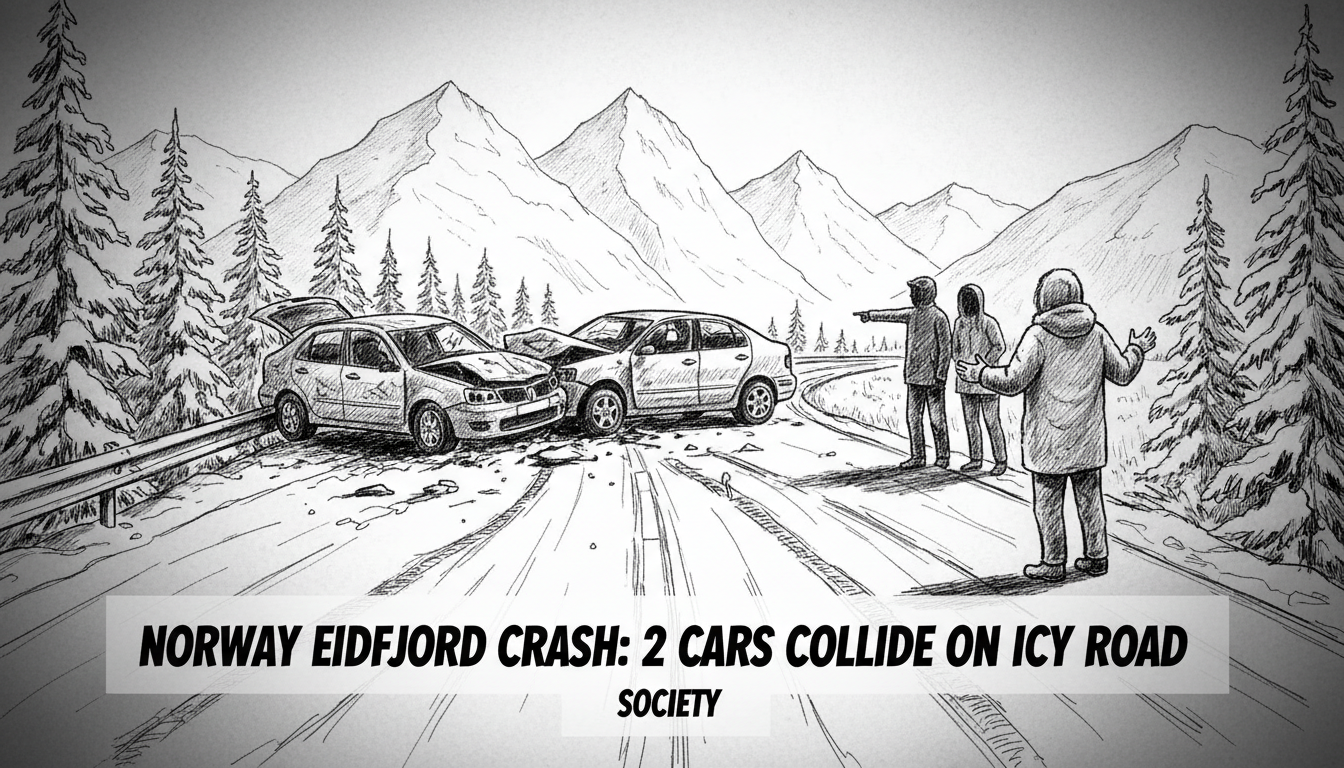
Norway's treacherous winter roads claimed another near-miss Monday as two cars collided head-on near Sysenvatnet lake in Eidfjord municipality. The crash occurred on a notoriously slippery stretch of road at Maurset, a small village serving as a gateway to the Hardangervidda plateau. Emergency services, alerted by the 110 emergency center, were dispatched to the remote scene with the involved drivers reported as conscious.
"The road in the area is extremely slippery," said duty commander Tore Fanebust from the 110 West emergency center, confirming the response. The incident highlights the persistent seasonal danger on Norway's secondary and tourist routes, where dramatic landscapes meet challenging driving conditions. For the drivers involved, the collision on the icy tarmac near Sysenvatnet represents a sudden, violent interruption to their journey through one of Norway's most scenic regions.
A Routine Drive Turns Dangerous
The collision happened in an area known for its raw natural beauty and unpredictable weather. Eidfjord, in Vestland county, is characterized by steep fjord walls and high mountain passes. Roads like the one at Maurset wind through this terrain, offering stunning views but demanding constant driver attention. During winter, these routes transform. Black ice forms quickly on shaded stretches, and blowing snow can reduce visibility in moments.
Local authorities did not immediately release details on the vehicles' models or the drivers' identities, standard practice in ongoing response operations. The primary concern was securing the scene and ensuring medical assessment. The fact that both drivers were awake and conscious upon the arrival of first responders is a positive initial indicator, though medical professionals stress that shock and latent injuries are common in such accidents.
The Logistical Challenge of Mountain Rescue
Responding to accidents in municipalities like Eidfjord presents a distinct set of challenges for Norway's emergency services. The terrain is rugged and sparsely populated. Long distances between communities mean longer response times for police, ambulance, and tow trucks. Weather conditions can further hinder access, with snowstorms sometimes requiring snowplows to clear a path for rescue vehicles.
This operational reality underscores a national conversation about resource allocation for the Norwegian Emergency Network (Nødnett) and local fire and rescue departments. "Every winter, we see these incidents in our mountain districts," said a veteran coordinator with the Norwegian Public Roads Administration (Statens vegvesen), who asked not to be named as they were not authorized to speak on this specific case. "The infrastructure is there, but the distances and the weather are factors we can never fully control. Preparedness is key."
Winter Statistics Paint a Clear Picture
While final figures for 2024 are not yet available, preliminary data for 2023 from the Norwegian Public Roads Administration provides crucial context. Last year, 117 people died in road traffic accidents across Norway. This was a decrease from 123 fatalities in 2022, continuing a general long-term downward trend attributed to safer cars, improved road engineering, and persistent public safety campaigns.
However, the distribution of accidents is not even. Vestland county, encompassing Eidfjord and the entire western fjord region, consistently records a higher incidence of weather-related accidents during the winter months. The combination of coastal moisture, freezing temperatures at altitude, and heavy tourist and commercial traffic on a few key arteries creates a persistent hazard zone from November through April.
| Road Safety in Norway (Preliminary Data) | 2022 | 2023 |
|---|---|---|
| Total Road Fatalities | 123 | 117 |
| Accidents Involving Winter Conditions (Est.)* | ~35% of total | ~34% of total |
| Estimated percentage of all serious accidents where ice/snow was a contributing factor. Source: Norwegian Public Roads Administration |
Expert Analysis: Beyond the Winter Tire
Road safety experts point to a multi-layered approach required for safe winter driving in Norway. "It starts with equipment, but it does not end there," explained Dr. Lena Holm, a transport safety researcher at the Institute of Transport Economics (TØI). "Yes, proper winter tires with adequate tread depth are a legal requirement and an absolute necessity. But driver behavior is the larger variable."
Holm's research emphasizes the "risk compensation" phenomenon, where drivers with better equipment sometimes adopt riskier behaviors, such as driving too fast for the conditions. "On a road like the one in Eidfjord, you might have a clear sky, but the road surface in the shadow of a mountain can be a sheet of ice. Speed must be adjusted accordingly, and following distance must be increased dramatically," she said.
Experts also highlight the importance of trip planning. Checking the nationwide road condition service (vegvesen.no/trafikkinformasjon) for real-time updates on ice warnings, closed passes, and convoy driving is considered essential before entering mountainous areas. Carrying emergency supplies—a blanket, food, water, and a shovel—is standard advice for winter travel in remote regions.
The Tourism Dimension and Infrastructure Pressure
Eidfjord's economy is significantly tied to tourism. The municipality is a popular stop for cruise ships and a base for exploring the Hardangervidda National Park and the Vøringsfossen waterfall. This influx, while beneficial, adds pressure to local road networks. Rental cars driven by international visitors unfamiliar with Norwegian winter conditions mix with local traffic and heavy transport vehicles.
"We see a clear pattern in some accident data," noted the road administration coordinator. "Unfamiliarity with the road, combined with a desire to reach a destination or sightsee, can lead to misjudgments. A bend that a local knows is always icy is taken at the wrong speed by someone new to the area." This has led to calls for more prominent, multi-language signage in tourist-heavy areas, warning of specific hazards like frequent ice or falling rock.
Policy Responses and Future Directions
The Norwegian government and the Public Roads Administration continuously evaluate road safety measures. Recent years have seen increased investment in automated weather stations that provide real-time surface condition data, which is fed into public apps. There is also ongoing work to improve physical road infrastructure, such as adding more anti-icing spray systems on critical slopes and curves.
However, funding is always finite, and priorities must be set. Major highways like the E16 or the E134 often receive the bulk of attention and winter maintenance resources. Smaller municipal roads, like the one at Maurset, rely on local budgets and patrols. This disparity can lead to variations in how quickly a road is treated after a snowfall or ice warning.
Some safety advocates propose stricter measures during extreme weather, such as mandating the use of studded tires in certain alpine zones or implementing temporary lower speed limits on specific routes based on weather data. These proposals are often debated, balancing safety against personal freedom and economic practicality.
A Close Call with a Broader Message
The head-on collision in Eidfjord ended without reported fatalities, a fortunate outcome that will not make national headlines. Yet, it serves as a stark, real-time reminder of the risks inherent in Norwegian winter mobility. It underscores the complex interplay between nature, infrastructure, technology, and human judgment.
For the residents of Vestland, it is a familiar winter story. For the authorities, it is another data point in the relentless effort to drive the number of accidents toward zero. For every driver navigating Norway's breathtaking but demanding landscapes this season, the incident near Sysenvatnet is a prompt: to check the tires, to check the forecast, and most importantly, to adjust their speed to the invisible threat of black ice hiding in the mountain shadows. The road to absolute safety remains long and winding, much like the roads of Eidfjord themselves.