
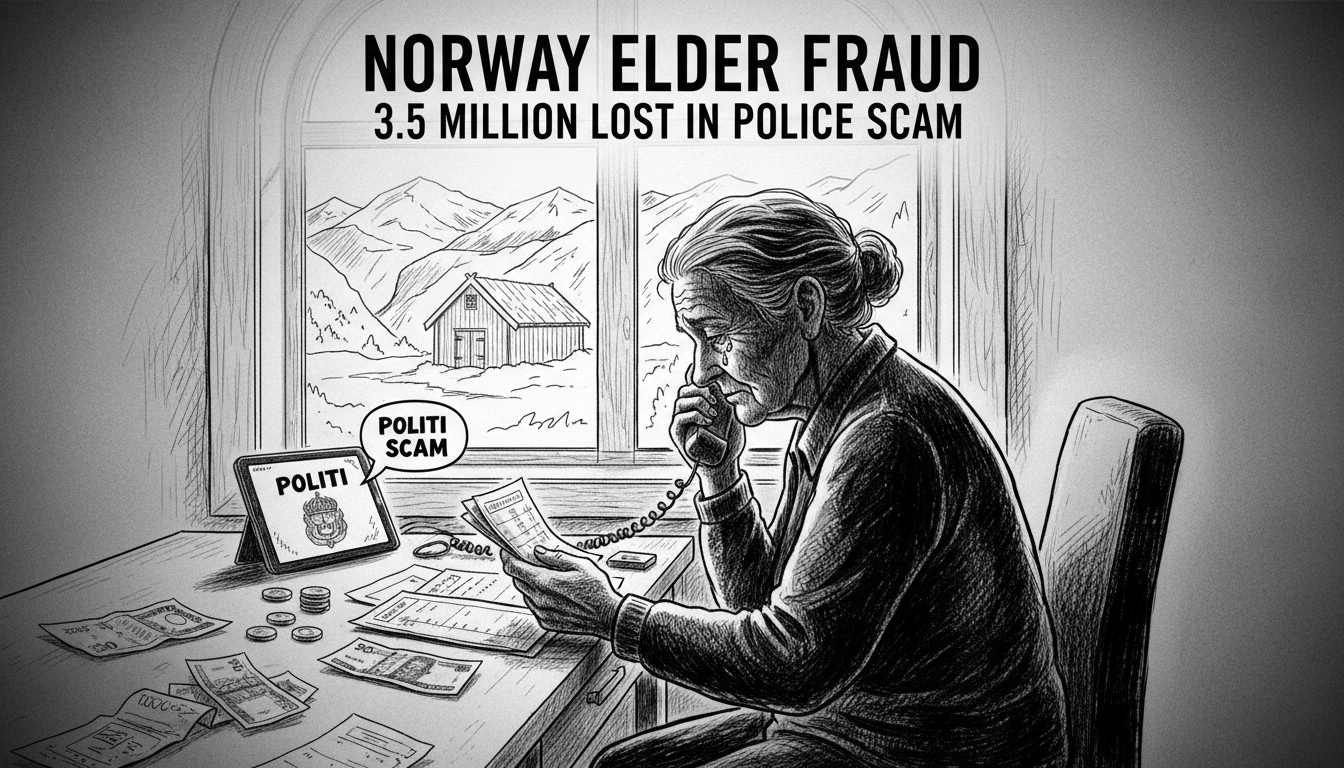
Norway's Møre og Romsdal police district has charged a Danish woman with aggravated fraud after a complex scam targeting a 70-year-old victim. The case highlights a growing threat across Scandinavia as criminals use sophisticated social manipulation to steal millions from elderly residents. A woman in her 50s from Denmark now faces prosecution for allegedly defrauding a Romsdal woman of 3.5 million Norwegian kroner.
Prosecutors state the scam involved the accused impersonating a police officer. Through this false authority, she convinced the elderly victim she was under investigation. The manipulation escalated, persuading the woman to travel to Turkey under false pretenses. This transnational element complicates the investigation and underscores the borderless nature of modern financial crime.
Anatomy of a Transnational Scam
The case follows a familiar yet devastating pattern seen across Europe. Scammers first establish trust by posing as figures of authority—police, bank officials, or government agents. They create a fabricated crisis, often alleging compromised accounts or criminal activity in the victim's name. Fear and urgency become the primary tools for manipulation.
In this instance, the perpetrator maintained prolonged contact with the victim. She built a narrative that required the victim to cooperate fully with the 'investigation.' This cooperation allegedly included transferring substantial sums of money. The final, extraordinary step was convincing the victim to travel internationally, isolating her further from family and local support networks in Norway.
A Rising Tide of Elder Fraud
This case is not isolated. Norwegian authorities report a sharp increase in fraud targeting older citizens. In 2023, reported losses from such scams reached hundreds of millions of kroner nationwide. The actual figure is likely higher, as shame and embarrassment prevent many victims from coming forward.
“These criminals are ruthless and systematic,” said a senior advisor with the Norwegian National Authority for Investigation and Prosecution of Economic and Environmental Crime. “They prey on trust and societal respect for institutions. When someone claiming to be a police officer tells you to act, many people, especially from an older generation, will follow instructions without question.”
Interpol has issued repeated warnings about networks operating across European borders. These groups often use voice-over-internet calls that mask their true location. Money is frequently funneled through complex chains of accounts or moved via cryptocurrency, making recovery nearly impossible.
The Human Cost Beyond the Millions
The financial loss of 3.5 million NOK is catastrophic for most individuals. For a retiree, it can represent a lifetime of savings, obliterating financial security. The damage, however, extends far beyond the bank balance. Victims experience profound psychological trauma, including severe shame, anxiety, and a shattered sense of trust.
“The emotional impact is comparable to a violent crime,” explained a psychologist specializing in fraud victim support. “The victim is left feeling foolish and vulnerable. They often withdraw socially, fearing judgment from family and friends. Restoring that sense of safety and trust is a long, difficult process.”
The manipulation can also strain family relationships. Relatives may question why the victim did not consult them, while the victim may feel infantilized by the oversight. This social rupture adds another layer of loss to the financial devastation.
Legal Challenges in Cross-Border Prosecution
The charging of a Danish national by Norwegian prosecutors demonstrates active international cooperation. The European Union Agency for Criminal Justice Cooperation likely facilitated evidence sharing and legal requests between Norway and Denmark. The victim's travel to Turkey introduces a third jurisdiction, complicating the investigative landscape.
Aggravated fraud charges in Norway carry a maximum prison sentence of six years. Prosecutors must prove the accused acted with intent and that the fraud was of a particularly serious nature, which the substantial sum and method of deception clearly indicate. The case will test the mechanisms for holding individuals accountable for crimes orchestrated across multiple countries.
“Jurisdiction is a constant challenge,” a legal expert on international fraud noted. “Scammers operate from one country, target victims in another, and move money through a third. Closing that net requires seamless coordination between police forces and prosecutors, which is improving but still faces bureaucratic hurdles.”
Prevention and Awareness Strategies
Norwegian police, alongside organizations like the Norwegian Consumer Council, run continuous awareness campaigns. They advise the public that no legitimate police officer or bank official will ever demand immediate payments, ask for PIN codes, or instruct someone to withdraw large cash sums. A key message is to always hang up and call the institution back using a verified number from their official website or a statement.
Families are encouraged to have open conversations with elderly relatives about these threats. Establishing a simple rule—like always checking with a trusted family member before transferring money due to an unsolicited call—can provide a critical safety net. Technology solutions, such as call-blocking services and bank account alerts for large transactions, also offer layers of defense.
A Question of Societal Responsibility
The case from Romsdal forces a broader societal question: how do we better protect vulnerable citizens in a digitally connected world? Banks are enhancing fraud detection algorithms and training staff to spot customers who may be under coercion. Social services are increasing their outreach to isolated seniors.
Yet, the onus cannot be on the victims alone. Law enforcement agencies argue for stronger international legal frameworks to pursue digital fraudsters. They also call for greater responsibility from telecommunications and tech companies to identify and shut down fraudulent operations more swiftly.
As this case moves through the Norwegian legal system, it serves as a stark reminder. The combination of social engineering and digital tools has created a potent threat. For every successful prosecution, countless scams go unreported or unresolved. The 3.5 million kroner lost in Romsdal is more than a statistic; it is a life altered and a warning that demands a coordinated response from individuals, families, institutions, and governments across Scandinavia and beyond.
Will increased awareness and international cooperation be enough to stem the tide, or will fraudsters continue to innovate faster than our defenses?