
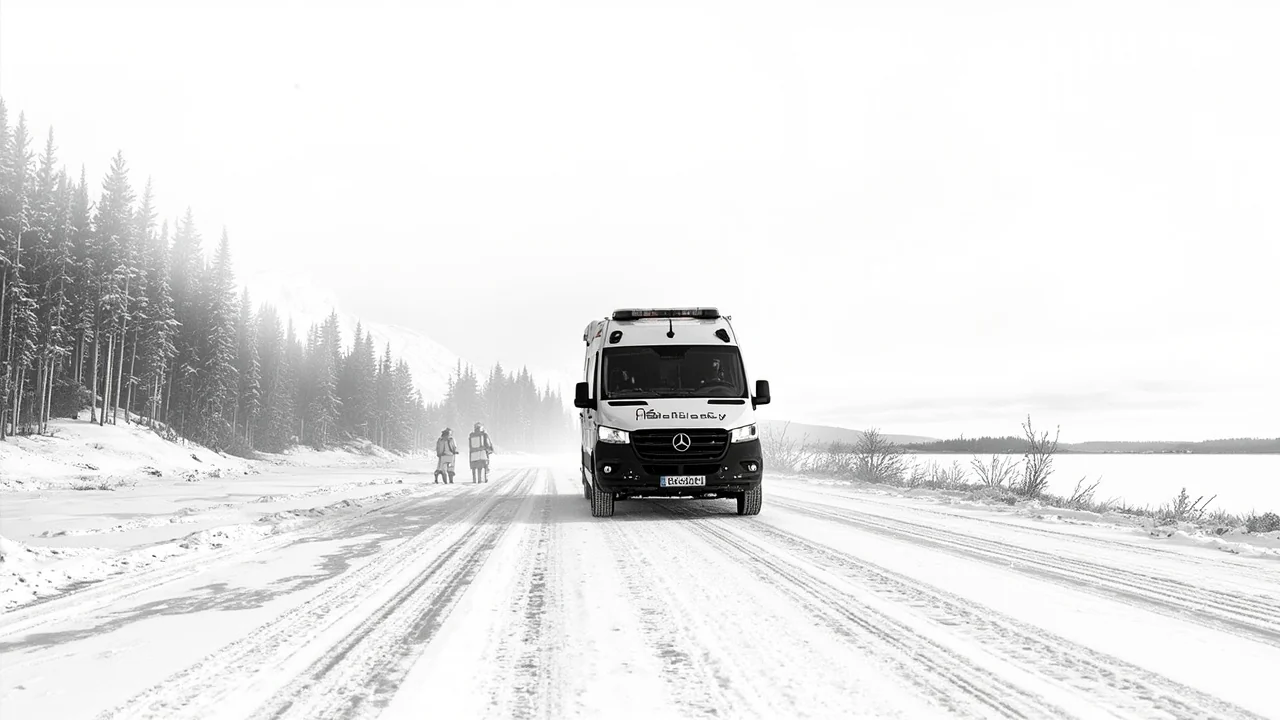
Norway’s ambitious push for electric vehicles in public services stranded a patient in the Arctic after his transport ran out of power on a remote mountain pass. The incident on January 2nd has ignited a fierce debate over the practical limits of the country’s green transition in its most severe climates. Mikkel Eriksen was being transported 150 kilometers from Hammerfest Hospital to his home in Alta when the taxi stopped with 25 kilometers left to go. The temperature was minus 15 degrees Celsius.
The Stranding on Sennalandet
Mikkel Eriksen was returning home after an acute hospital stay over the Christmas holidays. The electric taxi, operated by Hammerfest Taxi, was completing a standard patient transport route. As it crossed the exposed Sennalandet mountain plateau, strong headwinds drained the battery faster than anticipated. The vehicle came to a complete stop. A recovery vehicle was estimated to be one hour and forty minutes away. Eriksen, growing increasingly frustrated and cold, called his wife. She had to drive from Alta to collect him. “Then we were standing there and I started to get a little irritated,” Eriksen said of the experience.
Policy Versus Arctic Reality
The failed trip was a direct result of a policy enacted by the regional health authority, Helse Nord. To meet national goals of a climate-neutral public sector by 2045, all new taxis used for non-emergency patient transport must be fully electric. Companies contracted for these services are granted dispensation to use hybrids only when necessary. A communications chief for the Finnmark Hospital Trust, Eirik Palm, stated the policy clearly: “Transporters must not start a transport if this is assessed as risky, and must in that case confer with the Patient Travel service.” The critical question raised by the incident is whether that risk assessment failed, or if the policy itself is fundamentally flawed for Arctic conditions.
A Systemic Failure in Risk Assessment
This was not a simple case of a driver misjudging battery range. It represents a systemic breakdown in the chain of responsibility between policy makers, transport contractors, and logistics planners. The contracting system places the operational risk assessment on the taxi companies, who face both contractual obligations to use electric vehicles and commercial pressures to accept jobs. On a 150-kilometer route in a Finnish winter, with known mountainous terrain and unpredictable winds, the margin for error is perilously thin. Experts in Arctic logistics point out that battery performance can plummet by 40% or more in extreme cold, a factor that must be centrally planned for, not left as an afterthought for individual drivers to calculate.
The Human Cost of Green Targets
While the environmental goals are lauded, the incident exposes a disregard for patient welfare and dignity in remote regions. Non-emergency patient transport is often used by the elderly, chronically ill, and vulnerable. A stranding is not merely an inconvenience; it is a serious health and safety risk in an environment where exposure can be deadly. The policy, designed in administrative centers like Tromsø or Oslo, appears disconnected from the geographical realities of Norway’s largest and most sparsely populated county. Finnmark’s population of 75,000 is spread over an area larger than Denmark, with vast distances between critical health services. Reliability is not a luxury here; it is a prerequisite for basic care.
A National Reckoning on Electrification
The Eriksen case has struck a nerve in Norway’s ongoing national conversation about its world-leading electric vehicle adoption. The country has the highest per capita EV ownership globally, fueled by generous subsidies and a comprehensive charging network. However, that network’s density plummets north of the Arctic Circle. The government’s own 2025 target for all new cars to be zero-emission is now colliding with practical, lived experience. Political figures from northern constituencies are seizing on the incident. They argue that a one-size-fits-all national mandate is irresponsible without massive, prior investment in ruggedized infrastructure and technology adapted for polar conditions.
The Road Ahead for Patient Safety
The immediate response from health authorities will be scrutinized. Will Helse Nord issue new, strict guidelines prohibiting long-distance electric patient transports in winter without guaranteed overnight charging points? Or will it double down, viewing this as a necessary growing pain in the green transition? Sustainable solutions exist but require investment: strategically placed fast-charging stations at hospitals and along key transport corridors, mandates for EVs with significantly larger winter-range buffers for this specific use, or the permanent approval of advanced hybrid vehicles for all long-distance Arctic health transports. The alternative is to continue gambling with patient safety for the sake of a policy checkbox.
This single stranded taxi on a Finnmark mountain pass has become a powerful symbol. It illustrates the tension between Norway’s visionary climate leadership and the immutable facts of its own geography. As the country continues its mandated shift away from fossil fuels, it must answer a difficult question: can its policies be both the greenest in the world and the most adaptable to the world’s harshest environment? The safety of patients like Mikkel Eriksen depends on getting that balance right. The incident proves that when ideology meets a -15°C headwind on an isolated plateau, it is the human in the back seat who is left waiting for a ride.