
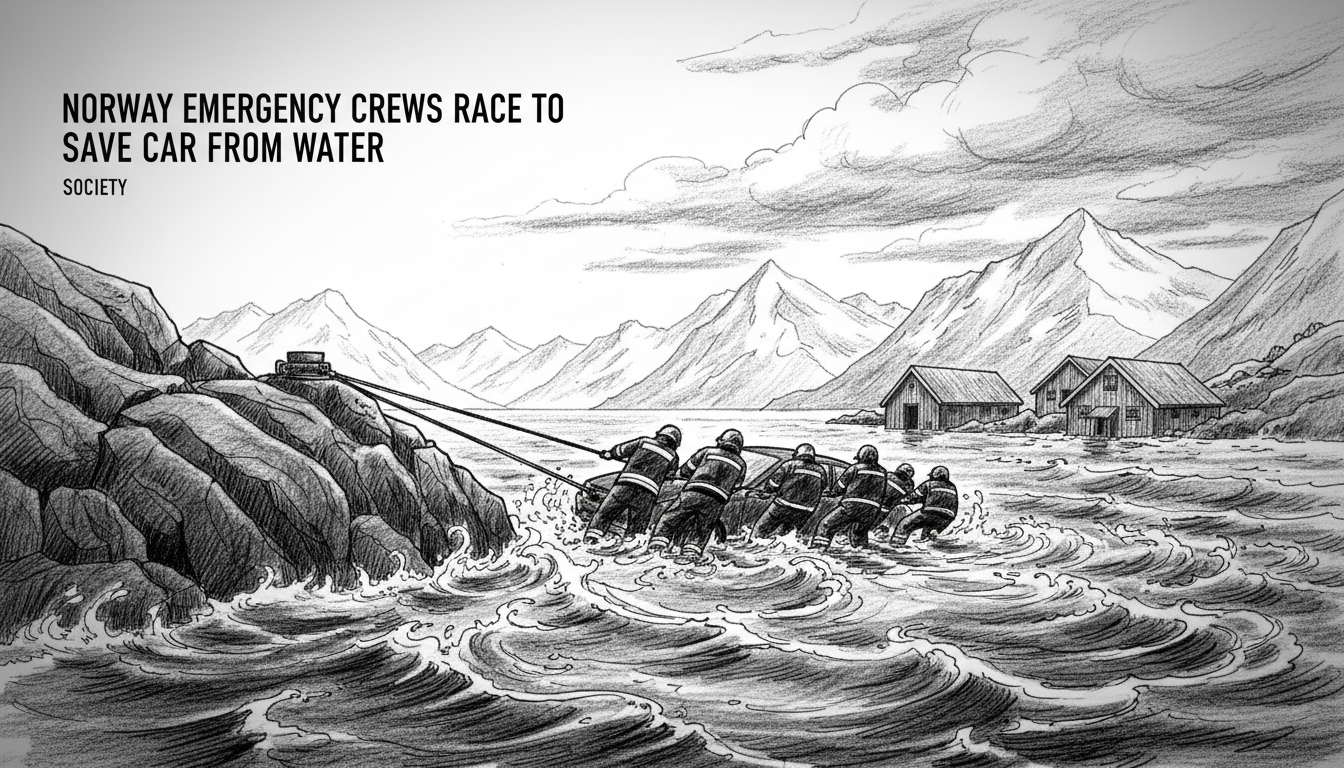
Norway emergency services are responding to a dramatic accident in Flatanger where one vehicle is precariously balanced at a water's edge. The incident, involving a collision between two cars, unfolded in the Trøndelag municipality earlier today, triggering a high-stakes rescue operation to prevent the car from falling into the water below.
First responders, including police, fire, and ambulance crews, were dispatched to the scene following emergency calls. The exact location and condition of those involved have not been officially released, though the primary immediate danger is the unstable position of one car. "Our absolute priority is securing the vehicle and ensuring no one is in imminent danger," a police operations manager said in a brief statement. The challenging terrain and proximity to water complicate the rescue and recovery efforts.
The Scene in Flatanger
Flatanger municipality, part of Norway's rugged Trøndelag county, is characterized by a complex coastline of fjords, islands, and lakes. Roadways in such regions often wind closely alongside steep embankments and bodies of water. This geography, while stunning, introduces specific hazards for motorists, particularly during variable weather conditions or periods of low light. Accidents with vehicles entering water, though not daily occurrences, present a severe and time-critical emergency for Norway's unified rescue services.
Initial reports indicate the two cars collided under circumstances yet to be determined. While one vehicle remained on the roadway, the other came to rest at the very brink of a water body. This scenario triggers a multi-agency protocol designed for technical rescues and potential water recovery. The Norwegian Coastal Administration and local volunteer marine rescue units are often placed on standby in such situations.
A National Focus on Road Safety
This accident near water highlights a particular subset of risks within Norway's broader road safety landscape. The country has long pursued a 'Vision Zero' policy, aiming to eliminate fatal and serious road injuries. This strategy involves continuous improvements to road design, vehicle safety standards, and driver education. Recent years have seen a focused effort on improving safety on rural roads, which statistically carry higher risks than motorways.
Preliminary figures from the Norwegian Public Roads Administration (Statens vegvesen) for 2023 indicate there were 92 road fatalities. This continues a general downward trend from the 117 recorded in 2022. Trøndelag county, with its mix of long-distance highways and winding rural routes, typically accounts for a notable share of the nation's total traffic accidents. Factors include harsh winter driving conditions, tourist traffic, and the challenging topography itself.
"Every accident is one too many, and each has its own tragic story," said transportation analyst Henrik Larsen. "When a vehicle is at risk of submersion, it multiplies the danger exponentially. Response time is everything, not just for potential occupants but for the environmental hazard of a vehicle in the water."
The Mechanics of a Water-Edge Rescue
Emergency responders face a complex task. The first step is to assess the stability of the vehicle and secure it to prevent any sudden movement. This often involves using heavy-duty straps, winches, and stabilization equipment from fire and rescue vehicles. Simultaneously, care for any injured persons must be managed. If the vehicle were to enter the water, the operation immediately shifts to a water rescue and potential recovery mission, requiring different equipment and expertise.
Norway's emergency services are highly integrated for this reason. Police manage the scene and investigation, fire and rescue services handle the technical extrication and stabilization, and ambulance personnel provide medical care. The Norwegian Society for Sea Rescue (RS) or local fire boats may be called if a water entry occurs. This coordinated response is tested regularly in a country with over 1,000 road tunnels and countless kilometers of water-adjacent roads.
Community and Infrastructure Context
For residents of communities like Flatanger, such accidents reinforce concerns about local road infrastructure. Municipalities consistently lobby the national government for funds to upgrade roads, install or improve barriers, and enhance lighting. "We know which stretches are problematic," a local council member from a neighboring municipality commented, preferring to remain anonymous as the investigation is active. "Funding is always the battle. We prioritize the worst spots, but it's a slow process."
The cause of this collision will be investigated by police. Standard procedure includes examining road conditions, vehicle speeds, potential driver impairment, and weather factors. This analysis can take weeks or months. The findings contribute to national accident databases, which in turn inform future safety investments and policy adjustments.
The Human Factor in Rural Driving
Beyond infrastructure, safety campaigns persistently target driver behavior. The Norwegian Public Roads Administration runs seasonal campaigns highlighting risks like fatigue on long rural drives, speeding on familiar roads, and the dangers of distracted driving. The message is that even on quiet country roads, full attention is required, especially near inherent hazards like cliffs, forests, or water.
As the operation in Flatanger continues, the focus remains on a safe resolution. The incident serves as a stark reminder of the fine margin between a routine journey and a crisis in Norway's breathtaking but demanding landscape. It underscores the vital, often unseen, work of emergency crews who train for these precise scenarios across the country's varied geography.
Will this event trigger a renewed local assessment of roadside barriers on this particular stretch? The answer will depend on the official investigation's conclusions and the persistent advocacy of local safety officials. For now, the community waits, hoping for a conclusion without further tragedy.