
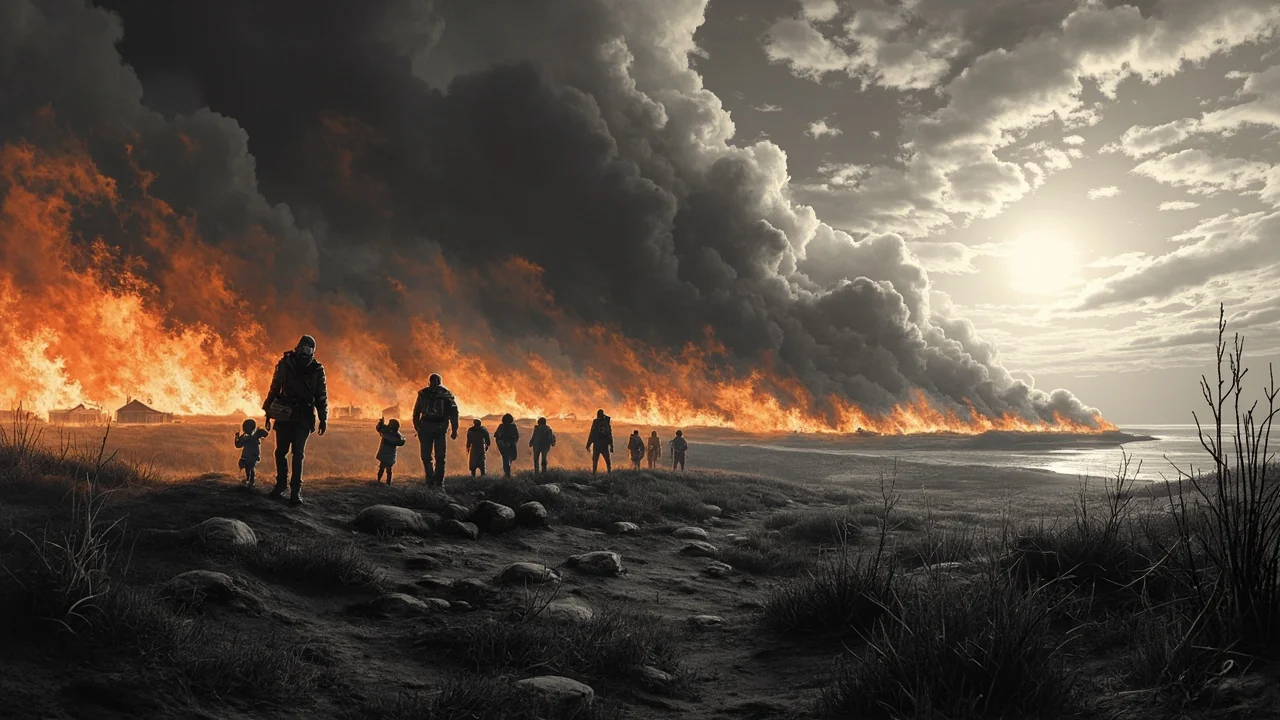
Norway's West Police District initiated emergency evacuations Sunday night as a challenging terrain fire advanced toward residential areas on Askøy island near Bergen. The blaze, reported by multiple callers around 6:30 PM near Hauglandshella, prompted immediate response from police and fire services facing difficult conditions and strong winds forecasted to worsen.
Operational leader Tor-Andre Brakstad confirmed the evacuation of buildings north of Hanøyvegen just before 7 PM. Watch leader Stian Kvam at the Vest police emergency center highlighted the fire's proximity to populated zones, marking a rapid escalation in the situation. Firefighters confirmed a challenging 'terrengbrann'—a Norwegian term for wildfire in natural terrain—upon arrival, complicating containment efforts.
A Race Against Wind and Terrain
The fire's advance toward homes represents a worst-case scenario for Norwegian emergency services during dry periods. Askøy's terrain, characterized by heathland, brush, and forest fragments common to the coastal region, creates abundant fuel. The Vestland county region received a yellow-level danger warning for powerful wind gusts overnight into Monday, threatening to fan flames and spread embers over greater distances.
This incident underscores a growing pattern across Scandinavia, where warmer, drier summers increase the frequency and intensity of wildfires. While major forest blazes remain less common in coastal western Norway than in eastern inland areas, changing conditions are altering the risk map. The response on Askøy tests protocols designed for a nation better known for its fjords and rainfall than for fire.
The Mechanics of a Norwegian Wildfire Response
When a 'terrengbrann' is reported, Norway activates a coordinated chain of command. Municipal fire services are first responders, assessed for need by the police district's operational leaders. For a complex incident like Askøy, the police assume overall responsibility for public safety, including the critical decision to evacuate.
The choice to evacuate structures north of Hanøyvegen is not taken lightly. Norwegian law provides clear authority for police to mandate evacuations under the Civil Protection Act when life and health are at immediate risk. This legal framework prioritizes human safety over property, allowing for swift action even as the fire front is assessed.
Rescue helicopters from the Norwegian Rescue Society or the Coast Guard are often deployed for aerial surveillance and water dropping in inaccessible areas, though their use depends on visibility and wind conditions. Ground crews face the dual challenge of steep, rocky terrain and the volatile nature of heathland fires, which can spread quickly across surface vegetation.
Climate Context and Regional Vulnerability
This fire occurs within a broader environmental context. Scientific assessments from the Norwegian Climate Services Centre indicate a trend toward longer dry spells in western Norway, even as annual precipitation remains high. Dried-out vegetation from a rainless period becomes susceptible to ignition from human activity or lightning.
Askøy, with its mix of scattered homes, recreational cabins, and natural areas, exemplifies the wildland-urban interface challenge. Development near forests and heathland brings people closer to fire-prone ecosystems. Municipalities are increasingly advised to create defensible space around structures, but existing communities like those near Hanøyvegen were often built under different risk assumptions.
The incident near Bergen also highlights resource allocation. Norway's professional and volunteer fire departments are exceptionally equipped for structural fires and technical rescues. Large-scale wildfire suppression requires different tactics, training, and equipment, placing a premium on inter-agency coordination with police, civil defense, and voluntary organizations.
The Human Element of Evacuation
Behind the operational updates lies a profound human disruption. An evacuation order forces residents to leave their homes with uncertainty about what they will find upon return. They must secure pets, gather essential documents and medications, and find temporary shelter—all under the stress of an approaching threat.
The social cohesion of Norwegian communities is often tested and demonstrated during such crises. It is common for evacuated families to stay with neighbors, relatives, or in community halls opened by the local municipality or the Norwegian Church's diaconal services. The Red Cross also plays a vital role in providing practical support and psychosocial care.
For homeowners, the financial implications extend beyond potential property damage. Many standard Norwegian home insurance policies cover fire damage, including from wildfires, but deductibles and the emotional toll of displacement are significant burdens. The state may provide compensation in certain disaster scenarios, but the process is often lengthy.
Analyzing Emergency Preparedness
From a policy perspective, the Askøy fire serves as a live drill for Norway's civil protection system. The effectiveness of communication between the 110 emergency center, police operatives, and fire ground commanders is paramount. Public alerts through the 'varslingssystem'—Norway's official warning system sent via SMS, radio, and TV—are crucial for reaching affected populations.
The incident will likely prompt a post-operation review by the Vest Police District and the Askøy municipality. Key questions will examine the speed of the initial response, the adequacy of risk assessment given the weather forecast, and the clarity of evacuation instructions to the public. Lessons learned are incorporated into national guidelines managed by the Directorate for Civil Protection.
Norway's approach to wildfire has historically been reactive, but there is a shift toward greater prevention. This includes public information campaigns about fire bans during dry periods, advice on creating firebreaks around properties, and municipal planning that considers fire risk in zoning decisions. Yet, as Askøy shows, when conditions align, reactive measures become the immediate line of defense.
A Look Ahead for Askøy and Beyond
The immediate focus remains on containment and cooling the perimeter to allow evacuees to return safely. Firefighters will work to establish control lines, likely using hand tools and targeted water applications to extinguish hotspots. Police will maintain a security cordon until the area is declared safe.
In the longer term, this event adds to the accumulating evidence that Norway must adapt its preparedness. Investment in specialized wildfire equipment, such as high-volume portable pumps and protective gear for terrain fires, may increase. Training exchanges with countries like Sweden, Finland, and southern Europe, which have more extensive wildfire experience, could become more routine.
For now, the residents of Askøy wait, and the emergency services work against the wind. The situation is a stark reminder that even in a nation defined by water, the threat of fire is real, immediate, and evolving with the climate. The success of tonight's evacuation order will be measured not just in property saved, but in the safe return of every resident to their home.