
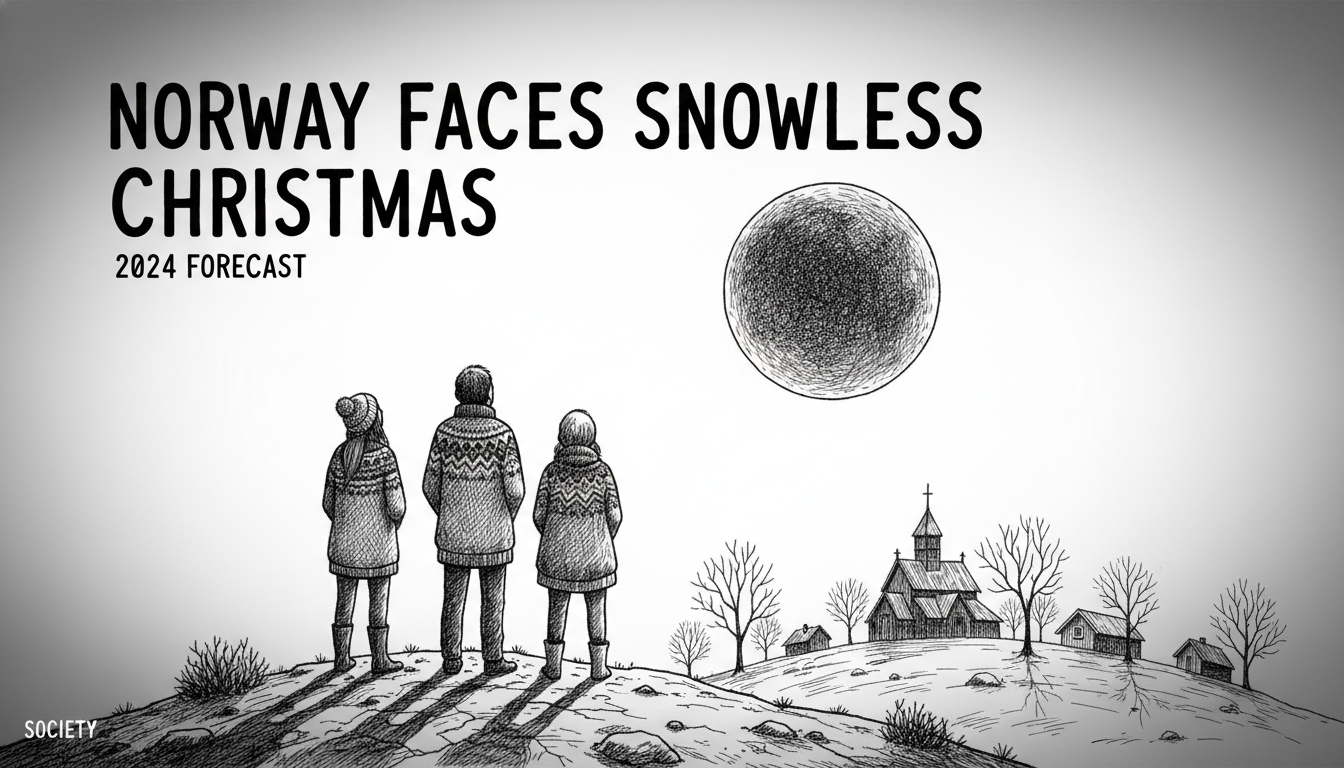
Norway Christmas weather forecasts are delivering a disappointing message for many hoping for a white holiday. State meteorologist Terje Alsvik Walløe has stated that areas currently without snow should not expect it to arrive before December 25th. This announcement dashes the hopes of countless Norwegians for whom a snow-covered landscape is an integral part of the festive season. The prevailing mild weather patterns across southern and coastal regions are to blame, creating a significant departure from the traditional winter postcard.
A Cultural and Meteorological Disappointment
The absence of 'Julesnø'—Christmas snow—strikes a cultural chord in Norway. The deep-rooted tradition of a white Christmas is celebrated in song, literature, and collective expectation. For many, the first snowfall marks the true beginning of the 'julefred', or Christmas peace. Meteorologist Walløe's assessment is blunt. "It is so mild now that those who do not have snow already should keep their expectations low," he said. This forecast highlights the stark climatic divide within the country, where mountain villages may enjoy deep powder while Oslo's streets remain bare and damp.
Average December temperatures in Oslo historically range from -4°C to 1°C (25°F to 34°F). This year, consistent milder air masses have pushed temperatures above these averages, particularly along the coast from Stavanger to Tromsø. The Norwegian Meteorological Institute notes that while such variability is not unprecedented, the frequency of warm December periods appears to be increasing. The immediate cause is a persistent weather system channeling warmer Atlantic air across the nation, preventing the cold, stable high-pressure systems needed for snow at lower elevations.
The Broader Climate Context
Experts are increasingly connecting these unseasonably warm winters to broader climatic shifts. While no single warm Christmas can be directly attributed to climate change, the pattern aligns with long-term projections for Northern Europe. "We are observing a trend where the boundary for reliable winter snow is retreating northward and to higher altitudes," explains a climate researcher at the University of Oslo, who requested anonymity as they were not authorized to speak publicly. "What was once a near-guarantee in eastern Norway's lowlands is becoming more of a lottery."
This shift has tangible effects beyond nostalgia. The winter tourism economy, reliant on predictable snow in regions like the mountains of Southern Norway, faces growing uncertainty. Municipalities budget for snow clearance, and energy consumption forecasts are based on temperature norms. A mild December disrupts these calculations. Furthermore, the ecological impact is significant. Delayed or absent snow cover exposes flora and fauna to freeze-thaw cycles and temperature shocks they are not adapted to withstand.
Regional Variations and Realistic Expectations
It is crucial to note that Norway's dramatic geography ensures a non-uniform forecast. The statement primarily affects the populous coastal and lowland areas. Inland regions, particularly in Finnmark, Trøndelag, and the major mountain plateaus like Hardangervidda, already have significant snowpack. The contrast this Christmas will be visual. Satellite images will likely show a green and brown coastline sharply bordered by a white interior. For residents of Bergen or Kristiansand, a white Christmas requires a drive to the nearest mountain pass.
Statistics from the Meteorological Institute show snow cover in December is highly variable. Coastal areas can experience entire winters with only fleeting snow, while mountainous regions typically have a meter or more by late December. The current situation is not a national snow drought but a misalignment between where most people live and where the snow reliably falls. This annual disconnect is becoming more pronounced, making the classic Norwegian Christmas scene—a wooden cabin nestled in deep snow—an experience that increasingly requires planning and travel.
Adapting Traditions in a Warmer Winter
The potential for a snowless Christmas prompts a conversation about cultural adaptation. Norwegian Christmas traditions are intimately tied to the winter environment: sledding, skiing on Christmas morning, and building snow lanterns. In the absence of snow, families are finding alternatives. Urban centers see a rise in Christmas market attendance, indoor 'kos' (coziness) becomes even more emphasized, and artificial ice rinks see longer queues. The core of the holiday—family, light in the darkness, and reflection—remains unchanged, but its aesthetic is undeniably different.
Some environmental psychologists suggest that the visible lack of snow could make the abstract concept of climate change more concrete for the public. A brown Christmas in Oslo serves as a direct, personal experience of shifting weather patterns. This could influence public opinion and policy priorities, adding a layer of cultural loss to the scientific arguments for climate action. The Norwegian government, while a global leader in electric vehicle adoption and renewable energy investment, continues to face criticism for its ongoing oil and gas exploration, a central tension in the nation's environmental policy.
Looking Beyond the Holiday
The immediate forecast is clear for those hoping for a last-minute miracle. "Those who do not have snow now will hardly get it before Christmas," Walløe confirmed. The meteorological conditions required for significant snowfall—a collision of moisture and sustained cold air—are simply not on the horizon for western and southern coastal districts. The weather models show a continuation of the mild, often rainy, southwesterly flows that have characterized the early winter.
This year's Christmas weather forecast for Norway is more than a seasonal curiosity. It is a snapshot of a changing climate reality that challenges deep-seated national traditions. It underscores the growing divergence between the Norway of cultural imagination and the Norway of meteorological fact. As Norwegians adjust their expectations and perhaps their plans, the question lingers: Is the white Christmas becoming a memory to be cherished rather than an expectation to be held? The answer, much like the snow itself, seems to be drifting away from the country's populated shores.