
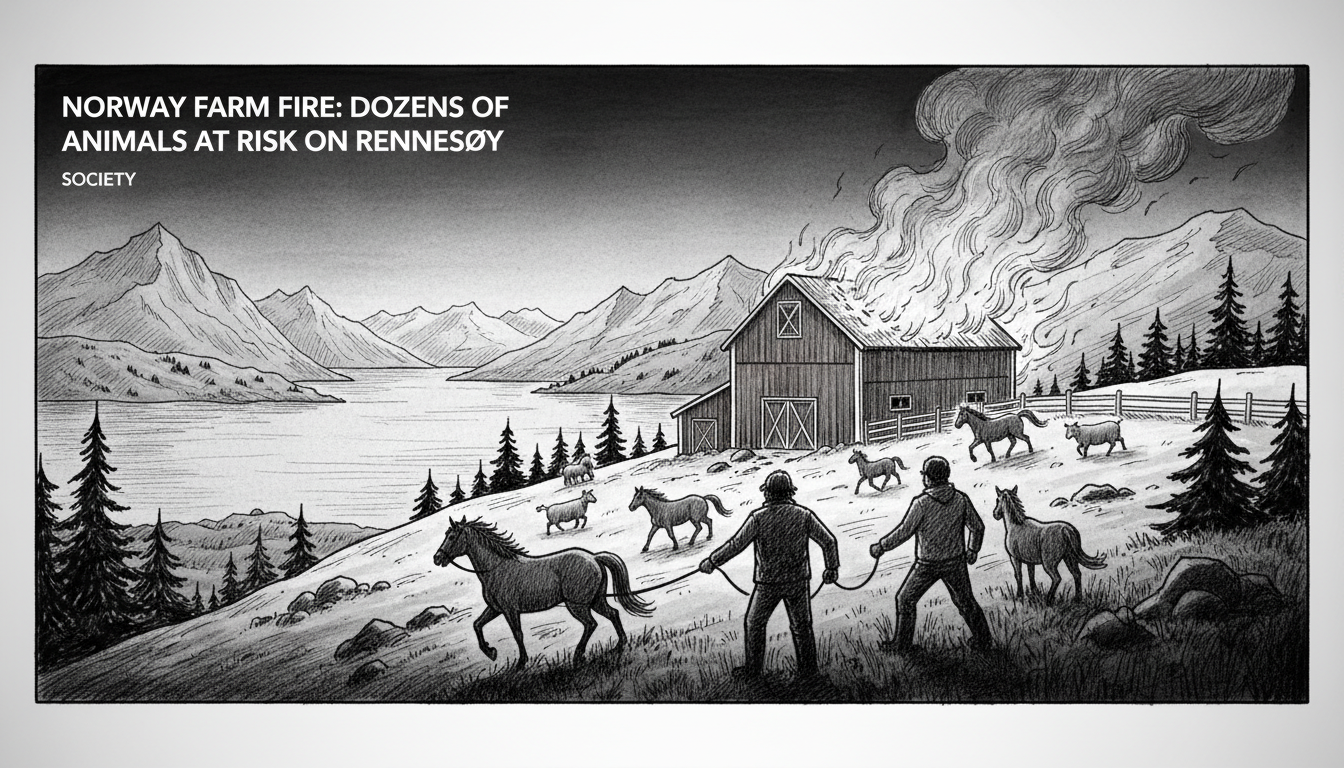
Norway emergency services are battling a major fire in an agricultural building on Rennesøy island near Stavanger. The blaze has fully engulfed the roof of the structure, which police confirm houses several dozen animals. The condition of the livestock remains unknown as firefighters work to contain the inferno.
Police and fire crews from the Stavanger region responded to the alarm on Thursday afternoon. Thick smoke was visible from the mainland as the fire took hold of the building's roof. Initial reports describe a 'full overtenning' or full involvement of the roof, indicating an intense and advanced fire.
"Our primary focus is on extinguishing the fire and securing the area," a police operations leader said in a statement. "We are acutely aware that animals are reported to be inside the building. We are working in close coordination with the fire service to address this."
The building is classified as a 'driftsbygning,' a term encompassing barns, machinery sheds, and other operational agricultural structures. In the rural parts of Rogaland county, such buildings are central to farming life. They often house valuable livestock, equipment, and winter feed, making a fire a potentially devastating event for a farming family.
A Tense Wait for Farmers and Neighbors
Local residents gathered at a safe distance, watching as emergency vehicles lined the narrow roads leading to the property. The mood was one of grim concern, not only for the property loss but for the welfare of the animals trapped inside. Animal welfare organizations were also alerted and are on standby to assist if needed.
"This is every farmer's worst nightmare," said Lars Mikkelsen, a regional representative for the Norwegian Farmers' Union. "Beyond the economic loss, there is a deep emotional attachment to the livestock. These animals are part of a daily routine, and their welfare is paramount. The uncertainty at this stage is very difficult."
Rennesøy, connected to the mainland by the Hundvåg Tunnel, is characterized by a mix of small-scale agriculture and commuter homes for nearby Stavanger. Incidents like this resonate deeply in such communities, where neighbors often rely on each other. Offers of help, from providing temporary animal shelter to supplying food for emergency workers, began circulating locally within hours.
The Complex Challenge of Agricultural Fires
Fires in farm buildings present unique challenges for emergency services. They are often located in remote areas with limited water supply, requiring tanker trucks to shuttle water to the scene. The buildings themselves can contain flammable materials like hay, straw, and fuels, which accelerate the fire's spread.
Most critically, the presence of live animals complicates rescue efforts. Firefighters must balance the urgent task of extinguishment with attempts to evacuate terrified livestock, a dangerous operation in smoke-filled, unstable structures. The priority for crews is always human life first, followed by animal rescue where it can be done without undue risk.
"Speed of response is everything," explained fire safety consultant, Kari Nilsen. "In an agricultural setting, fire can consume a building like this extremely quickly. Modern synthetic materials, even in older buildings, burn hotter and faster. For animals, smoke inhalation is a major killer, often before flames even reach them."
Norwegian fire regulations for agricultural buildings have been tightened in recent years, particularly concerning electrical installations and the storage of flammable materials. However, many older structures, essential to the country's farming landscape, predate the strictest codes. Investigations into this fire will almost certainly examine the building's construction, electrical systems, and any stored materials that may have contributed to the blaze's intensity.
Economic and Emotional Toll on Rural Norway
The immediate crisis focuses on life safety and fire suppression. The aftermath, however, will reveal the full impact. For the farm operator, the loss could be catastrophic. Beyond the building itself, damage to expensive machinery, loss of harvested feed, and the death of livestock can threaten the viability of a family business.
Insurance will cover some of the financial cost, but the recovery process is long. Replacing a functional agricultural building takes time and bureaucracy, navigating planning permissions and modern building standards. The loss of a breeding herd or flock can set a farm back years in its production cycle.
There is also a significant psychological toll. Studies on farming communities show that events like fires, which result in animal deaths, contribute to high levels of stress and anxiety among farmers. The connection to their animals and land is profound, and such a traumatic event is not quickly forgotten.
"We have support systems in place for exactly these situations," Mikkelsen of the Farmers' Union added. "Our role in the coming days and weeks will be to provide practical advice on insurance, permits, and animal welfare logistics, as well as ensuring the affected family has the psychosocial support they need."
A Broader Look at Regional Risks
While this fire is an isolated incident, it highlights a persistent risk in Norwegian agriculture. Rogaland, with its mix of intensive farming and vast rural areas, sees its share of such emergencies every year. Climate change may be introducing new variables, with drier summers potentially increasing the fire risk in certain periods, though the cause of this particular fire remains undetermined.
Local fire departments often conduct preventive visits to farms, advising on fire breaks, safe storage of chemicals, and the maintenance of electrical equipment. These services are crucial in a self-reliant rural culture where the nearest professional fire brigade may be 30 minutes away.
The response on Rennesøy demonstrates the interoperability of Norway's emergency services. Police managed traffic and safety perimeters, the fire service attacked the blaze, and other agencies stood ready to assist with animal welfare and environmental concerns—such as preventing runoff of contaminated water from firefighting efforts.
As night fell over the Stavanger archipelago, the glow from the fire on Rennesøy served as a stark reminder of the fragility of the rural economy. The coming hours will reveal the fate of the animals inside and the full scale of the damage. For the tight-knit community on the island, and for farmers across Norway watching the news, the event underscores a shared vulnerability. It also showcases the network of professional and voluntary response that mobilizes when disaster strikes, a small comfort in the face of rising smoke and an uncertain outcome. The investigation into how this blaze began will now be paramount, not just for assigning liability, but for preventing a similar tragedy in another Norwegian barn.