
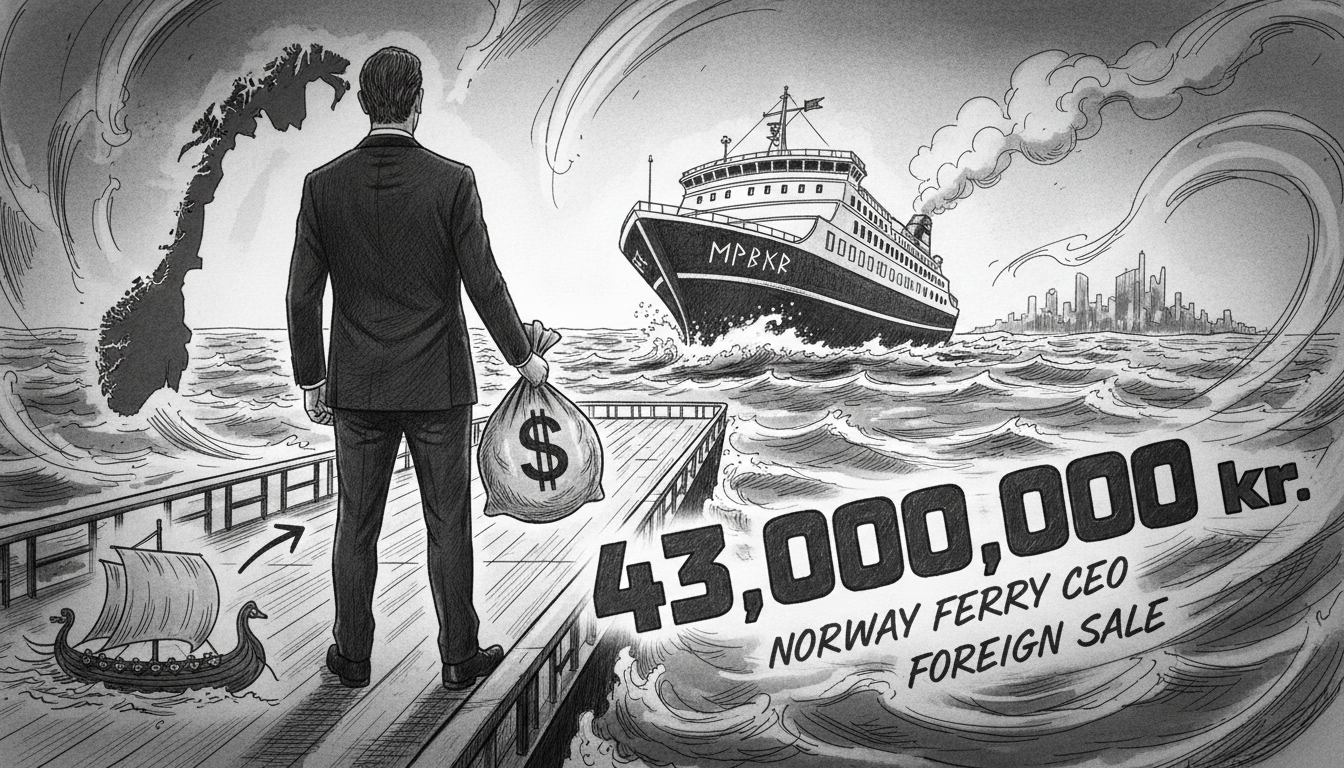
Norway's Fjord1 ferry CEO Dagfinn Neteland received over 43 million kroner in 2024, including a 36 million kroner bonus tied to the company's sale to foreign private equity funds. The payout has ignited a fierce debate about executive compensation in a company that operates essential public transport routes funded by Norwegian taxpayers. The sale itself, valued between 5 and 7.8 billion kroner, was driven in part by the former owner's criticism of Norway's wealth tax.
The Controversial Payout
Dagfinn Neteland's total compensation for 2024 exceeded 43 million Norwegian kroner (approximately $4 million USD). This sum comprised a base salary of 4.4 million kroner, an ordinary bonus of 2.2 million kroner, and a substantial 36 million kroner bonus directly linked to the successful sale of Fjord1. The company was sold in 2023 to two foreign investment funds, CVC Capital Partners and DIF Capital Partners. Neteland, who led the company from 2014-2015 and again from 2017 until stepping down in May 2024, has declined to comment publicly on the size of the payout.
The timing and scale of the bonus are particularly sensitive. Fjord1 is not a typical private corporation; it is a critical piece of Norway's national transport infrastructure. The company operates dozens of ferry and express boat routes along the Norwegian coast under contracts with public authorities like the Norwegian Public Roads Administration and various counties. These services are lifelines for remote coastal communities where road connections are impossible.
A Vital Public Service Goes Private
Fjord1 ASA is one of Norway's largest ferry operators. At its scale in 2017, the company transported about 21 million passengers and 10 million vehicles annually using a fleet of nearly 70 vessels. With annual revenue around 2.8 billion kroner at that time, it functions as a major transport utility. The 2023 sale marked a significant shift from its previous status as a publicly listed company on the Oslo Stock Exchange to private ownership under international institutional investors.
The sale price, reported by financial media to be between 5 and 7.8 billion kroner, represents a major transaction in the Nordic transport sector. Per Sævik of Havila Gruppen, a key former shareholder, explicitly cited Norway's wealth tax (formuesskatt) as a primary reason for selling. He argued the tax made it prohibitively difficult to maintain long-term domestic ownership of such a capital-intensive business. This rationale places the Fjord1 sale at the heart of Norway's ongoing political debate about wealth taxation and its impact on domestic ownership of strategic assets.
Key Figures: Fjord1's Scale and the CEO's Pay
| Metric | Value | Context |
|---|---|---|
| Total CEO Compensation (2024) | Over NOK 43 million | Includes NOK 36M sale bonus, NOK 4.4M salary, NOK 2.2M ordinary bonus |
| Fjord1 Sale Price (2023) | NOK 5–7.8 billion | Acquisition value by private equity funds CVC and DIF Capital Partners |
| Annual Passengers (2017) | 21.1 million | People carried by Fjord1's fleet |
| Annual Vehicles (2017) | 10.4 million | Vehicles transported on ferries |
| Fleet Size (2017) | 67 vessels | Ferries and express boats in operation |
| Annual Revenue (2017) | NOK 2.8 billion | Total revenue for the Fjord1 group |
Expert Analysis: Public Service vs. Private Incentives
Corporate governance experts note that large exit bonuses for executives are a standard feature of private equity transactions. These payouts are designed to align management's interests with shareholders during a sale process, ensuring executives work to maximize the transaction value. From a purely market-based perspective, Neteland's bonus could be viewed as a reward for delivering a multi-billion kroner deal to the company's owners.
However, policy analysts and public sector experts highlight the profound ethical and political questions this case raises. "When a company is essentially an arm of the public transport system, funded by taxpayer contracts, the rules of the game are perceived differently," says a professor of public policy at the University of Oslo, who requested anonymity due to the sensitivity of the topic. "A bonus of this magnitude, derived from selling a public-service operator to foreign funds, challenges the Nordic social contract that balances profitability with social responsibility."
The debate extends beyond executive pay. It touches on the growing trend of private equity ownership in essential Nordic infrastructure. Critics worry that foreign investment funds, with typical holding periods of five to seven years, may prioritize short-term financial engineering and cost-cutting over long-term service quality and infrastructure investment. Proponents argue that private capital brings efficiency and professional management to sectors historically dominated by state or municipal ownership.
Implications for Norway's Coastal Communities
The immediate operational impact on ferry routes from Sogn og Fjordane to Troms is likely minimal. Contracts with public authorities govern service levels, fares, and schedules. However, the long-term implications concern employees, unions, and local politicians. There is unease about whether a privately owned, foreign-controlled Fjord1 will maintain the same commitment to unprofitable but socially necessary routes, or if it will push for higher contract prices from cash-strapped counties during future tenders.
Politically, the case fuels arguments on multiple fronts. The political left and centrists may use it to argue for stricter transparency rules on executive pay for companies with major public contracts, or even for caps on bonuses in such sectors. The political right may point to the sale's root cause, reiterating that the wealth tax forces the sale of Norwegian companies to foreign owners, ultimately reducing domestic control over critical infrastructure.
A Nordic Pattern of Tension
This controversy is not unique to Norway. Similar debates have erupted across the region when companies providing essential public services—whether Swedish railways, Danish utilities, or Finnish ferries—are sold to private investors or award large executive bonuses. The common thread is the Nordic expectation that entities fulfilling a public mandate should adhere to a ethos of moderation and collective benefit.
In Sweden, state-owned rail operator SJ faced intense criticism for executive bonuses amid service disruptions. In Finland, the sale of municipal transport companies often sparks debates about fare increases and service cuts. The Fjord1 case fits this pattern, magnified by Norway's specific context of wealth taxation and its geography, where ferries are not optional but fundamental.
For the international community observing the Nordic model, this episode illustrates its ongoing evolution. The model is grappling with global capital flows, market incentives, and the preservation of its core values around equity and public trust. The resolution will depend on whether Norwegian policymakers believe the benefits of private investment in infrastructure outweigh the risks of reduced public accountability and perceptions of unfairness.
The final word rests with the public and their elected representatives. As one Storting representative from a coastal district noted, "Our communities depend on these ferries. We pay for them through our taxes and fares. When the captain of the ship gets a gold-plated lifeboat for selling it to new owners overseas, people rightly ask: who is this system really serving?" The answer to that question will shape Norwegian transport policy and corporate governance for years to come.