
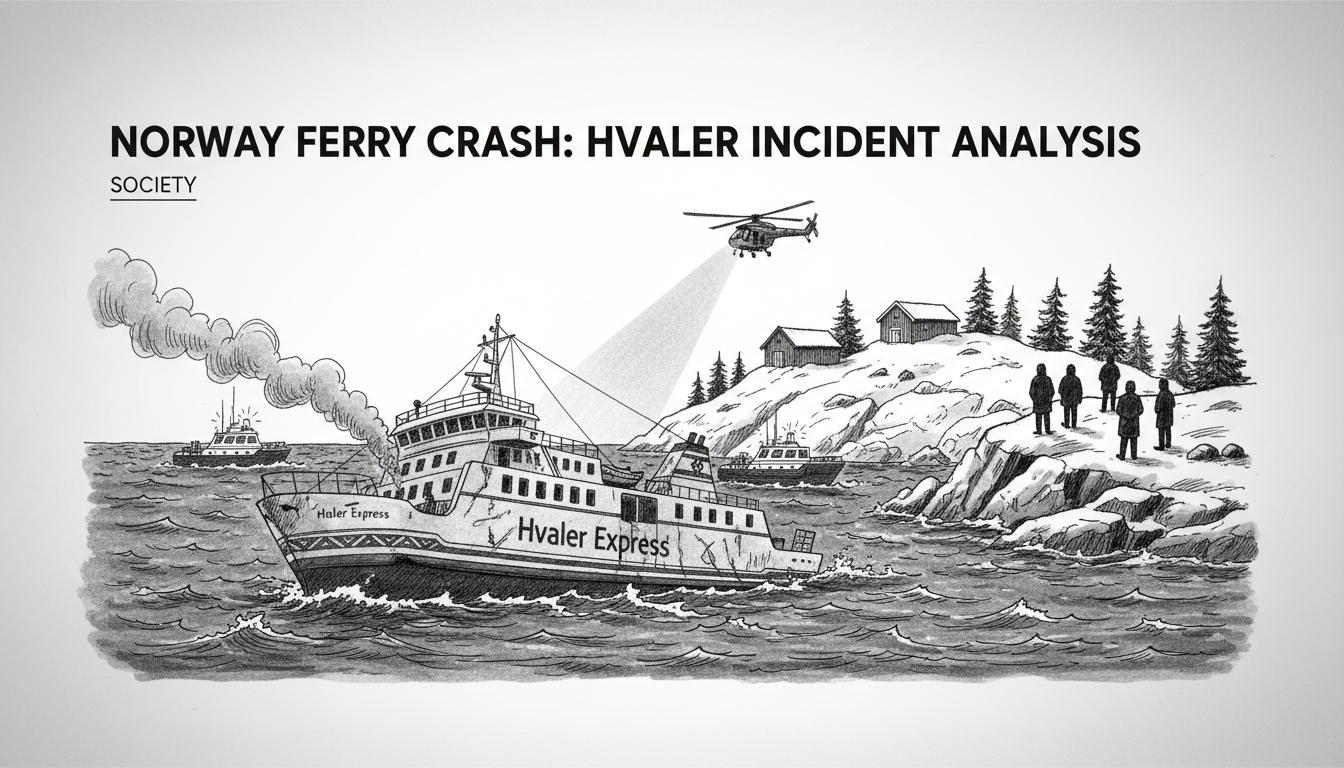
Norway's ferry network transports approximately 41 million passengers annually, yet a sudden crash of the Hvaler ferry into a building on Herføl island has exposed vulnerabilities in this critical system. The vessel, operated by major carrier Norled, struck a structure on Thursday morning, leading to an immediate suspension of the vital samband connection. No injuries have been reported, but the incident has severed a key transit link for island residents and sparked a swift safety investigation.
The Moment of Impact
Witnesses described a loud noise as the ferry made contact with the building on Herføl, part of the Hvaler archipelago in Viken county. Norled confirmed an 'unwanted incident' in a brief online statement, announcing the route's indefinite closure. Emergency services were dispatched to assess structural damage and ensure public safety. The ferry involved typically shuttles between the islands and the mainland at Fredrikstad, a route fundamental for commuting, schooling, and supply chains. This disruption highlights how a single point of failure can isolate remote communities reliant on maritime transport.
A Vital Lifeline Severed
Ferries are not mere conveniences in Norway; they are engineered necessities for coastal and archipelagic living. The Hvaler route connects a cluster of islands with a permanent population of over 4,000 residents, a figure that swells during the summer months. Without this service, daily life grinds to a halt. "For island communities, the ferry is our highway," said a local council member from Hvaler municipality, who requested anonymity as the investigation is ongoing. "When it stops, everything stops—from getting to work to receiving groceries." Norled is arranging alternative transport via water taxis, but capacity is limited and cannot match the regular ferry's efficiency. This incident underscores the fragile dependency on private operators like Norled, which holds contracts for numerous routes across the country.
Maritime Safety in the Norwegian Context
Norway prides itself on stringent maritime safety standards, governed by the Norwegian Maritime Authority (NMA). Accidents of this nature are statistically rare, given the extensive fleet and rigorous protocols. However, each event triggers a mandatory probe by the NMA and the Accident Investigation Board Norway. Preliminary focus will be on technical failure, human error, and environmental conditions such as wind or current in the narrow sounds around Herføl. "The investigation must determine whether this was an isolated operational mistake or a symptom of broader systemic issues, such as maintenance schedules or crew training," commented Lars Alvik, a maritime safety analyst at the Institute of Transport Economics. He noted that while Norway's overall record is strong, aging ferry infrastructure and pressure on operational budgets can introduce risks.
Infrastructure and Policy Implications
This crash arrives amid ongoing political debates in the Storting about Norway's transportation future. The government's National Transport Plan allocates billions of kroner to ferry electrification and replacement, aiming to reduce emissions and modernize the fleet. Incidents like the Hvaler crash provide tangible evidence for policymakers advocating increased investment. "Reliable ferry connections are a matter of regional equality and economic cohesion," stated Representative Marius Aronsen of the Labour Party, who sits on the parliamentary transport committee. "We cannot let cost-cutting compromises safety or service frequency for our coastal populations." The Conservative-led coalition has emphasized green shipping initiatives, but local governments often argue that basic operational reliability must come first. This accident will likely fuel discussions on funding allocations and the balance between innovation and maintenance.
Historical Precedents and Community Memory
Norway has witnessed more severe ferry accidents in past decades, such as the 2011 MS Nordlys engine fire, which reshaped safety regulations. The Hvaler incident, while less catastrophic, reactivates community anxiety about maritime travel. In regions like Hvaler, where the sea is both a livelihood and a barrier, trust in ferry operators is paramount. Local historians note that ferry services have evolved from small, privately run boats to sophisticated, publicly subsidized operations. Yet, the fundamental risk remains: navigating confined waters with precision, often in challenging weather. This crash may prompt a review of docking procedures and landside infrastructure, such as the design of quays and buildings near ferry terminals on Herføl and similar islands.
The Path Forward for Norled and Passengers
Norled faces immediate operational and reputational challenges. The company must cooperate fully with investigators, restore service safely, and communicate transparently with affected residents. Financial penalties or contract reviews could follow if negligence is found. For passengers, the ordeal means prolonged uncertainty. Businesses on Herføl that depend on tourist access or daily commuters are already calculating losses. The municipality may pressure the national government for emergency support or accelerated infrastructure upgrades. This event serves as a stark reminder that Norway's celebrated maritime culture is underpinned by complex, vulnerable logistics. As the investigation unfolds, the key question will be how to fortify this system against both human and mechanical failure, ensuring that lifelines remain unbroken for communities at the water's edge.