
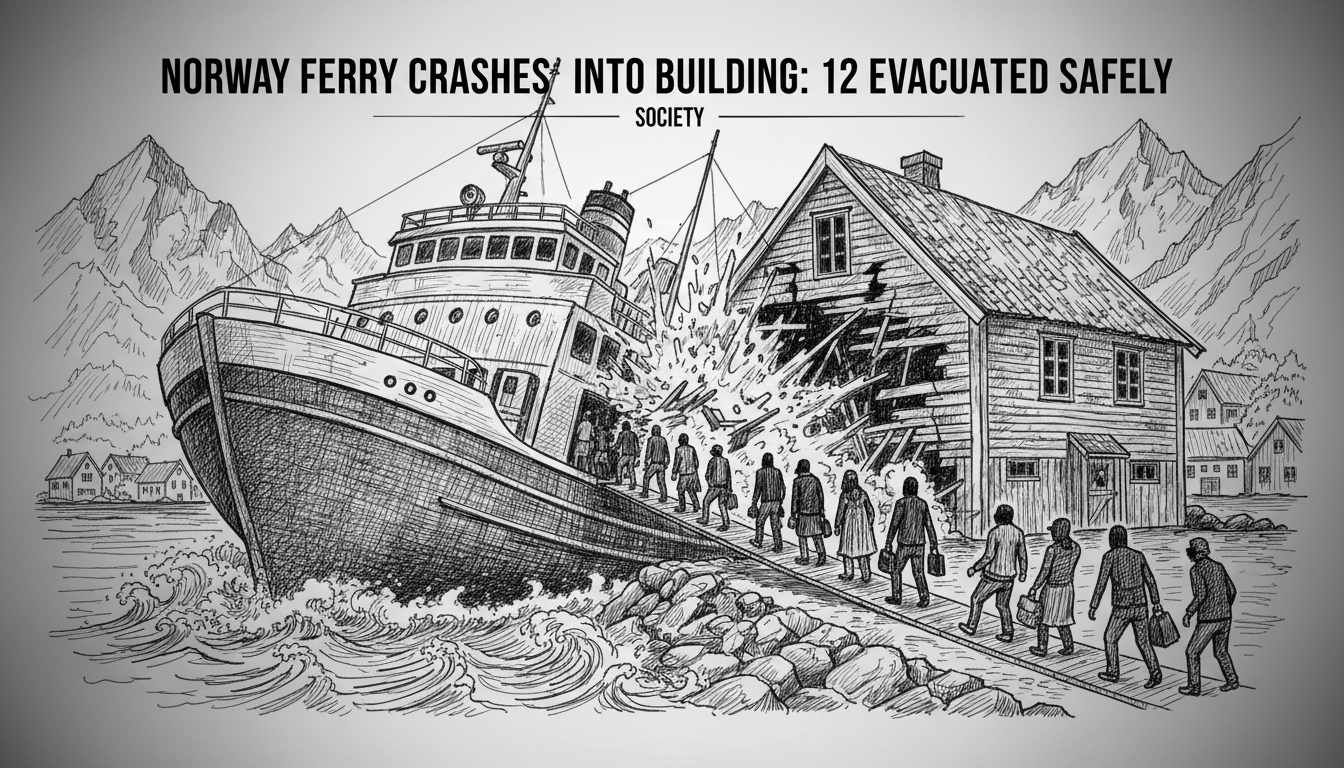
Norway's vital Hvaler archipelago ferry service was disrupted after the vessel 'Ternen' crashed into a building on Herføl island. The Norled-operated ferry struck the old post office, now a seasonal shop, while approaching the dock. All five crew members and seven passengers were evacuated safely, with no reports of injuries.
Initial reports from the ferry operator described the incident as the vessel simply running aground. The Øst police district confirmed they were first alerted to a "non-dramatic" grounding where the ferry was stuck in mud. However, communications chief Cathrine Gjertsen of Norled later clarified the crew reported striking a building, initially thought to be a boathouse.
"We received a message about a ferry that had run aground, and that there was no danger to the people on board. There was no mention that they had hit a building," said Jan Øyvind Rekeland, Rescue Leader at the Joint Rescue Coordination Centre (HRS). The discrepancy between early reports and the actual event highlights communication challenges in initial incident reporting.
A Critical Lifeline Disrupted
The Hvaler municipality, part of Viken county, comprises hundreds of islands and islets southeast of Oslo. Ferry connections are not merely convenient transport but essential infrastructure, linking communities, enabling commerce, and providing access to services. The 'Ternen' serves this critical network, and its suspension creates immediate logistical problems for island residents and businesses.
Norled issued an operational update at 09:38 stating, "The connection is suspended until further notice due to an unwanted incident." By 12:28, the company reported the ferry had been refloated with the assistance of a tugboat. The duration of the service suspension remains unclear, pending damage assessments to both the vessel and the structure it hit.
Operations Manager Fredrik Solbakken of the Øst police district noted they were striving to dispatch a patrol to investigate. The building involved, the historic post office on Herføl, represents the type of coastal infrastructure common in these island communities—structures often built close to the water's edge, serving multiple generations.
Unanswered Questions and Safety Protocols
This incident raises immediate questions about maritime safety procedures in Norway's complex coastal waters. The Norwegian Coastal Administration holds responsibility for maritime safety and navigational aids along the coast. A key focus will be whether all navigation systems and charts were functioning correctly and if weather conditions played a role.
"But is it correct to say it just ran aground when it hit a building?" asked Norled's Cathrine Gjertsen during her conversation with media, pinpointing the core ambiguity of the early hours. The company confirmed it alerted emergency services as soon as the crew relayed what had happened.
Maritime experts note that approaching a dock in archipelago waters requires precise maneuvering, especially in potentially narrow channels. Factors typically examined in such investigations include technical failure, human error, training procedures, and environmental conditions like currents or visibility.
The Investigation Path Ahead
The Norwegian Safety Investigation Authority (Statens havarikommisjon) will likely assess whether to open a formal investigation. Their mandate is to determine the causes of transportation accidents to improve future safety, not to assign blame. A decision will hinge on the severity of the incident and its potential safety implications for the wider ferry fleet.
Investigators will examine the vessel's voyage data recorder, equivalent to a black box, review crew communications and training records, and inspect the damage to both the ferry and the building. They will also evaluate the adequacy of the docking area's design and markings.
For Norled, one of Norway's largest ferry and high-speed boat operators, this incident occurs amid ongoing public and governmental scrutiny of maritime safety standards. The company manages numerous public service obligation contracts, making reliable and safe operations paramount.
Community Reliance on Maritime Transport
The Hvaler islands, with their rugged beauty, are a popular summer destination. This incident underscores the region's deep dependence on sea transport. For year-round residents, such disruptions affect commuting to work on the mainland, school runs, grocery deliveries, and access to healthcare.
The seasonal nature of the damaged shop—the old post office—also highlights the economic vulnerability of island businesses. A prolonged ferry stoppage during the busy season could have significant financial consequences for tourism-dependent enterprises.
Norway's geography, with its long coastline and numerous island communities, makes ferry services a backbone of the national transport system. Incidents like this, while fortunately causing no injuries, test the resilience of that system and prompt reviews of operational protocols.
Looking Beyond the Immediate Aftermath
While the safe evacuation of all twelve people on board is the primary relief, the crash will have lingering effects. Insurance assessments for property and vessel damage will be substantial. The Norwegian Maritime Authority may review operating procedures for this specific route.
For local authorities in Hvaler, the event may renew discussions about infrastructure investment, such as dock modernization or the potential for alternative transport links, though bridges or tunnels are often impractical in scattered archipelagos.
The incident serves as a stark reminder of the challenges of maritime transportation in Nordic conditions. It combines human operation, complex technology, and a demanding natural environment. The coming investigation will seek to untangle that combination to prevent recurrence.
As the 'Ternen' is towed for repairs and the dust settles on Herføl's old post office, the broader question remains: in a nation defined by its relationship with the sea, how can such essential services be made even more resilient? The answer will come not from dramatic overhauls, but from the meticulous analysis of unexpected events like this one.