
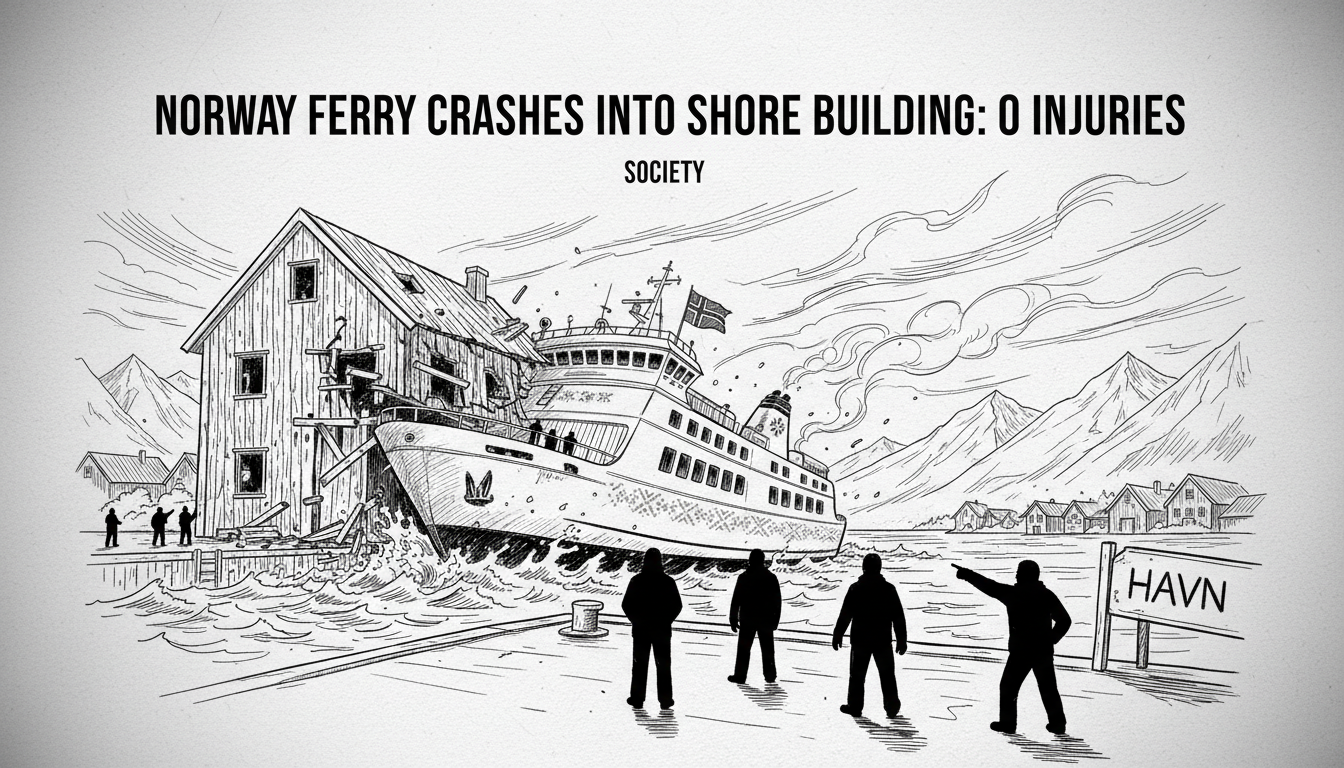
Norway ferry Ternen ended its scheduled route with a violent jolt on Thursday, running aground before colliding with a structure on the island of Herføl in Hvaler municipality. Police confirmed no injuries resulted from the incident, which saw the vital transport vessel abruptly leave the water. The event has sparked immediate scrutiny of maritime safety protocols in a nation where ferries are the lifelines of coastal communities.
Initial reports to the Øst police district described a seemingly minor grounding. "We first received a report that the ferry had backed into some mud and was stuck, but that it was undramatic and that they were managing on their own," said operations manager Fredrik Solbakken in a statement. The situation escalated minutes later when updated reports confirmed the ferry had not merely grounded but had struck a pier or building. Images from the scene showed the ferry's bow pressed against a wooden structure on the small island's shore.
A Routine Turned Chaotic
The Hvaler archipelago, a picturesque municipality in Viken county southeast of Oslo, is defined by its scattered islands and dependence on ferry connections. The Ternen, like other vessels in the fleet, performs dozens of daily crossings, shuttling residents, commuters, and tourists between islands and the mainland. Thursday's trip was proceeding normally until its final approach to Herføl. Witnesses described a sudden loss of control, with the vessel veering off its intended path. The sound of the impact echoed across the quiet island community, drawing residents to the shore.
Local authorities and the ferry operator moved quickly to secure the area and assess the damage. While the structural integrity of the building on the pier is under evaluation, the primary focus remained on the absence of casualties. "The most important thing is that no one was hurt," a Hvaler municipal official noted. Passengers were evacuated safely and alternative transport arrangements were made, though the incident caused significant disruption to the island's transport schedule.
Investigating a Maritime Mishap
Norway's Safety Investigation Authority has been notified and is expected to launch a formal probe. Maritime experts point to several potential causes for such an accident in sheltered waters. "Even in a familiar route, a confluence of factors can lead to a loss of position," said Captain Lars Andersen, a retired ferry master and maritime safety consultant. "The immediate suspects are a mechanical failure in the propulsion or steering system, a navigational error, or an unexpected environmental factor like a strong subsurface current or a sudden gust of wind."
Norwegian ferry operations are governed by strict regulations set by the Maritime Directorate. These cover everything from crew training and rest periods to vessel maintenance and bridge procedures. The investigation will examine the Ternen's maintenance logs, the crew's actions prior to the incident, data from the vessel's voyage data recorder, and local weather conditions. "The sequence is critical," Andersen added. "Did it run aground because it lost power, or did it collide because the grounding altered its trajectory? The answer dictates where the scrutiny falls."
The Lifeline of Island Communities
This incident underscores the critical, and sometimes vulnerable, role of ferry infrastructure in Norway. For island municipalities like Hvaler, ferries are not a convenience but an essential utility, as crucial as roads or power lines. They transport children to school, patients to doctors, workers to jobs, and goods to stores. Any interruption has immediate and tangible effects on daily life. While no injuries occurred, the crash disrupts a service that hundreds depend on, highlighting the community's exposure when a single vessel is disabled.
Norway has invested heavily in modernizing its ferry fleet, with a push towards electrification and automated docking systems to improve safety and reduce emissions. The Ternen incident serves as a reminder that technology and regulation must be matched by constant vigilance. "The human element is always present," said Professor Ingrid Bouwer Utne of the Norwegian University of Science and Technology's Department of Marine Technology. "Procedures and technology are designed to create safety, but they require consistent and correct application. Every incident, even a minor one, is a data point for improving the system."
Safety Record and Public Confidence
Norway's overall maritime safety record is strong, particularly for its domestic passenger ferry network. Serious accidents are rare, a fact attributed to rigorous standards. However, each event tests public confidence. Passengers must trust that the vessels crossing often-treacherous fjords and channels are operated flawlessly. The visual of a ferry embedded in a shoreline structure, while ultimately non-fatal, is deeply unsettling.
The psychological impact on the crew is also a consideration for investigators. The crew members, who followed emergency procedures, will be debriefed and offered support. Their testimony will be vital in reconstructing the event's timeline. The ferry operator, yet to release a detailed statement, faces the dual task of cooperating with the investigation and managing public communications to maintain trust.
Looking Ahead: Repairs and Reassurances
The immediate practical concerns are salvage and repair. Maritime engineers must determine how to extract the Ternen from its position without causing further damage to the vessel or the pier structure. An inspection will reveal the extent of hull damage, which will dictate whether repairs can be made locally or if the ferry requires a tow to a shipyard. This process will determine the duration of the service disruption on the Herføl route.
In the longer term, the investigation's findings will be disseminated within the maritime industry. Any identified flaws in procedure, training, or equipment will likely lead to updated directives from the Maritime Directorate. This process of learning from near-misses and minor incidents is a cornerstone of Norway's proactive safety culture. For the residents of Hvaler, the return to normalcy will be marked by the familiar sight of a ferry docking smoothly at the pier—a routine they now view with a renewed appreciation for the complexity behind it.
The Hvaler ferry crash, thankfully without injury, is more than a curious local news item. It is a stress test of intricate systems, a case study in emergency response, and a reminder of the invisible infrastructure that holds island life together. The coming weeks will reveal not just what went wrong on a Thursday afternoon in Herføl, but how Norway's maritime community works to ensure it does not happen again.