
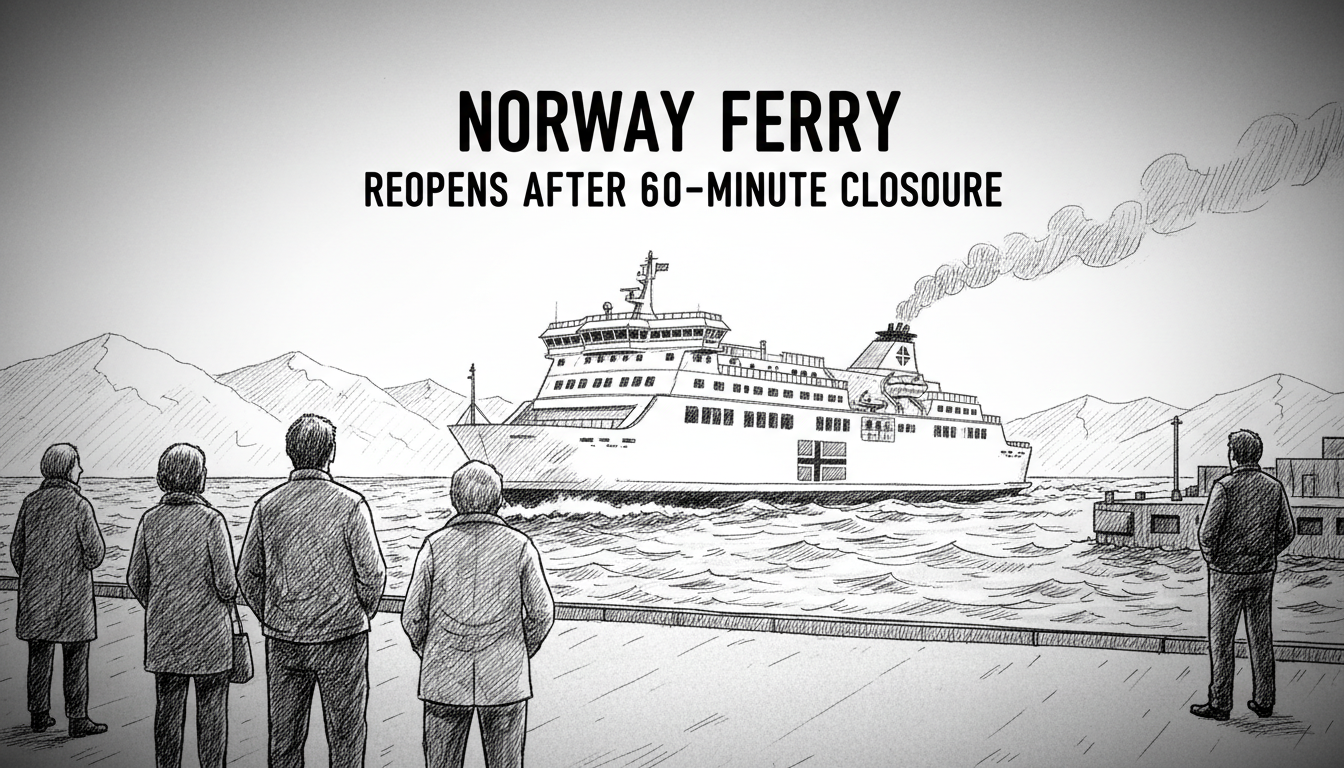
Norway's Moss-Horten ferry service resumed operations Saturday after a 60-minute closure stranded commuters and disrupted a key Oslofjord crossing. The vital link on National Road 19 (Rv. 19) was halted due to a technical fault with a fender at the Horten terminal, operator Torghatten confirmed. Driftssjef Simen Storskogen said the issue was resolved quickly, but the brief shutdown underscored the fragility of essential maritime infrastructure.
Technical Glitch Stops Oslofjord Traffic
The disruption began mid-morning when the Vegtrafikksentralen øst announced the sudden closure. A fender—a cushioning device protecting vessels and docks—had twisted out of position at the Horten ferry berth. This mechanical failure prevented ferries from safely docking. Simen Storskogen, operations chief for Torghatten, provided timely updates. “It is a fender that has twisted and is sticking straight out, so the ferries cannot berth,” Storskogen said to the press. Harbor services were dispatched, and a solution was implemented within the hour, allowing traffic to flow again by late morning.
Such incidents, while brief, cause immediate logistical headaches. The Moss-Horten connection is not a minor route. It is an integral segment of Rv. 19, shaving off substantial drive time between Viken and Vestfold counties. A one-hour stopage creates queues on both sides of the fjord. Passenger vehicles and commercial trucks alike were left idling, waiting for the green light to board. The efficiency of this shortcut vanished temporarily, forcing travelers to consider the long alternate drive around the fjord.
A Vital Artery for Regional Mobility
The Moss-Horten ferry is more than a convenience; it is economic infrastructure. Crossings operate frequently, transporting thousands of cars and passengers weekly. This route directly supports business connectivity, tourism, and daily commutes for workers living in one county and employed in the other. The Oslofjord acts as a natural barrier, and ferries like this one are movable bridges. Their reliable function is non-negotiable for regional cohesion.
National Road 19's importance cannot be overstated. It connects eastern and western shores of the Oslofjord, facilitating movement in a densely populated part of Norway. When the ferry stops, road traffic must divert over 70 kilometers via the E18 highway and through towns like Drammen. This alternative adds at least an hour to journey times, increasing fuel costs and congestion on other roads. For freight carriers, such delays ripple through supply chains, affecting delivery schedules and operational costs.
System Vulnerabilities and Proactive Maintenance
This event highlights a constant challenge for Norway’s ferry-dependent transport network. Fenders are critical but simple components. Their failure is a reminder that entire systems rely on countless small parts. Proactive maintenance schedules are essential to prevent such outages. Torghatten, as the operator, manages this infrastructure under contract with the Norwegian Public Roads Administration. The quick response on Saturday suggests protocols worked, but analysts ask if more can be done to predict failures.
“Even short disruptions on crucial links like Moss-Horten have disproportionate impacts,” says a maritime infrastructure consultant who advises local governments. “They expose a single point of failure. Investment in real-time monitoring of dock equipment could provide earlier warnings.” The consultant, who spoke on background, emphasized that Norway’s geography demands resilient ferry services. Climate conditions and heavy use put continuous stress on equipment, requiring vigilant upkeep.
Policy Context and Future Investments
Ferry operations sit at the intersection of transport policy and regional development. The Storting allocates funds for maintaining and upgrading these maritime highways. Incidents like the Moss-Horten closure inevitably prompt questions in Oslo about funding adequacy. Are maintenance budgets sufficient to handle wear and tear? Some politicians from Vestfold and Viken have long advocated for a fixed link—a tunnel or bridge—to replace the ferry. Such projects are colossal undertakings with environmental and financial hurdles.
Currently, the ferry remains the most feasible solution. The state budget for 2024 includes allocations for ferry service upgrades across the country. However, debates continue about prioritizing new technologies versus maintaining existing systems. Electrification of ferries is a major goal to cut emissions. Yet, this shift requires modernized ports with reliable docking apparatus. The fender issue in Horten is a mundane but telling detail in this larger narrative.
The Human Impact of Brief Interruptions
For the average user, the closure was an inconvenience. Families traveling for weekend trips, workers with shift start times, and truck drivers on tight deadlines all felt the impact. Social media channels filled with real-time complaints and queries during the hour-long stoppage. This public reaction demonstrates how embedded the ferry is in daily life. The service is a utility, expected to run as reliably as electricity or water. Its interruption, however temporary, breaks a social contract of mobility.
Local businesses in Moss and Horten also feel the pinch when connectivity severs. Cafés, fuel stations, and shops near the ferry terminals lose passing trade. While an hour may not spell disaster, repeated or longer disruptions could influence economic decisions. The reliability of transport links is a factor for companies considering investment in the region. Consistent service is a selling point for coastal communities.
Looking Beyond the Oslofjord
The Moss-Horten incident is not isolated. Norway's coastline is dotted with similar ferry connections, each vital to its local network. From the Nordland counties to the Sørlandet region, ferries are lifelines. Learning from small-scale faults helps improve the entire system. The Norwegian Public Roads Administration conducts regular reviews of ferry operations, using data from disruptions to update maintenance guidelines.
Future projects may gradually reduce reliance on some ferry routes. The proposed Bypakke for Oslo og Viken includes road and rail investments that could alter traffic patterns. However, for the foreseeable future, ferries will remain indispensable. The lesson from Saturday is clear: continuous investment in maintenance and swift response teams is crucial. As Norway balances its green transition with practical mobility needs, the humble ferry fender deserves attention.
Will Norway's transport authorities use this minor event to champion broader infrastructure resilience? The answer may determine how smoothly the Oslofjord—and countless other fjords—are crossed in the years to come.