
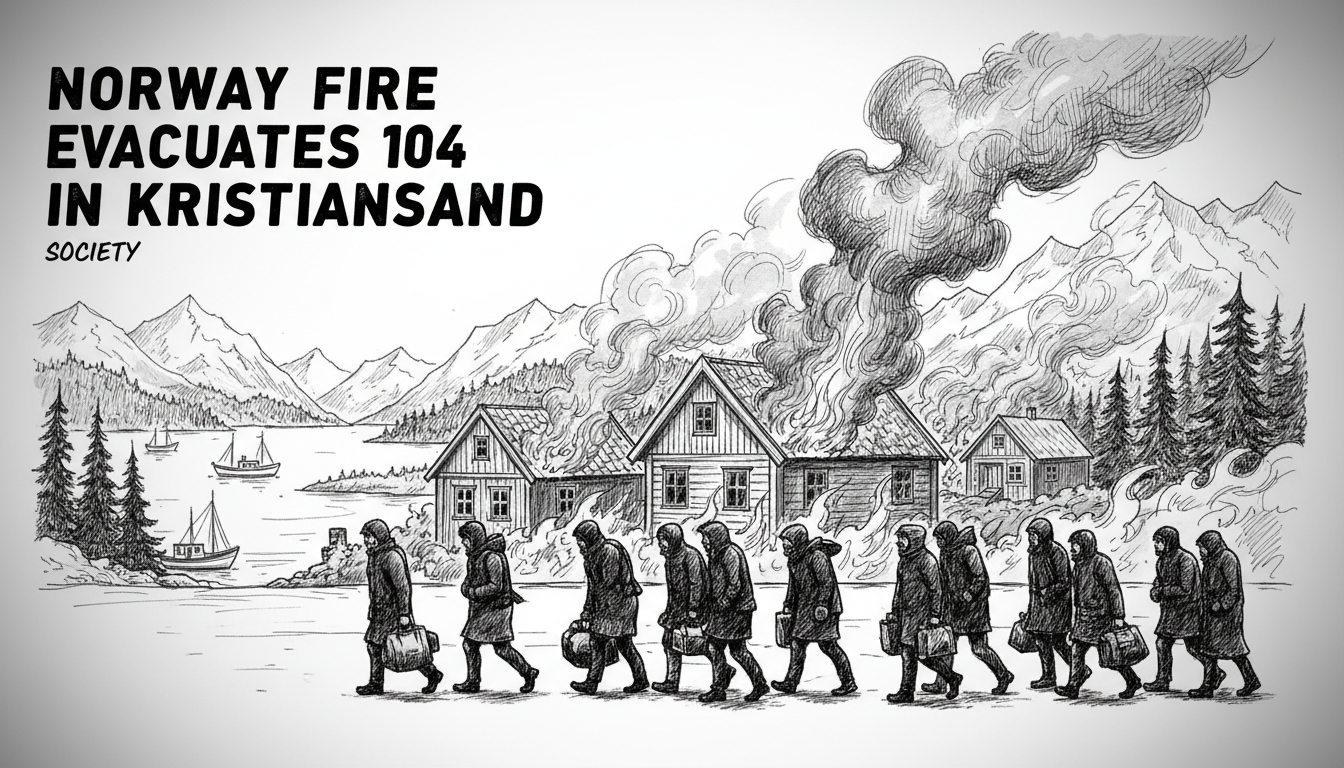
Norway fire services evacuated 104 people from a mixed-use building complex in Kristiansand after a major blaze broke out early Sunday morning. The fire, reported at 05:49 local time, sent open flames and heavy smoke through a quarter containing shops, businesses, and residential apartments. Emergency responders declared the fire under control by 14:00, but extensive damping down operations continued into the evening.
"This is a quarter with various buildings, shops, businesses, and some homes," said operations manager Linn Andresen. The immediate evacuation, assisted by the Civil Defence, was executed swiftly. All residents were accounted for, with no initial reports of injuries. The focus has now shifted to a painstaking assessment of when evacuees can return.
"There will be an ongoing assessment of when they can move back," wrote operations manager Ole Robert Strandhagen in a police log at 14:51. He emphasized that emergency services must first investigate how much smoke infiltrated the apartments. "The evacuation happens so there is no risk of people getting sick from the smoke," explained duty officer Grunde Holme. The municipality of Kristiansand is now providing support and follow-up for the displaced individuals.
A Swift Response Prevents Tragedy
The successful evacuation of over a hundred people from a burning building in the early hours highlights the efficiency of Norway's integrated emergency response system. The coordinated effort between police, the main fire service, and the Civil Defence—a national volunteer rescue organization—appears to have functioned as designed. This incident, occurring in Norway's fifth-largest city, tests protocols that are regularly drilled but less frequently deployed at this scale for structural fires.
Kristiansand, a key tourist hub in southern Norway known for its archipelago and zoo, is not typically associated with major urban fires. Its building stock, like much of Norway, includes older structures adapted for modern use. The fire's location in a mixed commercial and residential quarter presents specific challenges. "These buildings often have complex layouts, different ventilation systems, and varied occupancy patterns that can complicate firefighting and evacuation," says Lars Holm, a retired fire safety inspector from the region. "The priority is always life safety, and the fact that everyone was accounted for quickly is the primary success metric here."
The Long Road of Smoke Damage Assessment
While the flames are out, the crisis for residents is far from over. The statement from police that people cannot return until smoke infiltration is assessed points to a significant secondary hazard. Smoke from building fires is a toxic cocktail of chemicals, particles, and gases that can permeate soft furnishings, walls, and ventilation systems. Exposure risks range from immediate respiratory irritation to longer-term health effects.
This investigation phase is meticulous. Fire safety engineers and environmental health officials will need to access each affected dwelling. They will take air quality measurements, check HVAC systems, and assess porous materials for contamination. The process determines whether a deep clean by specialized remediation firms is sufficient or if more extensive repairs and replacements are necessary. For the 104 evacuees, this means an uncertain timeline. They are dependent on the municipality's social services for temporary housing, clothing, and essentials—a sudden disruption to daily life with no clear end date.
Building Safety in Norway's Urban Landscape
This fire will inevitably trigger a local review of fire safety compliance in the affected complex. Norway has stringent building codes, particularly after tragic historical fires. The regulations cover everything from material flammability and compartmentalization to the number and placement of smoke alarms and escape routes. Mixed-use buildings face additional rules to prevent fire spread between commercial units and residential spaces.
"An event like this is a stark reminder that codes are only as good as their implementation and maintenance," notes Kari Nystrøm, a professor of building safety at the University of Agder. "Regular inspections are crucial, especially for older buildings that have been renovated or changed purpose. Tenants and business owners also play a role in not propping open fire doors or overloading electrical circuits." The cause of this fire is not yet known, but common origins include electrical faults, kitchen accidents, or issues with heating systems. The Norwegian Directorate for Civil Protection (DSB) may issue broader advisories based on the investigation's findings.
Community and Economic Ripple Effects
Beyond the immediate evacuees, a fire of this magnitude disrupts an entire community block. Local businesses housed in the complex—the shops and services mentioned by officials—are now closed indefinitely. This means lost income for owners and lost wages for employees. For a small business, such an interruption can be existential. The commercial tenants face not only property damage but also the complex insurance claims process and the challenge of rebuilding customer traffic after reopening.
Kristiansand municipality's role in providing follow-up care is a standard part of Norway's social safety net, designed to prevent vulnerable individuals from falling through the cracks after a disaster. This support can include everything from crisis psychologists to practical help with navigating insurance and government aid. The response underscores a societal principle: when collective risk manifests, the collective has a responsibility to mitigate the fallout for individuals.
The fire in Kristiansand, while thankfully not claiming lives, exposes the fragile line between normalcy and crisis in urban environments. It showcases a well-oiled emergency response but also inaugurates a lengthy period of recovery and uncertainty for scores of citizens. The coming days will reveal the fire's origin, the full extent of the damage, and the true test of the support systems now activated. For now, 104 residents wait, their lives on pause, watching as experts in protective gear determine when, or if, they can go home.