
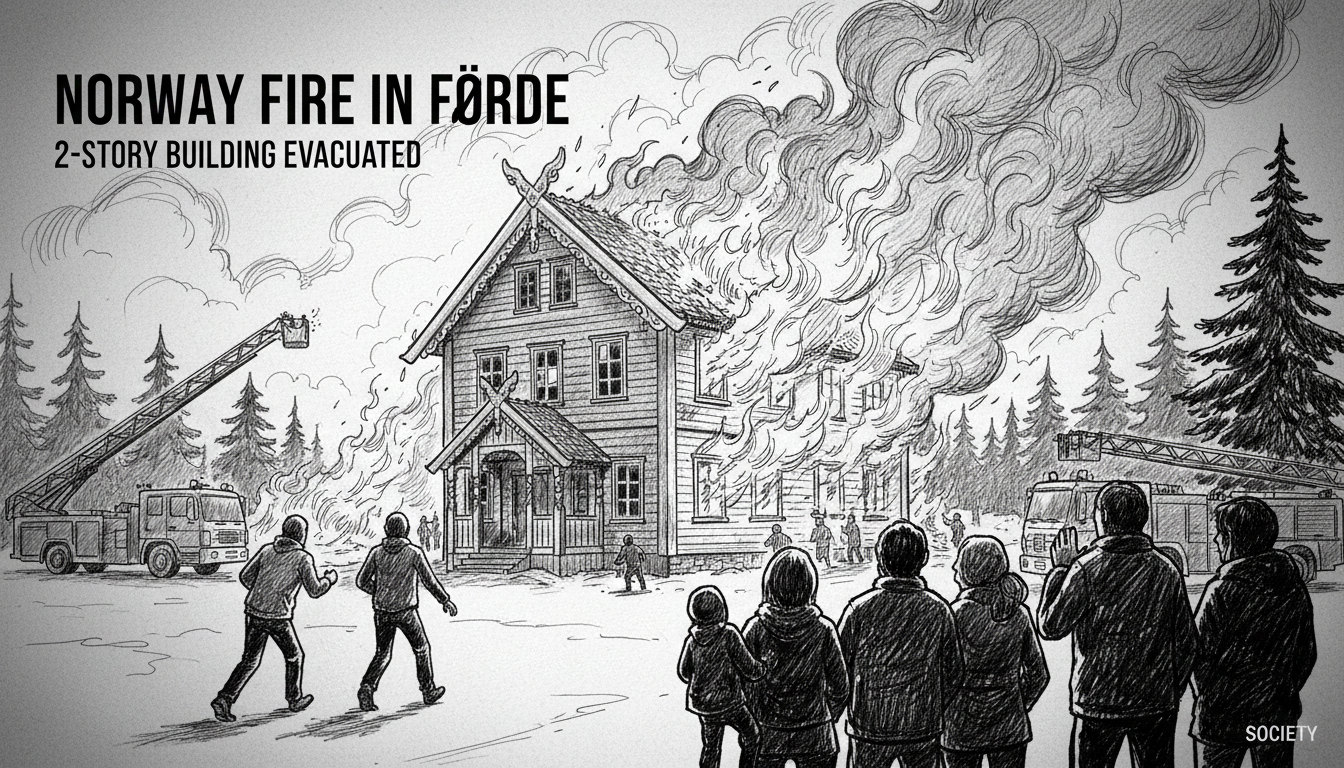
Norway fire services evacuated a two-story building in Førde city center after a blaze broke out on Monday afternoon. The local fire department reported having control of the situation by 3 PM, with no injuries reported. Initial reports suggest a short circuit caused the fire, which led to significant smoke inside the structure near the busy E39 highway.
Acting shift leader Trond Landås from the 110 West emergency center confirmed the situation was under control. "We have control at the scene," Landås said in an update. "It appears to be a short circuit, and the power to the building has been cut." The building's proximity to a major transport artery raised concerns about traffic disruptions, though police reported minimal impact.
Emergency Response and Evacuation
The fire department's response followed standard protocols for commercial structures in Norwegian town centers. Crews arrived quickly to the scene in Sunnfjord Municipality, where Førde serves as the administrative hub. Their priority was securing the building and preventing the fire from spreading to adjacent properties in the densely built center.
Evacuation procedures were implemented immediately as smoke filled the two-story structure. Business occupants and any residents were directed to safe assembly points. The efficient evacuation reflects Norway's stringent fire safety regulations for public buildings and commercial spaces. These regulations mandate clear escape routes and regular safety drills.
Electrical Safety and Building Standards
Norwegian building codes, particularly the TEK17 regulations, set comprehensive requirements for electrical installations and fire prevention. All electrical work must be performed by certified professionals, with systems designed to prevent overloads and short circuits. Older buildings in town centers like Førde sometimes face challenges updating infrastructure within historic structures.
"Electrical faults remain a common cause of building fires in Norway, especially in older commercial properties," said Lars Holm, a fire safety engineer with expertise in Nordic building standards. "Modern protective devices like residual-current devices (RCDs) and proper circuit breaking significantly reduce risk. This incident will likely trigger an inspection of the building's entire electrical system."
Commercial properties in Norway require regular electrical safety inspections, typically every five years, with more frequent checks for buildings with older installations. The suspected short circuit in Førde will prompt investigators to examine whether the building met these inspection requirements and if the electrical system had been properly maintained.
Economic Impact on Local Businesses
Fires in municipal centers like Førde create immediate economic disruption beyond property damage. The affected building likely housed multiple businesses serving the local community. Even temporary closure affects employees, customers, and supply chains in a town of approximately 10,000 residents.
Business interruption insurance is common among Norwegian commercial tenants, but the recovery process involves coordination between property owners, insurers, and municipal authorities. Sunnfjord Municipality may offer support services to displaced businesses through its economic development office.
"A fire in a central building affects the whole town's commercial ecosystem," noted economist Martine Iversen, who studies regional business impacts. "Beyond direct damage, there's lost revenue during closure, potential data loss, and customer diversion. In smaller communities like Førde, these effects are felt more acutely than in larger cities with more commercial redundancy."
Fire Service Capabilities in Western Norway
The prompt response highlights the capabilities of Norway's decentralized fire services. 110 Vest serves as the emergency communications center for the region, coordinating resources across multiple municipalities. Førde's fire station maintains equipment and personnel trained for structural fires in both traditional wooden buildings and modern constructions.
Western Norway's fire services regularly conduct joint exercises, particularly for scenarios involving historic town centers where fire spread between adjacent buildings presents special challenges. The region's topography, with fjords and mountains, requires tailored response strategies different from urban areas in eastern Norway.
Fire departments in municipalities like Sunnfjord balance response to structural fires with responsibilities for wildland firefighting, technical rescues, and maritime incidents. This requires versatile equipment and cross-trained personnel, reflecting Norway's integrated approach to emergency services.
Infrastructure and Traffic Considerations
Police initially warned that traffic on the E39 highway might be affected due to the building's proximity. The E39 serves as a vital coastal corridor connecting Bergen to Ålesund, with Førde positioned approximately midway. Any significant closure or diversion would impact commercial transport and regional mobility.
Fortunately, traffic disruptions appear to have been minimal. Norwegian emergency services typically establish security perimeters while minimizing impact on transportation networks. In compact town centers like Førde's, this requires careful coordination between police, fire services, and road authorities.
The incident occurred in a building near but not directly adjacent to the highway, allowing emergency access without full road closure. This contrasts with fires in more constrained urban environments where entire blocks might be cordoned off for extended periods.
Community Resilience and Recovery
Førde has experienced significant administrative changes in recent years, merging with neighboring municipalities in 2020 to form Sunnfjord Municipality. This consolidation of services may affect resource allocation for incident response and recovery. The new municipal structure presumably integrated emergency planning across a larger geographic area.
Community resilience in Norwegian towns often involves volunteer organizations supplementing professional emergency services. Local Red Cross chapters, volunteer fire departments in smaller villages, and community watch groups frequently support official responses. Their role becomes particularly important during prolonged incidents or when multiple emergencies occur simultaneously.
The absence of injuries suggests effective warning systems and orderly evacuation. Norwegian commercial buildings must have smoke detectors and alarm systems that alert occupants immediately. Regular fire drills ensure people know evacuation routes and assembly points, procedures that likely contributed to the safe outcome in Førde.
Looking Ahead: Investigation and Prevention
The fire department and police will conduct a standard investigation to determine the exact cause and contributing factors. Their report will examine the electrical system, building materials, fire detection systems, and evacuation effectiveness. Findings may influence inspections of similar buildings throughout Sunnfjord Municipality.
Insurance companies will conduct separate assessments for claims processing. Norwegian property insurance typically covers fire damage, business interruption, and liability, though specific terms vary by policy. The claims process involves documentation of damage, cause determination, and repair planning.
For Førde's business community, the incident serves as a reminder to review fire safety plans and insurance coverage. Many Norwegian businesses participate in the "Brannvernbedriftene" organization, which provides safety resources and training. Their guidance becomes particularly relevant following incidents in local commercial districts.
Norway's approach to fire safety emphasizes prevention through regulation, education, and technology. Each incident provides data to refine building codes and emergency response protocols. The Førde fire, while limited in scope, contributes to this continuous improvement process for municipalities across Vestland county.
As cleanup and investigation proceed, the community's focus shifts from emergency response to recovery and prevention. The incident's resolution without injury demonstrates effective systems, but always prompts reflection on how to make Norway's towns even safer from such unpredictable events.