
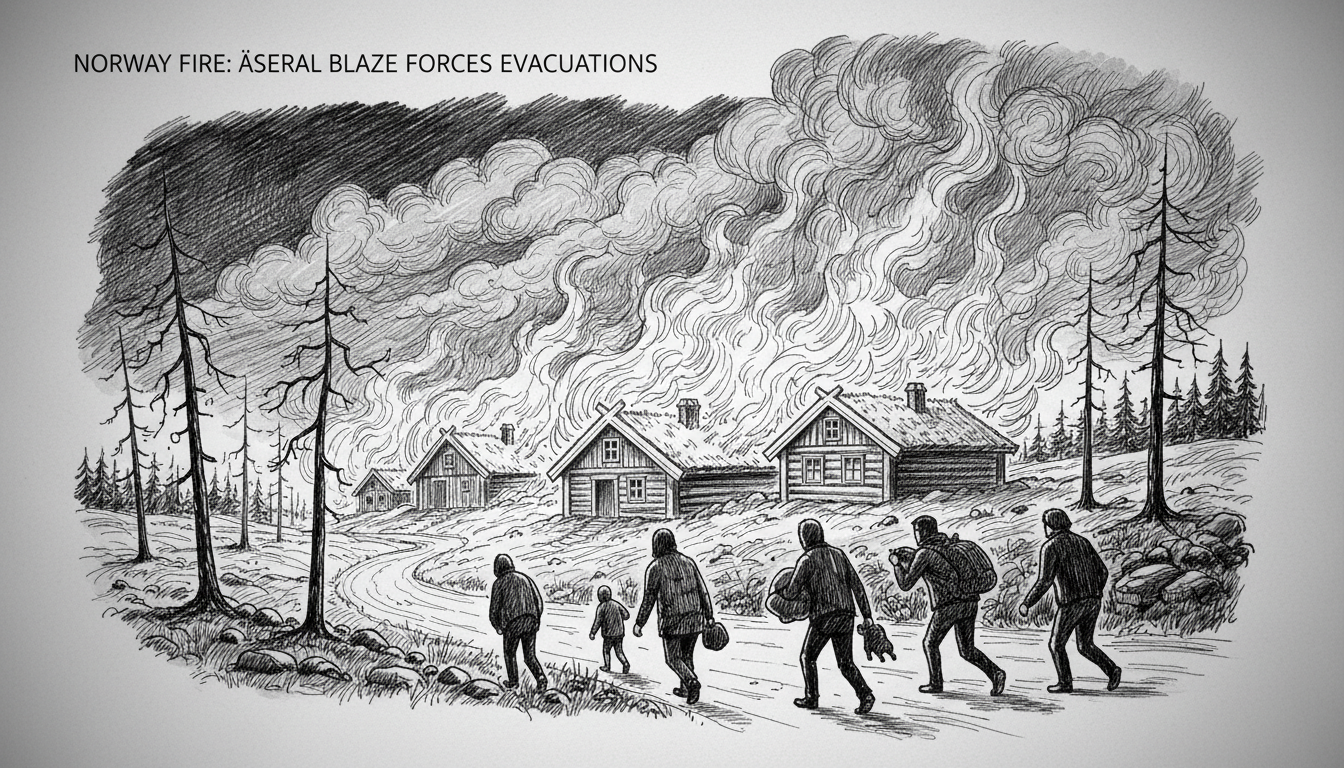
Norway fire crews are battling a major blaze in a storage building in the southern municipality of Åseral, with police evacuating nearby homes over fears of stored gas and potential explosions. The fire erupted in the Austerudsmoen industrial area, prompting authorities to establish a 300-meter safety perimeter around the volatile site.
Flames engulfed the structure containing various equipment and what police described as a probable gas supply. Emergency services from across Agder county are responding to the incident in this sparsely populated region. The immediate priority is containing the fire and ensuring the safety of residents within the expanding danger zone.
A Rural Community on Alert
Åseral municipality, located inland in Agder county, is characterized by its rugged terrain and dispersed population. This geography presents distinct challenges for emergency response. Local fire departments, often staffed by dedicated volunteers, form the first line of defense. They are now supported by regional resources mobilized to tackle the intense industrial fire.
“When an incident of this scale occurs in a rural area, it tests the entire emergency response chain,” said Lars Holen, a former director with the Norwegian Directorate for Civil Protection. “The establishment of a large safety zone indicates the responders have identified a significant risk, likely from pressurized tanks or hazardous materials. Distance becomes a critical factor for both evacuation and getting sufficient equipment to the scene.”
Police have begun evacuating residents living close to the Austerudsmoen area. The process in a rural municipality involves going door-to-door and accounting for individuals who may live on isolated properties. Community coordination is essential, often relying on local knowledge to ensure no one is left within the 300-meter radius deemed unsafe.
The Challenges of Remote Firefighting
Industrial fires in Norway’s smaller communities pose logistical problems not faced in urban centers. The concentration of specialized equipment, like high-capacity foam tenders or hazardous material units, is lower. Deploying them requires time. Water supply is another critical concern; without extensive municipal hydrant systems, responders may rely on tanker shuttles from nearby lakes or rivers.
“The initial report of possible gas on site dictates an extremely cautious strategy,” explained fire safety engineer Kari Nilsen. “The 300-meter zone isn’t arbitrary. It’s based on calculated blast fragmentation distances for certain types of propane or butane tanks. The goal is to protect both the public and the firefighters, who cannot make a direct attack on the fire until the fuel source is confirmed and isolated.”
The building’s contents—described as “various equipment”—add uncertainty. Stored chemicals, fertilizers, or fuels could create a complex and toxic smoke plume. Authorities will monitor air quality downwind, though the low population density in the immediate area reduces, but does not eliminate, public health risks.
Norway's Emergency Response Framework
This incident activates Norway’s tiered emergency response system. The Åseral municipal crisis staff leads the operation, coordinating local police, fire, and health services. As the situation developed, they requested assistance from the county governor’s office in Agder, which can mobilize regional assets and provide operational support.
If the fire were to escalate further, the national Norwegian Directorate for Civil Protection (DSB) could be engaged to provide additional expertise or resources. This layered system is designed to be scalable, ensuring even remote municipalities have access to substantial emergency support. The coordination happens through dedicated emergency communication networks, crucial in areas where standard cellular service can be unreliable.
“The system is built on the principle of neighborly help,” Holen noted. “You will see fire crews from neighboring municipalities like Kvinesdal or Hægebostad responding. Their familiarization with the regional landscape is invaluable.”
Economic and Environmental Impact
Beyond the immediate danger, a fire of this magnitude has longer-term implications. Austerudsmoen is an industrial area, and the destruction of a storage facility will affect local businesses that relied on it. Loss of equipment, inventory, and potentially vehicles represents a significant economic blow to the owners and the small local economy.
Environmental damage is also a concern. Runoff from firefighting foam and water, mixed with burned materials, must be contained to prevent contamination of soil and waterways. Åseral’s environment is part of its identity, featuring rivers and forests popular for fishing and hiking. The Norwegian Environment Agency may be consulted on mitigation efforts once the fire is extinguished.
For evacuated residents, the uncertainty is profound. They await news on when they can return home and what condition their properties will be in. The local municipality, with support from the Norwegian Red Cross or the Church's City Mission, typically sets up a temporary reception center to provide information, shelter, and psychological first aid.
A Test of Preparedness
Incidents like the Åseral fire serve as a real-time test of Norway’s much-vaunted emergency preparedness. The country invests heavily in planning and training, particularly for scenarios involving its offshore oil and gas installations. However, a terrestrial industrial fire in a quiet valley presents a different set of variables.
The response will be scrutinized for lessons learned. How quickly were resources deployed? Was communication with the public effective? Were the risk assessments accurate? Answers to these questions will inform future training and resource allocation for rural municipalities across Norway.
As night falls in Agder, the glow from the Åseral blaze will be a stark reminder of the vulnerability that exists alongside Norway’s serene landscapes. The successful containment of this fire, with no loss of life, will depend on the skill of the responders, the compliance of the public, and the robustness of the systems designed to protect them. The coming hours are critical, not just for putting out the flames, but for upholding the community's sense of security in a place where danger rarely makes headlines.