
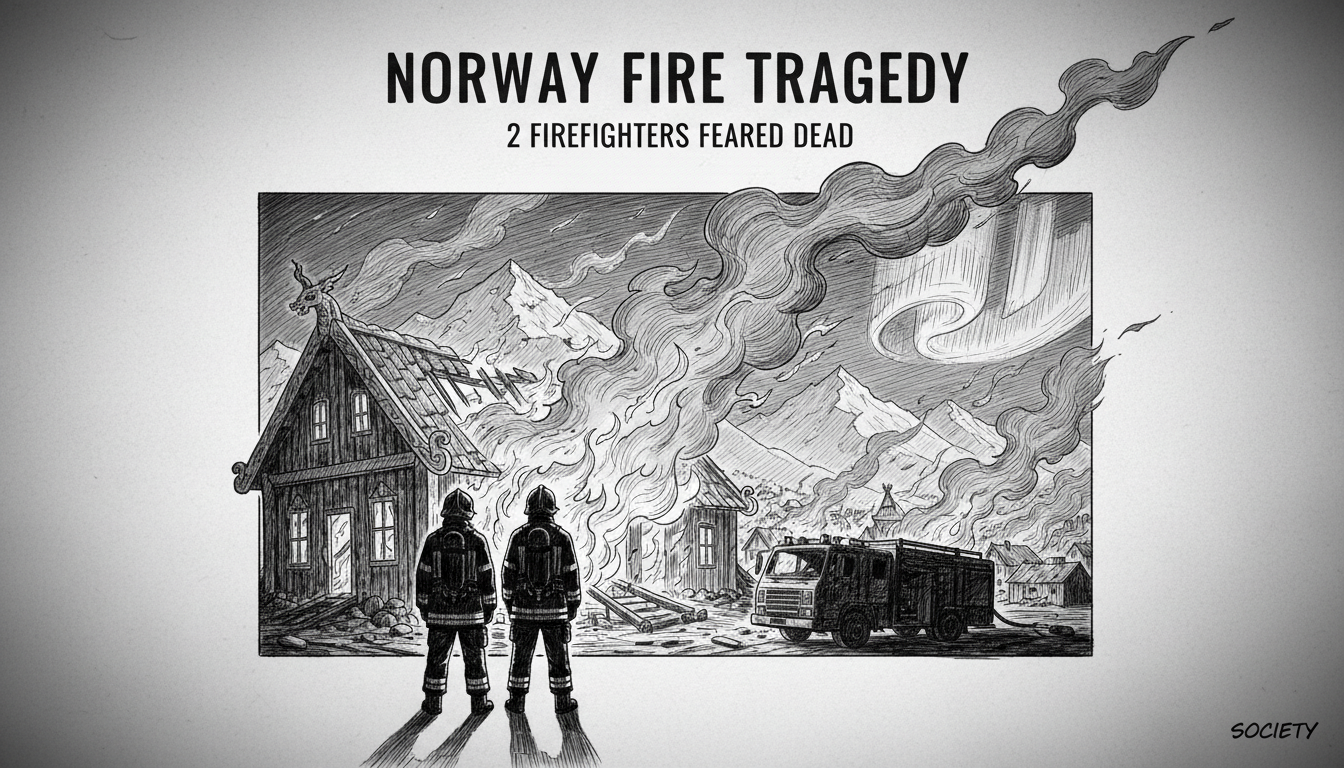
Norway fire crews in Verdal faced an inferno so intense it prevented rescue attempts for their own colleagues early Wednesday. Two specialized firefighters, known as ‘røykdykkere’ or smoke divers, are missing and presumed dead after losing contact inside a burning residential building. The incident has sent shockwaves through Norway’s emergency services and prompted a major investigation into one of the profession’s gravest risks.
Police were first alerted to the severe house fire in Verdal just after 2 a.m. A man in his 30s who was inside managed to evacuate himself and seek help from neighbors. Firefighters from Brannvesenet Midt IKS arrived on scene six minutes later and immediately began operations to contain the blaze. Approximately fifty minutes into the firefight, communication with the two smoke divers inside the structure was lost.
“After working on the fire for 50 minutes, it became clear that contact could not be made with the smoke divers,” said police spokesperson Morten Mørkved. “Attempts were then made to make contact and enter the house, but the fire was so powerful that it was not possible to get inside.”
The stark admission underscores the extreme conditions faced by the responders. Forensic teams are now on site, waiting for the smoldering ruins to cool sufficiently to begin a thorough search and investigation.
A Community and Service in Mourning
While the smoke divers have not yet been formally located, authorities have stated they assume the firefighters perished in the blaze. Next of kin have been notified, a process that marks the beginning of a profound period of grief for two families and the tight-knit firefighting community. The loss of emergency personnel in the line of duty is a rare and devastating event in Norway, where public safety systems are highly regarded.
The investigation is now proceeding on two parallel tracks. One focuses on the origin and cause of the fire itself. The other is classified as an industrial accident, examining the operational details that led to the firefighters' disappearance. This dual approach is standard in incidents involving responder fatalities, aiming to determine both the initial hazard and the response to it.
Innsatsleder Trond Marius Fornes of Brannvesenet Midt IKS stated that standard procedures for smoke diving were followed. “It has been a powerful fire, that is clear. And there is a risk associated with smoke diving. We don’t really know anything more than that,” the operations leader said. His comments highlight the ever-present danger these specialists accept, even when protocols are meticulously observed.
The Inherent Perils of Smoke Diving
Smoke divers are the elite frontline of firefighting, trained to enter intensely hostile environments where visibility is zero, temperatures are extreme, and structural stability is unknown. Their role is crucial for search and rescue and for attacking the seat of a fire from inside. The term ‘røykdykker’ literally translates to ‘smoke diver,’ evoking the image of submerging into a thick, toxic atmosphere.
Experts in firefighter safety explain that several critical factors can converge in a rapidly developing residential fire. Modern homes often contain synthetic materials that burn hotter and faster than traditional wood and fabric, leading to flashover conditions more quickly. The open-plan designs common in contemporary architecture can also allow fire and smoke to spread unchecked, creating large, fuel-rich volumes that are exceptionally dangerous.
“The fundamental risk is structural collapse,” explains a veteran fire safety instructor who requested anonymity due to the ongoing investigation. “When a fire burns with that intensity, it can compromise load-bearing elements like wooden joists or steel beams in minutes. A floor or roof can fail without audible warning. Communication lines can be severed by falling debris. The environment becomes a lethal maze.”
Norwegian fire services operate under strict national safety regulations, which include guidelines for crew integrity, communication check-ins, and emergency evacuation signals. The investigation will scrutinize whether all these measures were in place and functional, and whether the dynamic risk assessment on scene adequately accounted for the fire's behavior.
Norway's Fire Safety Framework Under Scrutiny
This tragedy will inevitably lead to broader questions about fire safety in Norwegian communities. Norway has rigorous building codes focused on fire prevention, mandating smoke alarms, regulated building materials, and compartmentalization to slow fire spread. However, these codes primarily address prevention and safe evacuation for occupants, not the working conditions for firefighters attacking a fully developed blaze.
The fire in Verdal raises difficult questions about whether building practices and material choices have inadvertently created more dangerous environments for responders. There is an ongoing international discussion in firefighting circles about the ‘modern fire environment’ being significantly more volatile than in past decades.
Furthermore, Norway’s fire service is organized regionally, with entities like Brannvesenet Midt IKS covering multiple municipalities. This system aims to pool resources and expertise. The investigation may examine whether resource allocation, training standards, and equipment for complex residential fires are consistent and sufficient across these regional bodies, especially in smaller towns like Verdal.
A Nation's Gratitude and Grief
The presumed loss of the two firefighters resonates deeply in a country with a strong ethos of communal safety and public service. Firefighters in Norway, whether volunteer or professional, hold a place of high respect. Flags are likely to be flown at half-mast, and public tributes will follow once the families have had time in private.
Such incidents also force a painful reckoning within the emergency services themselves. Critical Incident Stress Management teams will be deployed to support the crew members who responded, those who attempted the rescue, and the wider network of first responders in the region. The psychological impact of losing colleagues in an unrecoverable situation is profound and long-lasting.
The coming days will be focused on the grim recovery operation and the initial phases of the investigation. The police and the Norwegian Labour Inspection Authority will work to piece together the final moments of the operation, reviewing radio logs, helmet camera footage if available, and the physical evidence in the ruins.
For now, a community and a country wait for answers and mourn the ultimate sacrifice made in the line of duty. The Verdal fire is a stark reminder that despite advanced technology, rigorous training, and immense courage, the elemental force of fire can still overwhelm. The question that will haunt the investigation is not just about what went wrong, but whether anything could have changed the outcome when faced with a blaze described simply as “so powerful.”