
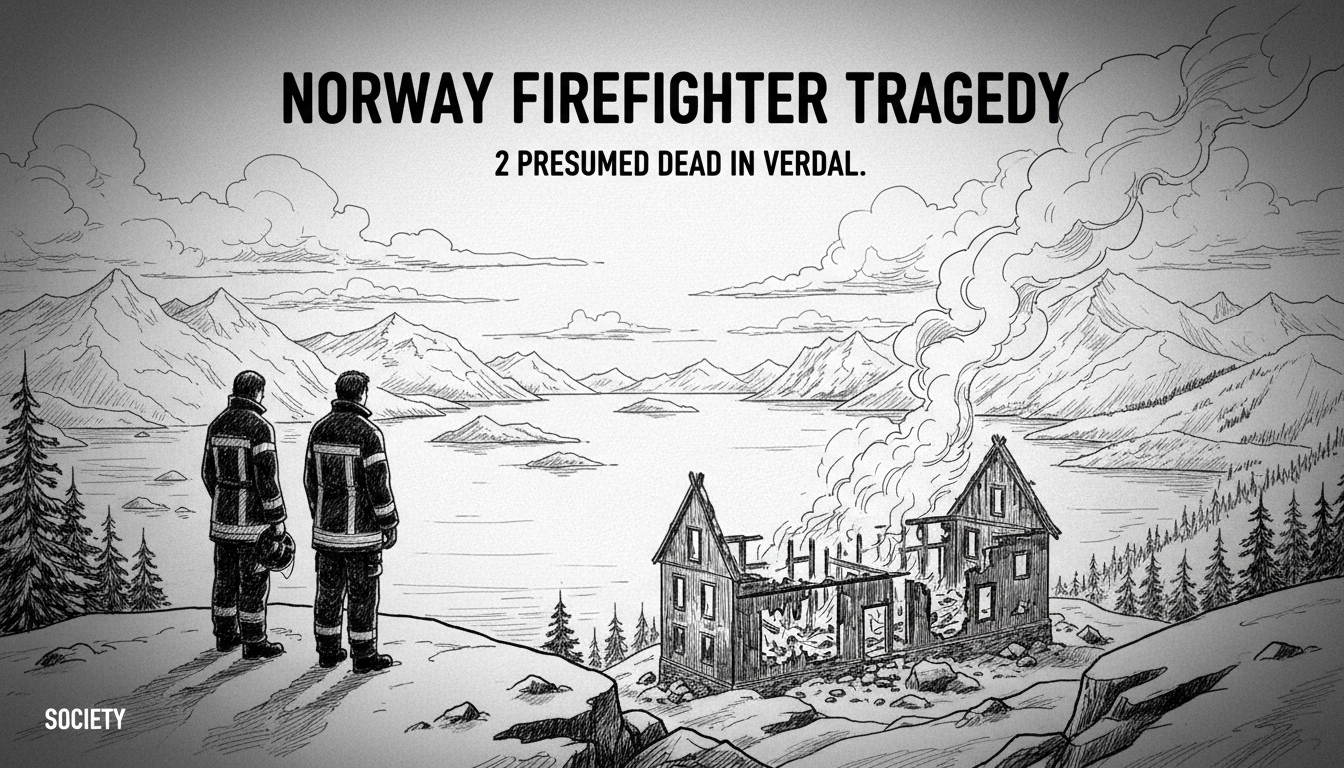
Norway's firefighting community is in mourning after two firefighters are presumed dead following a house fire in Verdal. The two fire constables entered a burning building early Wednesday morning and never came out. The incident has sent shockwaves through the nation's small, tight-knit emergency services.
Justice and Public Security Minister Astri Aas-Hansen expressed her profound condolences. "My deepest sympathy goes to their next of kin, relatives, and colleagues," Aas-Hansen said in a statement. "The fire service makes an invaluable contribution to society, and it is painful when public servants who are on duty to save others lose their own lives."
A Community in Shock
The fire occurred in Verdal, a municipality in Trøndelag county. One resident managed to self-evacuate from the burning house, which was completely destroyed. Four people from a neighboring building were also evacuated as a precaution. By Wednesday morning, crews were conducting mop-up operations at the scene. Police have stated they will conduct forensic technical examinations once the site is fully extinguished and cooled.
Local officials have mobilized support services. "This is a tragic event, and our thoughts go out to those affected and their relatives," said Verdal Mayor Knut Snorre Sandnes. The municipality has activated its crisis response team to provide support to those impacted, including fellow firefighters and the families of the two men.
A Tight-Knit Brotherhood Grieves
The loss is felt acutely within Norway's firefighting ranks, which union leaders describe as a close family. "It is deeply tragic. Our thoughts go to the family and colleagues of the two who are missing. There is nothing else to say than that it is a great tragedy," said Trond Busterud, leader of the Delta Firefighters' Union. He emphasized the small size of the professional firefighting community in Norway. "It's not a very large environment. Many people know many others all around Norway. And we are really like one big family. It affects us deeply when things like this happen."
Helene Harsvik Skeibrok, leader of the Norwegian Union of Municipal and General Employees (Fagforbundet), which represents about 5,500 members in fire and rescue services, echoed the sentiment. "It is terribly painful when those who are at work to help others lose their own lives. Our thoughts go out to family and colleagues."
The Inherent Risks of the Profession
This tragic event underscores the extreme dangers firefighters face every time they respond to a call. While Norway has an excellent safety record and advanced equipment, the profession remains one of the most hazardous public service jobs. Firefighters routinely enter unstable, oxygen-deprived, and intensely hot environments with near-zero visibility to search for victims and suppress flames.
Experts in emergency response note that residential structure fires pose particular risks. Modern building materials can burn hotter and faster, and synthetic materials produce toxic, flammable gases. A phenomenon called flashover, where all combustible materials in a room simultaneously ignite, can occur in minutes. The investigation in Verdal will meticulously examine the fire's cause, the building's construction, and the operational decisions made during the response to understand the sequence of events that led to this outcome.
Minister Aas-Hansen's Role and Response
As Minister of Justice and Public Security, Astri Aas-Hansen holds ultimate political responsibility for national emergency preparedness and the framework governing municipal fire services. Her department oversees the Directorate for Civil Protection (DSB), which sets national standards for fire safety and emergency response. While firefighting is organized at the municipal level, the ministry plays a key role in reviewing major incidents to identify systemic lessons for improving national safety protocols.
Aas-Hansen's immediate and empathetic response is standard in the Norwegian political tradition, where ministers are expected to offer personal condolences and public support in the wake of tragedies involving public servants. Her statement not only acknowledges the personal loss but also reinforces the societal value of the firefighters' work, a crucial message for maintaining morale within the emergency services.
The Path Forward: Investigation and Aftermath
The coming days and weeks will focus on the investigation and supporting the bereaved. The police, in cooperation with the fire service's own investigative units and the DSB, will work to determine the exact cause of the fire. They will also reconstruct the firefighters' actions, examining their equipment, communication logs, and the tactical approach to the blaze. The goal is not to assign blame, but to uncover any factors—whether related to procedures, training, equipment, or building safety—that can be addressed to prevent future fatalities.
For the families of the two firefighters, the process of formal identification and the return of their loved ones will be agonizing. The fire service community, known for its strong camaraderie, will rally around them. Counseling and peer support will be made available not just for the immediate crew from Verdal, but for firefighters across the region who may be traumatized by the loss of colleagues.
A Nation's Gratitude and Grief
Incidents where rescuers perish in the line of duty resonate deeply in Norway, a society built on principles of collective security and mutual aid. Firefighters, whether volunteer or professional, hold a place of high respect. They are neighbors who step forward to protect their community, embodying a civic duty that is highly valued. Their sacrifice, while a stark reminder of the job's perils, reinforces the debt society owes to those who run toward danger.
The tragedy in Verdal is a somber reminder that safety can never be taken for granted. It will inevitably lead to renewed discussions within municipal councils and in the Storting about resource allocation for fire services, the adequacy of staffing levels, and the continuous need for investment in the best possible protective gear and training. For now, the nation's focus is on mourning. The flags in Verdal will likely fly at half-mast, and a collective sense of loss will hang over the Trøndelag region, a quiet tribute to two public servants who gave everything in service to others.
What systemic lessons will Norway learn from this profound loss to ensure those who protect us are themselves protected?