
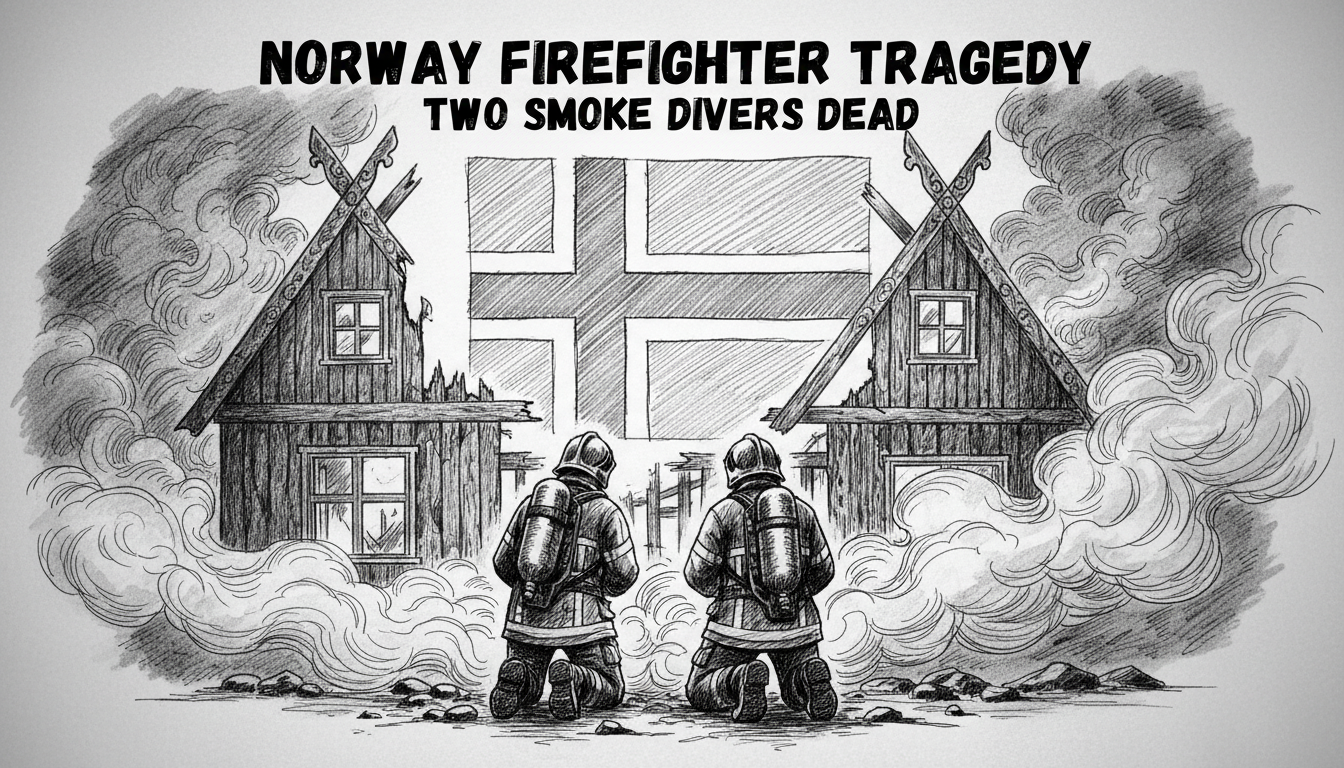
Norway's close-knit firefighting community mourns two presumed dead after a Verdal house fire. The missing firefighters, specialized smoke divers, entered the burning building overnight in a final rescue attempt. Colleagues from the Drammen region posted a memorial image online, stating the national fire service is 'one big family' united in grief.
A Community in Mourning
Brannvesenet Midt, the regional fire department for central Norway, confirmed the two firefighters are missing and presumed deceased. The men were operating as røykdykkere—smoke divers—a role requiring them to enter intensely hazardous, smoke-filled environments. Their mission was to extinguish the blaze in the residential building in Verdal, a municipality in Trøndelag county. The national attention this incident has garnered underscores the small size of Norway's emergency services and the profound personal connections within them. 'Our thoughts and deepest sympathy go to the families and relatives of the two, and to colleagues in Brannvesenet Midt,' wrote firefighters from the Drammen area on social media.
The spontaneous memorial from a fire unit over 400 kilometers away highlights a core truth about Norwegian emergency response. Despite being organized at the municipal level, a strong culture of national solidarity exists. 'The fire service in Norway is one big family, and it affects us all when such a tragedy happens,' the Drammen post continued. This sentiment resonates across police, ambulance, and civil defense units, creating a nationwide support network when crisis strikes.
The Inherent Risks of Smoke Diving
Smoke diving represents the most dangerous frontline duty in firefighting. These specialists enter structures during active, ventilation-controlled fires where temperatures can exceed 800 degrees Celsius and visibility is zero. Their task is to find the seat of the fire and apply water directly, a high-risk, high-reward strategy. The role demands exceptional physical fitness, rigorous training, and complete trust in teammates and equipment. Each dive follows strict protocols, but the dynamic nature of structural fires means conditions can collapse in seconds.
Professor Torstein K. Fjell, a former fire chief and lecturer in rescue science at the University of Southeastern Norway, explains the psychological and physical toll. 'A smoke diver operates in an alien world,' Fjell notes. 'They navigate by touch and sound, relying on their training to interpret the crackle of fire and the feel of a wall. The mental load is enormous. When we lose colleagues in such circumstances, it isn't just a statistic. It is a visceral loss that every firefighter, active or retired, feels personally.' This incident marks the first line-of-duty death for Norwegian firefighters in several years, a testament to generally high safety standards that make each loss deeply shocking.
The Aftermath and Investigation
Standard procedure following a serious incident like the Verdal fire involves a immediate operational halt for the involved crew and a comprehensive, multi-agency investigation. The Norwegian Directorate for Civil Protection (DSB) will likely oversee a formal inquiry. This process will examine the building's construction, the fire's progression, the operational decisions made, equipment functionality, and communication logs. The goal is not to assign blame but to identify any technical, procedural, or situational factors that contributed to the tragedy. Findings are used to update national training manuals and safety protocols.
Parallel to the official investigation, a critical incident stress management team will be deployed to support the firefighters from Brannvesenet Midt. Peer support is a cornerstone of Norway's emergency service culture. Colleagues from neighboring districts will often cover shifts, allowing the affected crew time to grieve and process the trauma. The families of the fallen firefighters will receive immediate and long-term support from the fire service's union and support organizations, a recognition of the shared sacrifice made by fire households.
National Policy and Local Reality
This tragedy brings focus to the structure of Norway's fire and rescue services. Unlike its Nordic neighbors Sweden and Denmark, which have more centralized systems, Norway's service is primarily municipal. Over 300 local municipalities are responsible for providing fire services, leading to variations in resources, equipment, and training levels. While this local model offers flexibility, it sometimes faces challenges during large-scale or exceptionally complex incidents. Regional cooperation agreements, like those underpinning Brannvesenet Midt, help bridge these gaps by pooling resources across municipalities.
The incident also sparks discussion about building materials and fire safety regulations in residential structures. Norwegian building codes are strict, but older homes, like the one in Verdal, may not meet modern standards. Fire spread speed and toxic smoke production have increased with the prevalence of synthetic materials in modern furnishings. This creates a more volatile environment for smoke divers, compressing the time they have to operate safely. Experts argue for continuous investment in advanced protective gear, thermal imaging technology, and fire behavior simulation training to keep pace with these evolving risks.
A Legacy of Service
The two firefighters in Verdal performed a duty that defines civic courage: moving toward danger as others flee. Their loss is felt from the local community in Trøndelag to fire stations in Oslo, Bergen, and Drammen. It reinforces the precarious balance between the imperative to save lives and property and the duty to protect the protectors. As the investigation proceeds quietly, the public expression of solidarity—the shared images, the simple posts—reveals the strength of Norway's emergency service family. This network, now mourning, is what will ultimately support the families and colleagues through the difficult months ahead.
The conversation following this loss will inevitably turn to how such risks can be further mitigated. Can technology, such as improved drones or robotics, eventually reduce the need for human entry into the most dangerous zones? For now, the profession relies on human skill and bravery. The ultimate tribute to the two smoke divers will be a relentless commitment to learning from this incident, ensuring their colleagues are as equipped and prepared as possible for the next call—a call that will undoubtedly be answered, despite the risks laid bare in Verdal.