
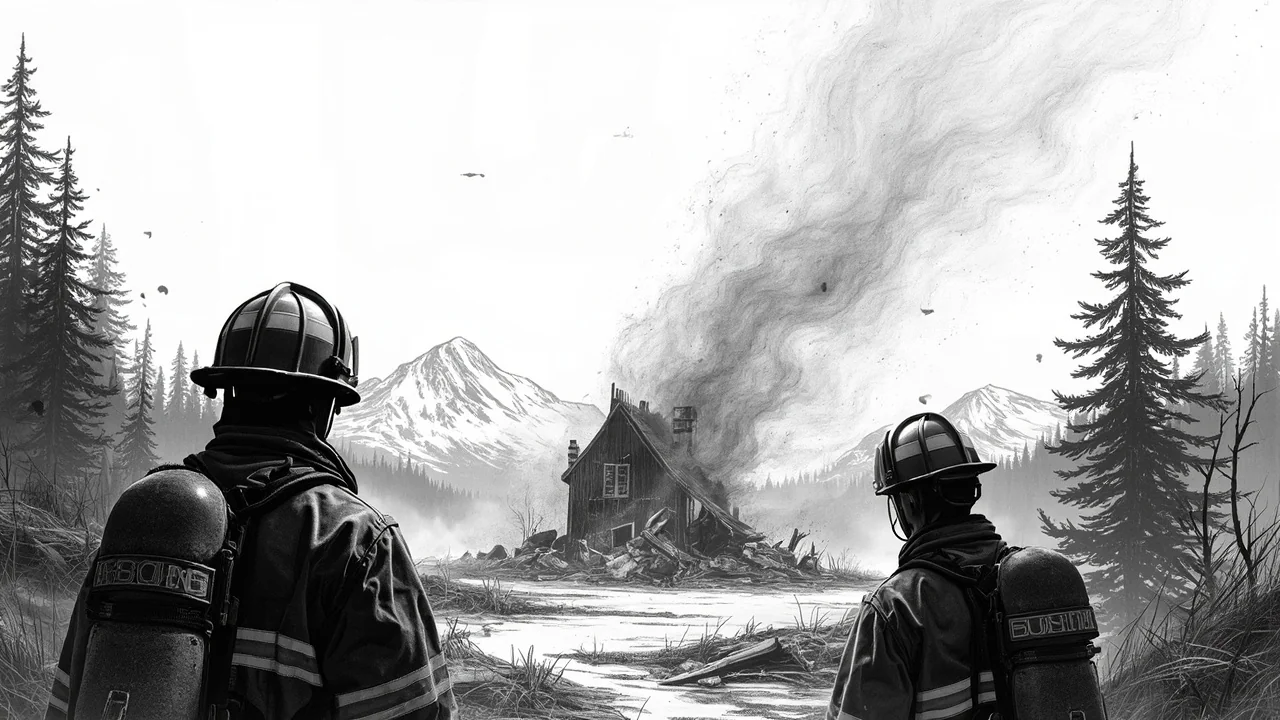
Norway's emergency services are mourning the loss of two veteran firefighters who died in a house fire in Verdal early Wednesday morning. The tragedy has prompted a major investigation and cast a shadow over the nation's firefighting community. Roger Kvello Hansen, 51, and Geir Otto Lein Johnson, 58, both experienced smoke divers from Verdal municipality, perished while battling the blaze. Their deaths mark one of the most serious operational fatalities for Norwegian firefighters in recent years.
Emergency services received the alarm at 2:01 AM. The homeowner had already evacuated the single-family dwelling by the time crews arrived. Fire Chief Håvard Bye described the two men as "experienced smoke divers." They entered the building as part of the firefighting operation. Approximately fifty minutes after suppression work began, the emergency command lost contact with the two firefighters inside. The fire had intensified significantly by that point. Their bodies were not recovered until Wednesday evening.
By Wednesday morning, authorities already feared the worst. The Trøndelag Police District confirmed the deaths in an official statement later that day. The names and photographs of the deceased were released with consent from their next of kin. Both men were local to the Verdal community, a fact that deepens the impact of their loss in the small municipality.
A Community in Mourning
The deaths of Hansen and Johnson have sent shockwaves through Verdal and Norway's close-knit professional fire service. Firefighting in Norway, particularly in smaller municipalities, relies heavily on a culture of local knowledge and deep trust. These men were not just responders; they were neighbors. Their loss is profoundly personal for the community they served. The Norwegian Firefighters' Union has expressed its profound grief, highlighting the inherent risks firefighters accept every time they answer a call. Flags across Trøndelag county are flying at half-mast.
This incident forces a grim reminder of the dangers of interior firefighting, or "smoke diving." Despite advanced personal protective equipment and rigorous training, conditions inside a burning structure can change with terrifying speed. Flashovers, backdrafts, and structural collapse are constant threats. The fact that two seasoned professionals were overcome speaks to the unpredictable violence of the fire in Verdal. The police have not released details on the suspected cause of the fire or the specific circumstances that led to the loss of contact.
A Major Investigative Effort Underway
In response to the fatalities, Norwegian authorities have launched a comprehensive investigation. On Thursday, forensic technicians from the National Criminal Investigation Service (Kripos) arrived in Verdal to assist local police. "There will be work on site with forensic technical investigations throughout the day," said police operations manager Bjørnar Gaasvik in a statement on Thursday morning. The police announced that investigative work at the scene would continue into Friday, supported by Kripos, and that further interviews would be conducted.
The purpose of this investigation is twofold. First, it aims to establish the exact cause of the fire. Second, and critically, it will conduct a meticulous reconstruction of the firefighting operation itself. Investigators will examine tactics, communication, equipment, and decision-making to determine what went wrong. This process, known as an operational debrief or after-action review in safety-critical industries, is standard procedure following a serious incident. Its goal is not to assign blame prematurely but to uncover facts that could prevent future tragedies.
For Norway's fire services, such investigations often lead to updated national guidelines or training protocols. The Norwegian Directorate for Civil Protection plays a key role in disseminating lessons learned from serious incidents across all municipal fire departments. The findings from Verdal will be scrutinized by fire chiefs and instructors nationwide.
The Human Cost of Public Service
Beyond the protocols and investigations lies the immense human cost. Roger Kvello Hansen and Geir Otto Lein Johnson were in their fifties, likely with decades of service and life experience. Their decision to enter a burning building represents the ultimate commitment to public duty. Firefighting in Norway, especially in regional areas, is a vocation that demands physical courage, technical skill, and a deep sense of community responsibility. These men embodied those values.
The impact on their colleagues is severe. The psychological toll on first responders who witness the loss of comrades can be debilitating. Peer support and critical incident stress management will be essential for the Verdal fire crew and other responders at the scene. The Norwegian labor and welfare system provides support for work-related psychological injury, but the path to recovery for the team will be long.
For the families of Hansen and Johnson, the loss is irrevocable. The fire service community is known for its strong internal support networks, which will now mobilize around the bereaved families. Memorial services and public expressions of gratitude are expected in the coming days as the nation acknowledges their sacrifice.
Safety in the Spotlight
This tragedy inevitably places Norway's fire service safety standards under the microscope. Norway has a generally strong reputation for health and safety across all professions. The fire service operates under strict regulations regarding equipment, crew ratios, and operational procedures. However, firefighting remains an activity where absolute safety is impossible to guarantee. The environment is actively hostile and dynamically changing.
Key questions the investigation may explore include the size and composition of the initial response crew, the information available to commanders about the building's structure and contents, and the specific tasks the two firefighters were performing when contact was lost. The timeline—from the alarm at 2:01 AM to the loss of contact around 50 minutes later—will be analyzed minute by minute. Understanding the fire's growth and spread is crucial.
Comparisons will be drawn, however painful, to previous firefighter fatalities in Norway. Each incident contributes to a body of knowledge aimed at improving survival odds. The focus will be on whether existing procedures were followed, and if those procedures are adequate for the risks faced in modern structures, which can contain synthetic materials that burn hotter and faster than traditional wood.
A Nation's Reflection
As the investigation proceeds quietly in Verdal, Norway reflects on a fundamental social contract. Citizens rely on a small group of individuals to run toward dangers everyone else flees. We equip them with tools and training, but ultimately, we ask them to accept a level of risk that is foreign to most workplaces. The deaths of Hansen and Johnson are a stark reminder of the price that can be paid.
Their sacrifice underscores the value of public service and the fragility of life. It will prompt discussions in town halls and fire stations about resources, training, and the eternal balance between aggressive intervention and firefighter safety. For now, the priority is supporting the grieving families and colleagues, and allowing investigators the time and space to uncover the truth of what happened in those dark, early morning hours in Verdal. The answers they find will honor the fallen by striving to protect those who continue to serve.