
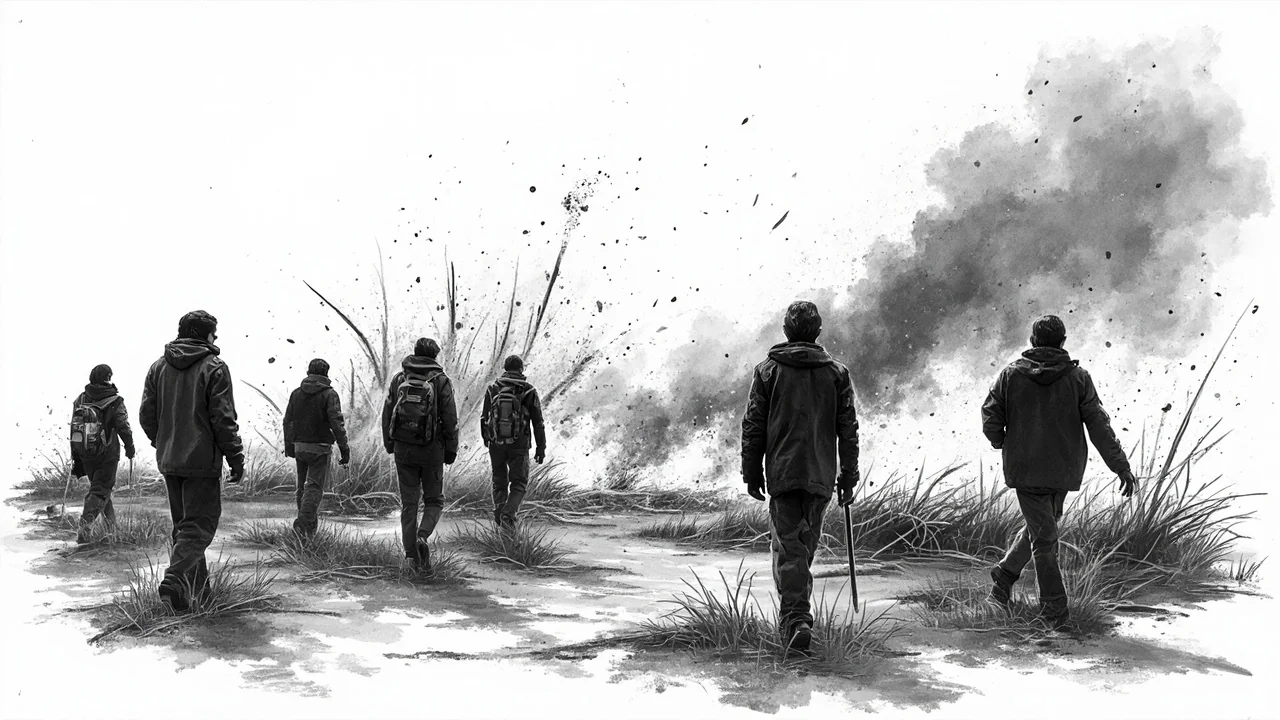
Norway's emergency services battled a serious terrain fire on Askøy island Sunday night, evacuating seven residents from two homes as flames threatened residential areas. Police suspect teenagers playing with fireworks ignited the blaze, with strong winds complicating firefighting efforts in the coastal community near Bergen.
"It was dramatic for a period. It was a fairly powerful fire. The wind and the terrain made it difficult," said police operations leader Tore-André Brakstad. Authorities confirmed the fire is now under control, with no open flames remaining, though mop-up operations continue. The evacuated residents have been cleared to return to their homes.
A Dramatic Evening on Askøy
The incident began unfolding Sunday evening on Askøy, a populous island municipality in Vestland county. Police initiated evacuations on the north side of Hanøyvegen road around 7 p.m. after confirming the terrain fire posed a direct threat to buildings. A yellow-level danger warning for strong winds was in effect for Vestlandet, with gusts reaching up to 19 meters per second on Askøy according to meteorological reports.
Fire crews faced challenging conditions. The combination of dry terrain, flammable vegetation, and powerful wind gusts allowed the fire to spread rapidly toward residential structures. At the height of the emergency, authorities continuously assessed whether additional evacuations would be necessary beyond the initial two households.
"Fortunately, it appears to be moving away from buildings. Regarding the cabins that were threatened for a while, the fire is now at least moving away from those cabins," a fire service commander reported around 8:30 p.m., even as crews acknowledged they did not yet have full control.
A Multi-Agency Response
The response escalated quickly into a significant operation. Multiple fire trucks and emergency personnel from several stations converged on the area. Around 8 p.m., the fireboat Sjøbrand arrived from the seaward side to assist with suppression efforts, utilizing its water-pumping capacity to attack the flames from an additional angle.
Police deployed a drone to map the fire's extent and monitor its behavior, providing crucial aerial intelligence to ground crews. This technology helps commanders understand fire spread patterns and direct resources more effectively. By 9 p.m., police announced that the fire service had achieved "reasonable control" of the situation, marking a turning point in the hours-long battle.
Operations leader Brakstad confirmed the transition from active firefighting to the mop-up phase. "The latest status is that the fire service believes they have reasonable control of the situation. Now there are no open flames anymore, but they are still working on mop-up," he stated.
Fireworks and Criminal Responsibility
Police quickly focused their investigation on human activity as the likely cause. "We have had dialogue around the fact that some teenagers were playing with some fireworks. It is something we have had some conversations with some people about, and will follow up further," Brakstad told reporters.
He confirmed the investigation will continue in the aftermath. A critical legal detail emerged: the teenagers linked to the fireworks are under the age of criminal responsibility in Norway, which is 15. This means standard criminal prosecution is not an option. "It will be assessed how this should be followed up," Brakstad said, indicating authorities will explore alternative measures within the child welfare and juvenile justice systems.
This aspect highlights a recurring seasonal problem in Norway. Despite regulations, the misuse of fireworks, particularly by minors outside of traditional New Year's celebrations, periodically leads to property damage, injuries, and wildfires. The incident raises immediate questions about supervision, access to pyrotechnics, and public education.
Analysis: Terrain Fires in a Changing Climate
While this fire was contained, it serves as a stark reminder of Norway's vulnerability to terrain fires, even in coastal regions. Askøy's landscape, with its mix of heath, forest, and residential development, is representative of many Norwegian communities where wildland-urban interfaces create significant risk.
"Wind is the primary driver of fire behavior in these scenarios," explains a veteran Norwegian fire analyst who requested anonymity as they were not directly involved in this incident. "On a night like this, with gusts near 20 meters per second, a small ignition can become a major threat to structures in minutes. The terrain on islands like Askøy often includes slopes and valleys that can funnel wind and accelerate fire spread."
Climate data indicates Norway is experiencing warmer, drier summers and shifting precipitation patterns, potentially extending the window of high fire risk beyond the traditional spring and autumn periods. While Sunday's fire was likely human-caused, the conditions that allowed it to spread—dry vegetation and strong winds—are becoming more frequent and intense.
Norway's fire service is highly professional but is primarily structured for structural fire protection and rescue operations. Large-scale terrain fires require different tactics, equipment, and often inter-municipal cooperation. The deployment of the Sjøbrand fireboat demonstrates adaptive use of available resources, as maritime assets can provide high-volume water access where hydrant systems are absent.
Legal and Preventive Pathways Forward
The suspected cause—teenagers with fireworks—points toward broader societal and regulatory challenges. Norway's Fireworks Regulations permit the sale of certain consumer fireworks to adults over 18, primarily for use on New Year's Eve. However, fireworks are often obtained and set off outside these legal frameworks, particularly in the weeks leading up to and following the holiday.
Municipalities can impose local bans, and many have done so in recent years due to safety concerns and nuisance complaints. The incident on Askøy will likely renew debate over whether national regulations should be tightened further, potentially restricting sales to organized displays only—a policy already adopted by several other European nations.
For minors under the criminal age, the follow-up typically involves child welfare services (Barnevernet) and possibly mediation or restorative justice programs aimed at educating the young person and repairing harm. Parents may also face liability for damages caused by their children.
Preventively, fire services and civil protection agencies run public awareness campaigns about fire danger, especially during periods of low humidity and high winds. The public is urged to avoid open flames, discard cigarettes properly, and report any signs of fire immediately. For homeowners in interface areas, creating defensible space by clearing dry brush around structures is a recommended mitigation measure.
A Community's Close Call
For the seven evacuated residents, Sunday night was a frightening disruption that ended without loss of homes or lives. The physical damage appears confined to the terrain. The psychological impact and the reminder of vulnerability may linger longer.
The successful containment is a credit to the rapid response and coordination between police, multiple fire crews, and maritime resources. It also involved an element of luck—a shift in wind direction that pushed the fire away from buildings at a critical moment.
As the investigation continues and the community on Askøy returns to normal, the questions raised are national in scope. How does Norway balance tradition with safety regarding fireworks? How are municipalities preparing for increased wildfire risk in a changing climate? And how can parents and communities better educate young people about the very real dangers of fire in a country where vast, beautiful, and flammable nature is never far from the doorstep?
The ashes on Askøy are cold, but the conversation they ignite is just beginning.