
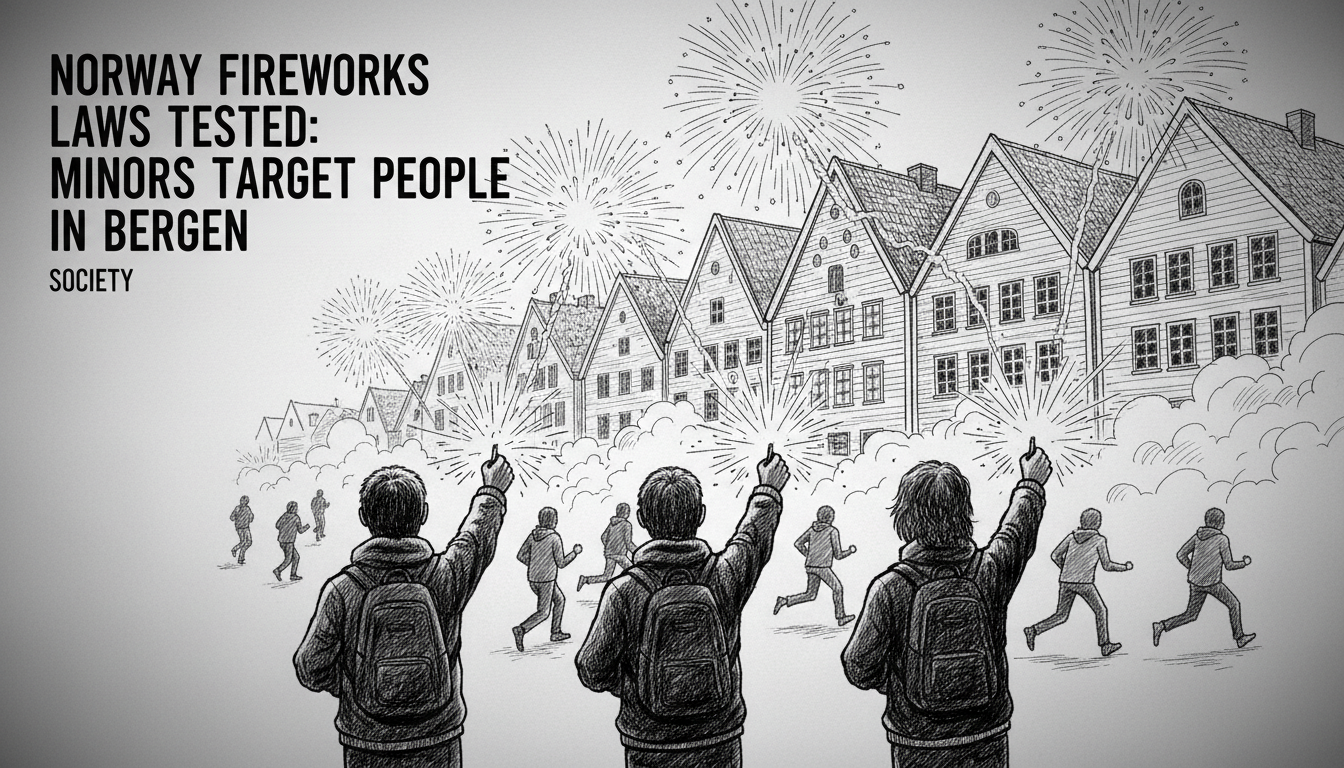
Norway's strict fireworks regulations face a new challenge after a group of minor boys allegedly shot fireworks at other people in a Bergen suburb. The incident occurred near Framohallen in Fyllingsdalen, according to police operations leader Bjarte Rebnord of the Vest Police District. No injuries were reported, but the event has sparked immediate police investigation and broader questions about enforcement during the off-season.
"Some people came home and told their parents about the incident, and what they experienced as someone shooting fireworks at them," Rebnord said in a statement. Police are now checking if individuals still possess fireworks that should have been used up during the sanctioned New Year period. The early investigation suggests a deliberate act by juveniles, moving beyond accidental misuse to targeted behavior.
A Breach of Seasonal Safety
Norwegian law confines the private use of fireworks to a brief window, typically from December 27th to January 1st. Sales are restricted to licensed retailers operating within specific dates. The primary goal is to minimize fire risks, injuries, and public disturbance. This temporal containment is a cornerstone of national safety policy, making possession and use outside this period a violation.
The Fyllingsdalen incident is particularly concerning because it involved minors, who are legally prohibited from purchasing category F2 and F3 fireworks intended for public use. "We are checking if anyone has fireworks that should have been used up yesterday, but so far we have not found anyone," Rebnord noted. This points to either illegal storage of leftover fireworks or an illicit supply chain operating outside the legal season.
The Legal and Social Repercussions
Using fireworks in a manner that endangers life or property is a criminal offense under Norwegian law. When the perpetrators are minors, the situation involves both penal and child welfare legislation. Police must balance legal accountability with considerations for the youths' age and intent. Charges could range from violations of the Fireworks Regulations to more serious allegations of reckless conduct.
Child welfare services often become involved in such cases. Their focus is on the underlying behavior and family situation. "An act like this isn't just about breaking fireworks laws," says Kari Jensen, a sociologist specializing in youth behavior at the University of Bergen. "It's a signal. It shows a disregard for public safety and the well-being of others. The question for authorities is whether this is a one-time foolish act or part of a pattern of antisocial behavior that requires intervention."
Parental responsibility is a key theme. Norwegian law holds parents civilly liable for damages caused by their children. The police statement highlights that complaints originated from parents whose children felt targeted. This immediate community reporting reflects the social contract around fireworks: they are a controlled privilege, not a right.
The Challenge of Enforcement and Storage
A persistent issue for Norwegian authorities is the safe storage and disposal of unused fireworks. The regulations are clear—fireworks must be used during the legal period. However, ensuring compliance is difficult. Leftover rockets and firecrackers stored in homes or garages become a latent risk for accidents or misuse months later.
Police occasionally run amnesty campaigns or disposal drives, but participation is voluntary. The Fyllingsdalen case suggests these efforts may be insufficient. "Every year after New Year's, we deal with sporadic incidents involving leftover fireworks," a veteran police officer, who spoke on condition of anonymity, told Nordics Today. "It's a resource drain. Tracking down who has a few old rockets is nearly impossible without specific tips, like we apparently have here."
Security experts argue for tighter controls on the point of sale. "Perhaps we need to look at the quantity sold per household or improve tracking," suggests Lars Holm, a public safety analyst. "The ultimate goal is zero leftovers. If people buy only what they plan to use on New Year's Eve, the stock available for misuse in January drops to zero."
A Community on Edge in Fyllingsdalen
Fyllingsdalen, a suburban area in Bergen, is known as a family-friendly neighborhood. Incidents of this nature are uncommon and disrupt the community's sense of security. The fact that the fireworks were reportedly aimed at people, rather than just set off dangerously, escalates the perceived threat from nuisance to intimidation.
Local politicians are already reacting. "This is completely unacceptable," said Marit Østervold, a city council representative for the district. "We have clear rules for a reason. Fireworks are dangerous explosives. Using them as weapons against people, especially by young people, is a serious matter that we and the police must address firmly." She has called for a review of local information campaigns targeting youth about the dangers and laws surrounding fireworks.
Community policing efforts may increase in the area. Building trust so that residents report suspicious activity early is seen as critical. The quick response from parents in this case is a positive sign of community engagement.
A Broader Look at Nordic Fireworks Culture
Norway's approach is relatively strict compared to some of its neighbors. Denmark also has a concentrated New Year period but has faced significant problems with illegal imports and pre-New Year's usage. Sweden's regulations are similar to Norway's, focusing on a short, permitted timeframe.
The Nordic consensus treats fireworks as a public safety hazard requiring state management, not an expression of individual freedom. This incident tests that model. It proves that regulation, while effective at reducing overall harm, cannot eliminate deliberate criminal misuse.
What happens next in Bergen will be telling. The police investigation's outcome—whether it leads to charges, confiscations, or referrals to child welfare—will send a message about tolerance for such acts. The case also puts a spotlight on parental vigilance and the enduring challenge of ensuring that the colorful explosions of New Year's Eve don't lead to darker incidents in the cold days of January.
As the police continue their search for the juveniles and any remaining fireworks, the quiet streets of Fyllingsdalen are a reminder that safety regulations are only as strong as the community's commitment to upholding them. The real test is not on December 31st, but on random evenings in January when temptation and opportunity meet.